Search the SPREP Catalogue

Refine Search Results

Tags / Keywords

Available Online

Tags / Keywords

Available Online

355 result(s) found.

Sort by

You searched for

  • Subject Environment
    X
Archipelago-wide island restoration in the Galapagos Islands: Reducing costs of invaisve mammal eradication programs and reinvasion risk
BRB
Available Online

Campbell, Karl J.

,

Carrion, Victor

,

Cruz, Felipe

,

Donian, C. Josh

,

Lavoie, Christian

2011
Invasive alien mammals are the major driver of biodiversity loss and ecosystem degradation on islands. Over the past three decades, invasive mammal eradication from islands has become one of society's most powerful tools for preventing extinction of insular endemics and restoring insular ecosystems. As practitioners tackle larger islands for restoration, three factors will heavily influence success and outcomes: the degree of local support, the ability to mitigate for non-target impacts, and the ability to eradicate non-native species more cost-effectively. Investments in removing invasive species, however, must be weighed against the risk of reintroduction. One way to reduce reintroduction risks is to eradicate the target invasive species from an entire archipelago, and thus eliminate readily available sources. We illustrate the costs and benefits of this approach with the efforts to remove invasive goats from the Galápagos Islands. Project Isabela, the world's largest island restoration effort to date, removed > 140,000 goats from > 500,000 ha for a cost of US$10.5 million. Leveraging the capacity built during Project Isabela, and given that goat reintroductions have been common over the past decade, we implemented an archipelago-wide goat eradication strategy. Feral goats remain on three islands in the archipelago, and removal efforts are underway. Efforts on the Galápagos Islands demonstrate that for some species, island size is no longer the limiting factor with respect to eradication. Rather, bureaucratic processes, financing, political will, and stakeholder approval appear to be the new challenges. Eradication efforts have delivered a suite of biodiversity benefits that are in the process of revealing themselves. The costs of rectifying intentional reintroductions are high in terms of financial and human resources. Reducing the archipelago-wide goat density to low levels is a technical approach to reducing reintroduction risk in the short-term, and is being complemented with a longer-term social approach focused on education and governance.
The legacy of Big South Cape: rat irruption to rat eradication
BRB
Available Online

Bell, Brian D.

,

Bell, Elizabeth A.

,

Merton, Don V.

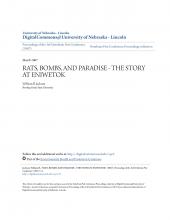
Big South Cape Island (Taukihepa) is a 1040 ha island, 1.5 km from the southwest coast of Stewart Island/Rakiura, New Zealand. This island was rat-free until the incursion of ship rats (Rattus rattus) in, or shortly before, 1963, suspected to have been accidentally introduced via local fishing boats that moored at the island with ropes to the shore, and were used to transport the mutton birders to the island. This incursion was reported by the muttonbirders – local Iwi who harvest the young of titi (sooty shearwater, Puffinus riseus) – to the then New Zealand Wildlife Service (via the New Zealand Department of Lands and Survey). Investigation into the reports found ship rats had reached the island and had decimated the local land bird populations. Brian Bell and Don Merton attempted some of the first translocations of South Island saddleback (Philesturnus c. carunculatus), Stewart Island snipe (Coenocorypha aucklandica iredalei) and Stead’s bush wren (Xenicus longipes variabilis) with only the saddleback being successful. Extinctions of the snipe, wren and greater short-tailed bat (Mystacina robusta) were recorded. This was the first time rats were definitively recognised as the cause of extinction of native land birds and directed further debate into the impacts of rats and how to deal with them.
Rural women and food security in Asia and the Pacific: Prospects and paradoxes
BRB
Available Online

Balakrishnan, Revathi

,

Fairbairn-Dunlop, Peggy

2005
Agriculture and food production offer stable livelihood options to rural communities throughout Asia and the Pacific region. Even as the effects of globalization spread in the region, farm production – most often at the smallholder level – continues to be a family enterprise. A fair share of farmers in the region engages in subsistence farming and poverty is a common occurrence among them. Farm enterprises are mostly managed by family members and family labour is a critical asset and often the only reliable investment. As rural women and men toil to preserve their heritage and broaden their economic choices, their endeavours are made more difficult by a lack of resources and market fluctuations. Asian and Pacific farmers, both men and women, are guardians of biodiversity, household food security and providers of food to urban communities. In these small farm enterprises distinct gender roles and gender differentiated access to technology and resources are evident. This disparity is compounded by the neglect of investment in rural social infrastructures such as education, health care and communications. In such resource poor rural environments, the struggle by rural women for access to resources and services is inevitable. In many Asian and Pacific countries, substantial gender equality gains have been made in urban areas in education, health and employment. Yet rural women lag behind. Moreover, rural women’s work is multifaceted and demanding both as family workers and agricultural labourers. Social and economic indicators often do not do justice to their contributions. Development innovations such as microcredit and self-help groups promote rural women’s economic development, but emerging evidence suggests that gender equality in rural communities is far from an everyday reality. Persisting social biases and traditional perceptions and assumptions regarding women’s responsibilities and their capacities continue to hamper women’s progress. This publication presents an overview of both the substantial contribution made by rural women to the economies in the region and the persisting barriers to their advancement. The framework of analysis, data and information reviewed together illustrate the complexity of rural women’s work in the region and offer a broad perspective on women’s economic and social contribution as well as on the barriers they encounter in accessing resources.
Terminal evaluation of UN Environment project: Prevention, control and management on invasive alien species in the Pacific island.
Biodiversity Conservation, BRB
Available Online

Thomas, Peter.

2017
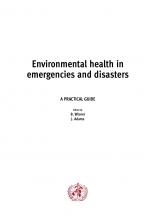
Invasive alien species represent an insidious and pervasive threat to the environmental, economic and human well-being of the Pacific islands. Pacific island ecosystems make up one of the world’s important biodiversity hotspots, with high numbers of endemic species that are particularly vulnerable to extinction due to their limited habitat and isolation.|This book is intended to serve as a practical guide, calling attention to the need to link emergencies, disasters and development, not only in policy statements, but in practical ways. The book identifies physical and social factors and processes determining disaster vulnerability and offers the reader a range of vulnerability-reduction options in development and disaster mitigation. The book covers the main relief and response technologies for a range of natural and technological disasters, and deals with community participation, health education, training and other social aspects relevant to the protection of health and the environment in emergencies and disasters.|The UNEP/GEF Prevention, Control and Management of Invasive Alien Species in the Pacific Islands project also known as the IAS project, commenced on 12 September 2012 and was due for completion on 30 September 2016, following an extension of one year. The project was designed to provide support to Pacific Island countries in their national efforts to implement the Guidelines for Invasive Species Management in the Pacific – a Pacific Strategy for managing pest, weeds and other invasive species (Tye 2009) which were developed and adopted as the regional strategic framework for invasive species management in 2009. Ten Pacific Island countries originally participated in the IAS project, these being the Cook Islands, Federated States of Micronesia, Kiribati, Marshall Islands, Niue, Palau, Papua New Guinea, Samoa, Tonga and Vanuatu. These were reduced to nine countries with the withdrawal of Papua New Guinea following the Mid-Term Review due to issues related to the country’s readiness to engage with the project. The project was therefore, responsible for delivering of support to a culturally, geographically and economic diverse set of Small Island Developing States (SIDS) spread across the vast geographical scope of the Pacific Ocean. The project was implemented by the UN Environment as the Implementing Agency (IA) and Executed by the Secretariat of the Pacific Regional Environment Programme (SPREP) as the Executing Agency (EA). In-country sub projects and activities were facilitated by National Project Coordinators and overseen by national Invasive Species Coordinating Committees. Its goal "to conserve ecosystems, species and genetic diversity in the Pacific region" is broad and aspirational and is backed by the Objective "to reduce the environmental economic and human health impacts of invasive alien species in both terrestrial and marine habitats in the Pacific region". The Project consisted of 5 core components: Building foundations for sustainable Invasive Alien Species (IAS) management by generating awareness and support, building institution and human capacity and strengthening legislation, policy and protocols. Defining problems, prioritisation and decision making by improving baseline information on IAS distribution and status, establishing systems to assess risk and prioritise action and developing or utilising effective management techniques. Taking management action through improved bio-security and border protection, direct management action through eradication and application of best practice methods and restoring ecosystems after IAS management. Undertaking effective monitoring and evaluation of the project.| Establishing effective and efficient project management and governance. This Terminal Project Evaluation is undertaken by the Evaluation Office of the UN Environment in order to assess the effectiveness of the project and its likely future impact on the state of IAS management in the region and its likely impact on invasive species and the environmental health of the participating countries. Further, the report aims to discern lessons and offers recommendations which may help improve the development and implementation of similar multi-country projects in the future both in the Pacific region and globally.
Report on results of rat control trials in the Tokelau Islands from 30 July to 20 September 1970 and recommendations for a comprehensive scheme of rat control
BRB
Available Online

Kazimierz Wodzicki

1970
The visit to the Tokelau Islands described below is the third carried out in a study of ecology, rat control and related problems. The first visit in 1966/67 (Wodzicki 1968 A) was devoted primarily to the study of the ecology of the Polynesian rat (Rattus exulans) and the environment, including the animals and the vegetation, of Nukunonu atoll. The main objects of the second expedition in April-June 1968 (Wodzicki 1968 B) were the initiation of a long-term investigation of rat damage on all three atolls and the training of two men from each island as rat control operatives. The present visit was planned with the following tow main objectives in mind: 1. the study of the relationship of rat damage to various coconut varieties growing in the Tokelau Islands; and 2. the conduct of rat control trials with the view of preparing for the Administrator, Tokelau Islands (Mr. Richard B. Taylor) recommendations for a rat control scheme suitable for the Tokelau Islands. The preliminary analysis of data collected during the fifteen months long investigation of rat damage in 1968/69 on the three atolls suggested that palms belonging to some varieties may be more prone to rat damage then others (Wodzicki 1970). It seemed important that we learn more about the character of palms growing on the three atolls. With regard to rat control, trials with various kinds of poisons have been carried out since our first visit to the Tokelaus in 1966/67 (Wodzicki 1968 A). However, during our first two visits knowledge of rat ecology was not sufficiently advanced to allow for more sophisticated tests. Since the author's 1968 visit, the important work on rat control in the Gilbert and Ellice Islands by F.J. Smith (Smith 1969) has become available. This information and our knowledge of rat ecology, gradually acquired since the beginning of the Tokelau Islands rat project, now makes possible a programme that could become the basis of a practical rat control scheme for the three islands. As most of the previous work had been carried out on Nukunonu atoll only, it was felt that half of the time during the visit should be spent on Fakaofo and th remainder on Atafu. Following a brief descrption of these trials is the writer's recommendation of a rat control scheme submitted to the Administrator, Tokelau Islands. Finally, some other observations on plants, animals and related aspects are friefly reported and collections made for the Botany Division, D.S.I.R. and the Dominion Museum are briefly mentioned.
Estimating burdens of neglected tropical zoonotic diseases on islands with introduced mammals
BRB
Available Online

Croll, Donald A.

,

Holmes, Nick D.

,

Kilpatrick, A. Marm.

,

Newton, Kelly M.

,

Spatz, Dena R.

,

Tershy, Bernie.

,

de Wit, Luz A.

2017
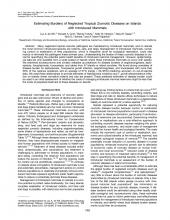
Many neglected tropical zoonotic pathogens are maintained by introduced mammals, and on islands the most common introduced species are rodents, cats, and dogs. Management of introduced mammals, including control or eradication of feral populations, which is frequently done for ecological restoration, could also reduce or eliminate the pathogens these animals carry. Understanding the burden of these zoonotic diseases is crucial for quantifying the potential public health benefits of introduced mammal management. However, epidemiological data are only available from a small subset of islands where these introduced mammals co-occur with people. We examined socioeconomic and climatic variables as predictors for disease burdens of angiostrongyliasis, leptospirosis, toxoplasmosis, toxocariasis, and rabies from 57 islands or island countries. We found strong correlates of disease burden for leptospirosis, Toxoplasma gondii infection, angiostrongyliasis, and toxocariasis with more than 50% of the variance explained, and an average of 57% (range = 32–95%) predictive accuracy on out-of-sample data. We used these relationships to provide estimates of leptospirosis incidence and T. gondii seroprevalence infection on islands where nonnative rodents and cats are present. These predicted estimates of disease burden could be used in an initial assessment of whether the costs of managing introduced mammal reservoirs might be less than the costs of perpetual treatment of these diseases on islands.
Paris Climate Agreement: Beacon of Hope
Available Online

Ross J. Salawitch, Timothy P. Canty, Austin P. Hope, Walter R. Tribett, Brian F. Bennett

2017
On 11 November 2014, a remarkable event occurred. President Barack Obama of the United States and President Xi Jinping of China announced a bilateral agreement to reduce the emission of greenhouse gases (GHGs) that cause global warming by their respective nations. On 12 December 2015, a year and a month later, representatives of 195 countries attending the 21st Conference of the Parties of the United Nations Framework Convention on Climate Change meeting in Paris, France, announced the Paris Climate Agreement. The goal of the Paris Climate Agreement is to limit the future emission of GHGs such that the rise in global mean surface temperature will be no more than 1.5 °C (target) or 2.0 °C (upper limit) above the pre-industrial level. The Paris Climate Agreement utilizes an approach for reducing the emissions of GHGs that is distinctly different than earlier efforts. The approach for Paris consists of a series of Intended Nationally Determined Contributions (INDCs), submitted by the world’s nations, reflecting either a firm commitment (unconditional INDCs) or a plan contingent on financial and/or technological support (conditional INDCs). The Obama–Xi announcement was instrumental in the framing of the Paris Climate Agreement. The INDCs submitted by the USA and China were built closely upon the November 2014 bilateral announcement. China and the USA rank number one and two, respectively, in terms of national emission of GHGs. Practically speaking, unified global action to combat global warming required these two nations to get on the same page.