Search the SPREP Catalogue

Refine Search Results

Organisation

Publication Year

Material Type

Available Online

Organisation

Publication Year

Material Type

Available Online

5 result(s) found.

Sort by

You searched for

Dispositif de suivi de l'abondance et de l'impact du cerf - Fiche finale de capitalisation - PROTEGE
SPREP Publications, Biodiversity Conservation, BRB
Available Online

PROE / SPREP

2025
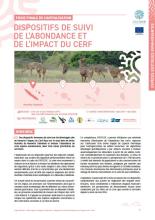
Des dispositifs innovants de suivi ont été développés afin de mesurer l’impact du Cerf Rusa sur le sous-bois de forêts humides de Nouvelle Calédonie et évaluer l’abondance de cette espèce envahissante, dans trois zones prioritaires du territoire. L’élaboration de ces dispositifs poursuit des objectifs complémentaires aux actions de régulation professionnelle mises en œuvre dans le cadre de PROTEGE. Le suivi vise notamment à réaliser un état initial et à évaluer les bénéfices des opérations de régulation, grâce à des outils adaptés à des zones d’intervention difficiles d’accès et caractérisées par une biodiversité exceptionnelle, plus de 80% des espèces végétales des forêts humides d’altitude étant endémiques à la Nouvelle-Calédonie. Un travail initial de sectorisation a permis mieux de caractériser les enjeux, les pressions sur l’environnement ainsi que le contexte socio-économique afin de délimiter les zones d’intervention prioritaires. Pour la première fois en Nouvelle-Calédonie, un protocole standardisé de mesure de l’impact des cerfs a été élaboré. Il s’appuie sur plusieurs indicateurs et prend en compte les spécificités des espèces végétales concernées et des contraintes associées à sa mise en œuvre. En complément, PROTEGE a permis d’élaborer une méthodeinnovante d’évaluation de l’abondance des cerfs, reposant sur l’utilisation d’un drone équipé de capteur thermique pour l’enregistrement de vidéos nocturnes. Un algorithme développé spécifiquement a par ailleurs vocation à réaliser automatiquement les détections à partir de ces vidéos, facilitant considérablement le traitement des données. La mise en œuvre de ce protocole pour la prospection de 4 700 hectares a révélé des densités de populations et des concentrations de hardes localement très élevées, atteignant par endroits des niveaux parmi les plus élevés enregistrés à l’échelle mondiale. Ces résultats fournissent des informations précieuses pour le ciblage de futures interventions et le suivi de leurs bénéfices. FICHE FINALE DE CAPITALISATION DU PROJET PROTEGE, financé par l'Union Européenne.
Monitoring recommendations for the Community-based fisheries Mangement Program of Tutuila, American Samoa; For the departmnet of Marine and wildlife Resources Tutuila, American Samoa August 2004
Biodiversity Conservation
Available Online

Musburger, Craig

2004
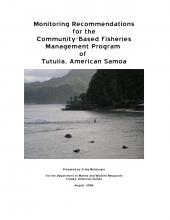
The American Samoa Department of Marine and Wildlife Resources (“DMWR”)began working with local communities on the island of Tutuila in 2001 to develop the Community­Based Fisheries Management Program (“CBFMP”). Through a series of meetings with representatives from select villages, DMWR sought the voluntary participation of communities in an effort to manage and monitor their own coral reef resources. The program has grown to include seven villages, each of which is responsible for all aspects of managing and monitoring their own resources, with technical assistance from DMWR. Committees from each village have designed and implemented management plans which vary from village to village, but generally include some type of restriction on fishing activity on part or all of the reef fronting their villages. Many of the participating villages have reported anecdotally that they have seen improvement in their resources since the program’s inception, but as of yet, there has been no effort devoted towards scientifically monitoring these areas. As such, a robust, quantitative analysis of the effectiveness of the management efforts has not been possible in any of the participating villages. While it may be too late to obtain useful “baseline” data that shows the state of the marine resources prior to the implementation of the management plans, it is imperative that monitoring commence as soon as possible to allow for future analysis of the trends in the health of the reefs of the villages participating in the CBFMP.