Search the SPREP Catalogue

5 result(s) found.

Sort by

You searched for

  • Collection BRB
    X
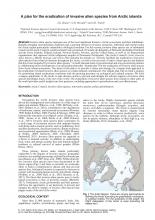
A plan for the eradication of invasive alien species from Arctic islands
BRB
Available Online

Howald, G.

,

Reaser, J.

,

Veatch, S.

2019
Invasive alien species represent one of the most significant threats to Arctic ecosystems and their inhabitants. Rapidly changing environmental conditions and a growing interest in resource extraction, settlement and tourism make the Arctic region particularly vulnerable to biological invasion. For this reason, invasive alien species are of substantial concern to the Arctic Council, a multi-national body comprised of Canada, the Kingdom of Denmark (including Greenland and the Faroe Islands), Finland, Iceland, Norway, Russia, Sweden, and the United States, as well as six international organisations that represent Arctic indigenous peoples as Permanent Participants. The Arctic Council’s Arctic Invasive Alien Species (ARIAS) Strategy and Action Plan includes the priority to: “actively facilitate the eradication of invasive alien species from island ecosystems throughout the Arctic, as well as the recovery of native island species and habitats that have been impacted by invasive alien species.” A multi-national team of governmental and non-government partners is collaborating in the development of an action plan (hereafter ‘islands plan’) for the eradication of invasive alien species from Arctic island ecosystems. The intent of the plan is to provide a vision and strategy for a region-wide approach to the eradication of island invasive alien species as a multi-national commitment. The islands plan will set forth a strategy for prioritising island eradications consistent with the growing pressures on ecological and cultural systems. We have a unique opportunity in the Arctic to take decisive action to prevent and mitigate the adverse impacts of invasive alien species that plague much of the rest of the world. The eradication of invasive alien species from islands in other parts of the world provides useful insights into best practices, including approaches to prioritisation and cost-effectiveness.
Successes and failures of rat eradications on tropical islands: a comparative review of eight recent projects
Biodiversity Conservation, BRB
Available Online

Brown, D.

,

Cranwell, S.

,

Cuthbert, R.J.

,

Griffiths, R.

,

Howald, G.

,

Keitt, B.

,

Pitt, W.C.

,

Tershy, B.

,

Wegmann, A.

2019
Rat eradication is a highly effective tool for conserving biodiversity, but one that requires considerable planning eff ort, a high level of precision during implementation and carries no guarantee of success. Overall, rates of success are generally high but lower for tropical islands where most biodiversity is at risk. We completed a qualitative comparative review on four successful and four unsuccessful tropical rat eradication projects to better understand the factors influencing the success of tropical rat eradications and shed light on how the risk of future failures can be minimised. Observations of juvenile rats surviving more than four weeks after bait application on two islands validate the previously considered theoretical risk that unweaned rats can remain isolated from exposure to rodent bait for a period. Juvenile rats emerging after bait was no longer readily available may have been the cause of some or all the project failures. The elevated availability of natural resources (primarily fruiting or seeding plants) generated by rainfall prior to project implementation(documented for three of the unsuccessful projects) may also have contributed to project failure by reducing the likelihood that all rats would consume sufficient rodent bait or compounding other factors such as rodent breeding. Our analysis highlights that rat eradication can be achieved on tropical islands but suggests that events that cannot be predicted with certainty in some tropical regions can act individually or in concert to reduce the likelihood of project success. We recommend research to determine the relative importance of these factors in the fate of future tropical projects and suggest that existing practices be re-evaluated for tropical island rodent eradications.
Considerations and consequences when conducting aerial broadcast applications during rodent eradications
Biodiversity Conservation, BRB
Available Online

Gill, C.

,

Griffi ths, R.

,

Holmes, N.

,

Howald, G.

,

Will, D.

2019
Aerial broadcast application is currently one of the most common methods for conducting rodent eradications on islands, particularly islands greater than 100 ha or with complex and difficult topography where access by ground teams is difficult. Overall, aerial broadcast applications have a high success rate, but can be burdened by logistical, regulatory, and environmental challenges. This is particularly true for islands where complex shorelines, sheer terrain, and the interface with the marine environment pose additional risks and concerns. Using data collected during ten eradication projects we investigate the influence that operational realities have on broadcast applications. We tested the association between the amount of bait used and island size, topography, and the desire to reduce bait application into the marine environment and then compared planned bait application to actual bait application quantities. Based on our results, islands of decreasing size and increasing coastal complexity tended to use more bait than anticipated and experienced greater variability in localised bait densities. During operations, we recommend analysing flight data to identify treated areas with localised bait densities that fall below the target application rate. We recommend that areas with low localised bait densities may result in biologically significant gaps that should receive an additional application of bait based on project risk variables such as target home range size, non-target bait competitors, and alternative foods. We also recommend a common language for discussing aerial broadcast applications and where future work can be done to improve operational decision making.
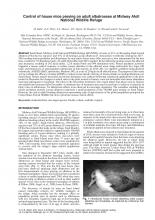
Control of house mice preying on adult albatrosses at Midway Atoll National Wildlife Refuge
Biodiversity Conservation, BRB
Available Online

Duhr,M.

,

Flanders, B.

,

Flint, E.N.

,

Howald, G.

,

Hunter, S.A.

,

Norwood, D.

,

Taylor, R.V.

2019
Sand Island, Midway Atoll National Wildlife Refuge (MANWR), is home to 21% of all nesting black-footed albatross (Phoebastria nigripes) and 47% of all nesting Laysan albatross (P. immutabilis) worldwide. During the 2015–2016 nesting season predation and disturbance by non-native house mice (Mus musculus), here documented for the first time, resulted in 70 abandoned nests, 42 adult birds killed and 480 wounded. In the following nesting season the affected area increased, resulting in 242 dead adults, 1,218 injured birds and 994 abandoned nests. Mouse predation activities triggered a mouse control response to reduce mouse densities in the affected areas using multi-catch live traps, kill traps, and limited use of anticoagulant rodenticides in bait stations. In 2016–2017 we applied a pelleted cholecalciferol rodenticide, AGRID (Bell Laboratories, Madison, WI), at a rate of 20 kg/ha in all affected areas. The purpose of this study was to evaluate the efficacy of using AGRID to reduce mouse density and rate of mouse attacks on nesting albatrosses on Sand Island. Mouse attacks decreased and mouse abundance was reduced following rodenticide applications in the plots treated in December but changes in attack rates in the plots treated in January were not detectable and mouse abundance increased subsequent to treatment. The plots in the December treatments were much larger than those used in January and rainfall rate increased after December. A minimum size of treatment area may be necessary to achieve a reduction in injury rates in albatrosses. No deleterious effects were observed in non-target organisms. The casualties resulting from mouse predation (mostly Laysan albatross) represent a small proportion of the 360,000 pairs nesting on Sand Island. However, the risk to adult breeding albatrosses representing such a large fraction of the global population prompted the United States Fish & Wildlife Service to prioritise mouse control efforts.
Improving the breeding success of a colonial seabird: a cost-benefit comparison of the eradication and control of its rat predator
BRB
Available Online

Bretagnolle, Vincent.

,

Culioli, Jean-Michel.

,

Lorvelec, Olivier.

,

Pascal, Michel Pascal.

2008
Breeding success of 5 Cory’s shearwater Calonectris diomedea sub-colonies of Lavezzu Island (Lavezzi Archipelago, Corsica) was checked annually for 25 consecutive years from 1979 to 2004. Between 1989 and 1994, 4 ship rat Rattus rattus controls were performed in several subcolonies. In November 2000, rats were eradicated from Lavezzu Island and its 16 peripheral islets (85 ha) using traps then toxic baits. We compare cost (number of person-hours required in the field) and benefit (Cory’s shearwater breeding success) of control and eradication. The average breeding success doubled when rats were controlled or eradicated (0.82) compared to the situation without rat management (0.45). Moreover, the average breeding success after eradication (0.86) was significantly (11%) higher than after rat controls (0.75). Furthermore, the great variation in breeding success recorded among sub-colonies both with and without rat control declined dramatically after eradication, suggesting that rats had a major impact on breeding success. The estimated effort needed to perform eradication and checking of the permanent bait-station system during the year following eradication was 1360 person-hours. In contrast, rat control was estimated to require 240 or 1440 person-hours per year when implemented by trained and untrained staff, respectively. Within 6 yr, eradication cost is lower than control cost performed by untrained staff and confers several ecological advantages on more ecosystem components than Cory’s shearwater alone. Improved eradication tools such as hand or aerial broadcasting of toxic baits instead of the fairly labour-intensive eradication strategy we used would dramatically increase the economic advantage of eradication vs. control. Therefore, when feasible, we recommend eradication rather than control of non-native rat populations. Nevertheless, control remains a useful management tool when eradication is not practicable.