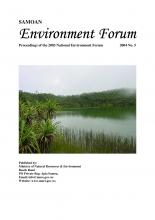
Samoan Environment Forum: proceedings of the 2003 National Environment Forum|Fe'ese'esea'iga i aiga ma nuu o Samoa : aafiaga o le tofa i Tuana'i ma Saanapu / Tu'u'u Ieti Taulealo|Some prospects for managing Merremia peltata / William Stuart Kirkham|The Green turtle tour project : a successful approach to aiding natural resources management in Samoa / Funealii Lumaava Sooa'emalelagi & Steve Brown|Persistent Organic Pollutants and persistent toxic substances in Samoa's Environment / Taule'ale'ausumai Laavasa Malua, Bill Cable & Paul F. Heveldt|Bridging the gap: building environment information linkages & network - a Pacific Samoan model / Satui Bentin & Leilani Duffy|The MNRE model for institutional strengthening in the public sector / Tu'u'u Ieti Taule'alo & Moilevao Elisaia Talouli|SPREP in Samoa / F. Vitolio Lui|Samoa: a paradise lost? / Le Mamea Sefulu Ioane|Taking of customary land for the new Salelologa township / Patea M. Setefano, Vaitogi I Vaitogi, Faanimo Warren & Fiona Sapatu|A study of indigenous knowledge and its role to sustainable agriculture in Samoa / Pitakia Tikai & Aaron Kama|PABITRA (Samoa): promoting capacity building via biodiversity studies by young Samoans / Nat Tuivavalagi

BRB
Available Online
Merremia peltata, disturbance ecology, tropical cyclones and Samoa. The biology and ecology of Merremia peltata are not well understood. While some regard the species as an exotic invader of Pacific Island ecosystems (Meyer. 2000). others identify the plant as a native species likely to be harmful to native ecosystems (Whistler, 1995a. 2002) or as either native or ancient Polynesian introduction behaving invasively (Space and Flynn.(2002). In Samoa, this species occurs up to an elevation of around 300 meters (Whistler 1995a). and thus only affects lowland ecosystems. This species increases its distribution and abundance in two ways, either vegetatively. by sprawling into neighboring areas and rooting from its nodes or by seeds, although early research in the Solomons observed a low seed viability rate, and creeping may thus be its primary means of reproduction (Bacon. 1982). M. peltata has apparently been in the Pacific for hundreds of years (Whistler, pers. com.) but has only become invasive in the years following tropical cyclones Ofa (1990) and Val (1991) according to comments from local government officials. Disturbance thus appears to be an ecological contributing factor to this invasion.