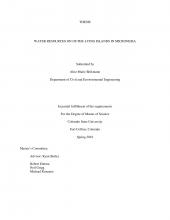
Thesis: Water resources on outer-lying islands in Micronesia


Climate Change Resilience, Biodiversity Conservation
Available Online
Pacific islands are long-settled by mankind, dating back several hundreds to thousands of years ago since discovery by islanders traveling by boat. Amongst these islands are atoll islands, which are small coral islands that lie at a low elevation and are usually part of a ring-like coral reef formation. Past and present islanders collect water from rainwater catchments and groundwater wells, with rainwater used primarily for drinking water and groundwater used as a supplement for wash water. Unfortunately, this region can experience severe drought, over-wash events during strong tropical storms, and typhoons, all of which threaten the freshwater supply for these islands. Due to rising concerns over climate change, there is interest in studying the water security of these especially vulnerable land forms. This thesis evaluates the reliability of the water supplies on four atoll islands in Yap, Micronesia by modeling the reliability of the two main sources. To first analyze rainwater catchment performance, Ifalik Island is evaluated using data collected on the island in 2015 by a collaborative research field team and a water balance model. Second, the results are used to develop design curves as a tool for rainwater catchment design and improvement. The fresh groundwater source is also modeled for each of the four islands to test the effects of varying climate conditions on the shallow, freshwater lens. Rainwater catchment systems on Ifalik Island are evaluated for their performance using a mass balance model that quantifies water storage through time. Performance is quantified primarily by reliability, which is a term to represent the percentage of days a rainwater catchment supplies sufficient water to the users. Based on the data from the Ifalik field survey, ii the average household rainwater catchment system on Ifalik uses a 16.5 square meter guttered roof with a 2,000 liter storage tank and serves seven individuals at 12 liters per capita per day. As a result of a rainwater catchment system sensitivity analyses based on the average rainwater catchment conditions, the most important factors in performance are effective roof area size, water demand, and gutter-downspout efficiency. Further analyses using the mass balance model found that the performance of each individual catchment is sufficient to provide water to the community during conditions similar to the severe drought year of 1997-1998, as well as projected rainfall conditions for the next 30 years. Therefore, analyses suggest Ifalik Island has sufficient rainwater catchment performance to provide water for the community. However, to introduce a conservative measure for water security, it is recommended that the catchment area be extended to the full size of the roof area. This would thereby increase the storage supply for the community by 25 cubic meters on the day of lowest supply under the 1997-1998 severe drought conditions.