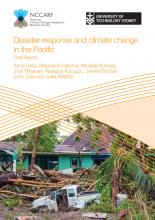
Disaster response and climate change in the Pacific : final report.

Climate Change Resilience
Available Online
Fletcher, Stephanie
,
Gero, Anna
2012
Disasters, and therefore disaster response, in the Pacific are expected to be affected by climate change. This research addressed this issue, and focused on the immediate humanitarian needs following a disaster, drawing upon adaptive capacity as a concept to assess the resilience of individual organisations and the robustness of the broader system of disaster response. Four case study countries (Fiji, Cook Islands, Vanuatu and Samoa) were chosen for deeper investigation of the range of issues present in the Pacific. The research process was guided by a Project Reference Group, which included key stakeholders from relevant organisations involved in Pacific disaster response to guide major decisions of the research process and to influence its progression. Given the complexity of issues involved, including the contested definitions of adaptive capacity, the research team developed a conceptual framework to underpin the research. This framework drew upon concepts from a range of relevant disciplines including Earth System Governance, climate change adaptation, health resources, resilience in institutions and practice theory. Objective and subjective determinants of adaptive capacity were used to assess the disaster response system, comprised of actors and agents from government and non-government sectors, and the governance structures, policies, plans and formal and informal networks that support them. Results revealed the most important determinant of adaptive capacity in the Pacific to be communications and relationships, with both informal and formal mechanisms found to be essential. Capacity (including human, financial and technical); leadership, management and governance structures; and risk perceptions were also highly important determinants of adaptive capacity. The research also found that in small Pacific island bureaucracies, responsibility and capacity often rests with individuals rather than organisations. Leadership, trust, informal networks and relationships were found to have a strong influence on the adaptive capacity of organisations and the broader disaster response system. A common finding across all four case study countries affecting adaptive capacity was the limited human resources for health and disaster response more generally, both in times of disaster response and in day-to-day operations. Another common finding was the gap in psychosocial support after a disaster. Water, sanitation and hygiene (WASH) as an immediate post-disaster humanitarian need was relatively well established amongst responding organisations (although long term WASH issues were not resolved), while other humanitarian needs (health care, and food and nutrition) had varying stages of capacity often limited by human, financial and technical resources. Adaptive capacity was therefore constrained by current gaps which need addressing alongside a future focus where risk is changing. Drawing on these and other findings, recommendations for addressing key determinants of adaptive capacity were developed for relevant stakeholder groups including policy makers and practitioners in the disaster and emergency response sectors in Australia and the Pacific.