Search the SPREP Catalogue

Refine Search Results

Tags / Keywords

Available Online

Tags / Keywords

Available Online

8166 result(s) found.

Sort by

You searched for

  • Tags / Keywords pacific
    X
An invasive ant distribution database to support biosecurity risk analysis in the Pacific
Biodiversity Conservation, BRB

Burne, Allan R.

,

Cooling, Meghan

,

Gruber, Monica A.

2017
Invasive species are one of the most serious threats to biodiversity. Up-to-date and accurate information on the distribution of invasive species is an important biosecurity risk analysis tool. Several databases are available to determine the distributions of invasive species and native species. However, keeping this information current is a real challenge. Ants are among the most widespread invasive species. Five species of ants are listed in the IUCN list of damaging invasive species, and many other species are also invasive in the Pacific. We sought to determine and update the distribution information for the 18 most problematic invasive ant species in the Pacific to assist in Small Island Developing States with risk analysis. We compared the information on six public databases, conducted a literature review, and contacted experts on invasive ants in the Pacific region to resolve conflicting information. While most public records were accurate we found some new records had not yet been incorporated into the public databases, and some information was inaccurate. The maintenance of public databases faces an enormous challenge in balancing completeness (~15 000 ant species in this case) with accuracy (the impossibility of constantly surveying) and utility.
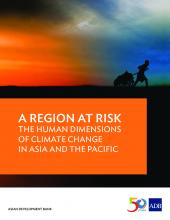
A region at risk - The human dimensions of climate change in Asia and the Pacific
Climate Change Resilience, Biodiversity Conservation
Available Online

Asian Development Bank

2017
The Asia and Pacific region is extremely vulnerable to the impacts of climate change. Unabated warming could significantly undo previous achievements of economic development and improvements of living standards. At the same time, the region has both the economic capacity and weight of influence to change the present fossil-fuel based development pathway and curb global emissions. This report sheds light on the regional implications of the latest projections of changes in climate conditions over Asia and the Pacific. The assessment concludes that, even under the Paris consensus scenario in which global warming is limited to 1.5°C to 2°C above preindustrial levels, some of the land area, ecosystems, and socioeconomic sectors will be significantly affected by climate change impacts, to which policy makers and the investment community need to adapt to. However, under a Business-As-Usual (BAU) scenario, which will cause a global mean temperature rise of over 4°C by the end of this century, the possibilities for adaptation are drastically reduced. Among others, climate change impacts such as the deterioration of the Asian “water towers”, prolonged heat waves, coastal sea-level rise and changes in rainfall patterns could disrupt ecosystem services and lead to severe effects on livelihoods which in turn would affect human health, migration dynamics and the potential for conflicts. This assessment also underlines that, for many areas vital to the region’s economy, research on the effects of climate change is still lacking.