Search the SPREP Catalogue

Refine Search Results

Tags / Keywords

Available Online

Tags / Keywords

Available Online

2390 result(s) found.

Sort by

You searched for

  • Tags / Keywords samoa
    X
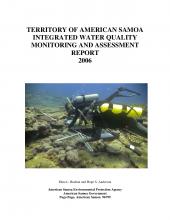
Territory of American Samoa integrated water quality monitoring and assessment report, 2006
Available Online

Anderson, Hope S.

,

Buchan Edna L.

2006
The Territory of American Samoa lies roughly 14 degrees south of the equator between longitude 169 and 173 west and about 2,500 miles southwest of Hawaii. The principal islands are Tutuila, Aunu'u, and the Manu'a islands (a cluster of three islands, Ta'u, Ofu and Olosega, located about 65 miles east of Tutuila). Swains Island, a small island with a population of less than 25 and Rose Atoll, an uninhabited atoll about 120 miles east of Tutuila make up the remainder of the territory. The population of the territory was 57,291 people in the year 2000, of which approximately 97% live on the island of Tutuila. The islands of American Samoa are volcanic in origin and exhibit the rugged topographic relief common to the Pacific volcanic islands. The climate of the territory is tropical, with uniform high temperatures and high humidity throughout the year. Mean daily temperature during the year varies from about 78 to 82 degrees Fahrenheit. The maximum altitude is about 3,180 ft. above mean sea level at the summit of Lata Mountain on Ta'u Island. Tutuila, with an area of 53 square miles, is the largest island in the territory. It is approximately 20 miles long and ranges in width from less than one mile, to a maximum of 5 miles at the Tafuna Leone plain. A sharp-crested ridge 1,000 to 2,000 feet high with steeply eroded slopes dominates the entire length of the island.
Samoan Environment Forum: proceedings of the 2005 National Environment Forum|The fact-or-myth of Samoan cultural heritage: personal reflections on family oral history / Tu'u'u Ieti Taule'alo|Samoan and Japan: concerns over mangroves development / Juliet Boon-Nanai|Status of hawksbill turtle nesting in Samoa, 2003/2004 / Mauigoa Lui Bell, Malama S. Momoemausu, Juney Ward & Malaki Iakopo|Participatory approaches for environmental initiatives - community consultation in Samoa / Natalie Mitchell|Emotional intelligence, management concept: a contributing factor for effective service delivery / Mulipola Ausetalia Titimaea|Tropical cyclone forecasting: theory and practical application - case study of tropical cyclone Olaf 2005 / Sala Sagato Tuiafiso|Samoa and the World Heritage Convention - is Samoa ready for world heritage listing / Tuiolo Schuster|Exploring the status of tsunami early warning systems in Samoa / Shaun P. Williams & Aliimalemanu F.M. Leavasa|Determination of a mean daily discharge values for Faleaseela River: implications for population water demand / Masina Nagau Chun, Iosefatu Eti & Mulipola A. Titimaea
Available Online

MNRE

2006
The community based conservation (CBC)paradigm predicts that sustainable biodiversity can only be achieved if local people perceive benefits from conservation. Through interviews, the situation in Samoa portrays that the CBC of mangroves was received with apprehension because the mangrove biodiversity was more significant than sustaining the livelihood of the local communities. In contrast, Iriomote Island residents were able to achieve maximum socio-economic benefits but to the extent that they were over commercializing the mangrove ecosystem. More research is imperative to find out how biodiversity conservation can be married with sustainable development objectives to sustain the local communities' livelihood.