Search the SPREP Catalogue

Refine Search Results

Tags / Keywords

Language

Available Online

Tags / Keywords

Available Online

28 result(s) found.

Sort by

You searched for

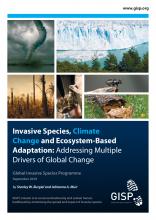
Invasive species, climate change and ecosystem-based adaptation: addressing multiple drivers of global change
Climate Change Resilience, BRB
Available Online

Burglele Stanley W.

,

Muir Adrianna A

2010
This report is targeted at policy-makers, particularly those responsible for developing climate mitigation and adaption strategies that address issues like conservation, ecosystem services, agriculture and sustainable livelihoods. It focuses on the primary linkages between invasive species and climate change, as well as the secondary and tertiary interactions of their corresponding impacts. Finally, the enclosed recommendations are intended to provide guidance on the best ways to integrate invasive species prevention and management into the consideration of climate change responses across a range of sectors. Building on a review of existing scientific and conservation literature (which is frequently centered on well-studied invasive species in developed countries), our research has reaffirmed that there are significant gaps and questions about the intersection of these two major drivers of change. The case studies included below highlight key relationships and questions related to invasive species, climate change and the role of ecosystem-based adaptation. The three key messages that can be distilled from this report are: 1. Climate change will have direct and second order impacts that facilitate the introduction, establishment and/or spread of invasive species. 2.Invasive species can increase the vulnerability of ecosystems to other climate-related stressors and also reduce their potential to sequester greenhouse gasses. 3.Using an ecosystem-based adaptation approach, these pressures on ecosystems and their ability to provide important services can be offset by preventing the introduction of new invasive species and by eradicating or controlling those damaging species already present.
Rural women and food security in Asia and the Pacific: Prospects and paradoxes
BRB
Available Online

Balakrishnan, Revathi

,

Fairbairn-Dunlop, Peggy

2005
Agriculture and food production offer stable livelihood options to rural communities throughout Asia and the Pacific region. Even as the effects of globalization spread in the region, farm production – most often at the smallholder level – continues to be a family enterprise. A fair share of farmers in the region engages in subsistence farming and poverty is a common occurrence among them. Farm enterprises are mostly managed by family members and family labour is a critical asset and often the only reliable investment. As rural women and men toil to preserve their heritage and broaden their economic choices, their endeavours are made more difficult by a lack of resources and market fluctuations. Asian and Pacific farmers, both men and women, are guardians of biodiversity, household food security and providers of food to urban communities. In these small farm enterprises distinct gender roles and gender differentiated access to technology and resources are evident. This disparity is compounded by the neglect of investment in rural social infrastructures such as education, health care and communications. In such resource poor rural environments, the struggle by rural women for access to resources and services is inevitable. In many Asian and Pacific countries, substantial gender equality gains have been made in urban areas in education, health and employment. Yet rural women lag behind. Moreover, rural women’s work is multifaceted and demanding both as family workers and agricultural labourers. Social and economic indicators often do not do justice to their contributions. Development innovations such as microcredit and self-help groups promote rural women’s economic development, but emerging evidence suggests that gender equality in rural communities is far from an everyday reality. Persisting social biases and traditional perceptions and assumptions regarding women’s responsibilities and their capacities continue to hamper women’s progress. This publication presents an overview of both the substantial contribution made by rural women to the economies in the region and the persisting barriers to their advancement. The framework of analysis, data and information reviewed together illustrate the complexity of rural women’s work in the region and offer a broad perspective on women’s economic and social contribution as well as on the barriers they encounter in accessing resources.
Report on results of rat control trials in the Tokelau Islands from 30 July to 20 September 1970 and recommendations for a comprehensive scheme of rat control
BRB
Available Online

Kazimierz Wodzicki

1970
The visit to the Tokelau Islands described below is the third carried out in a study of ecology, rat control and related problems. The first visit in 1966/67 (Wodzicki 1968 A) was devoted primarily to the study of the ecology of the Polynesian rat (Rattus exulans) and the environment, including the animals and the vegetation, of Nukunonu atoll. The main objects of the second expedition in April-June 1968 (Wodzicki 1968 B) were the initiation of a long-term investigation of rat damage on all three atolls and the training of two men from each island as rat control operatives. The present visit was planned with the following tow main objectives in mind: 1. the study of the relationship of rat damage to various coconut varieties growing in the Tokelau Islands; and 2. the conduct of rat control trials with the view of preparing for the Administrator, Tokelau Islands (Mr. Richard B. Taylor) recommendations for a rat control scheme suitable for the Tokelau Islands. The preliminary analysis of data collected during the fifteen months long investigation of rat damage in 1968/69 on the three atolls suggested that palms belonging to some varieties may be more prone to rat damage then others (Wodzicki 1970). It seemed important that we learn more about the character of palms growing on the three atolls. With regard to rat control, trials with various kinds of poisons have been carried out since our first visit to the Tokelaus in 1966/67 (Wodzicki 1968 A). However, during our first two visits knowledge of rat ecology was not sufficiently advanced to allow for more sophisticated tests. Since the author's 1968 visit, the important work on rat control in the Gilbert and Ellice Islands by F.J. Smith (Smith 1969) has become available. This information and our knowledge of rat ecology, gradually acquired since the beginning of the Tokelau Islands rat project, now makes possible a programme that could become the basis of a practical rat control scheme for the three islands. As most of the previous work had been carried out on Nukunonu atoll only, it was felt that half of the time during the visit should be spent on Fakaofo and th remainder on Atafu. Following a brief descrption of these trials is the writer's recommendation of a rat control scheme submitted to the Administrator, Tokelau Islands. Finally, some other observations on plants, animals and related aspects are friefly reported and collections made for the Botany Division, D.S.I.R. and the Dominion Museum are briefly mentioned.
The legacy of Big South Cape: rat irruption to rat eradication
BRB
Available Online

Bell, Brian D.

,

Bell, Elizabeth A.

,

Merton, Don V.

Big South Cape Island (Taukihepa) is a 1040 ha island, 1.5 km from the southwest coast of Stewart Island/Rakiura, New Zealand. This island was rat-free until the incursion of ship rats (Rattus rattus) in, or shortly before, 1963, suspected to have been accidentally introduced via local fishing boats that moored at the island with ropes to the shore, and were used to transport the mutton birders to the island. This incursion was reported by the muttonbirders – local Iwi who harvest the young of titi (sooty shearwater, Puffinus riseus) – to the then New Zealand Wildlife Service (via the New Zealand Department of Lands and Survey). Investigation into the reports found ship rats had reached the island and had decimated the local land bird populations. Brian Bell and Don Merton attempted some of the first translocations of South Island saddleback (Philesturnus c. carunculatus), Stewart Island snipe (Coenocorypha aucklandica iredalei) and Stead’s bush wren (Xenicus longipes variabilis) with only the saddleback being successful. Extinctions of the snipe, wren and greater short-tailed bat (Mystacina robusta) were recorded. This was the first time rats were definitively recognised as the cause of extinction of native land birds and directed further debate into the impacts of rats and how to deal with them.
Forests, trees and food
BRB
Available Online
1992
Despite substantial increases in food production in many countries over the past two decades, the world is still poorly fed. Over 500 million people suffer from malnutrition; and every year about 20 million people die of starvation and its related diseases. In this situation, it is important that every effort be made to improve nutrition and increase food security, particularly for the rural poor. This publication aims to afford proper recognition to the contribution forests and trees make to the food economies of rural societies. It also outlines the changes that need to be made within forestry institutions to enable them to make a significant contribution to the food security of local communities. Food security is increased not only by the presence of forests but also by the small stands of trees found in homegardens and on farms. We use the term `cultivated trees' to describe the latter, and reserve the term `forests' for large stands of trees situated outside the homestead or farm, whether such forests are managed or not. Both play major, often little recognized roles in improving food security in rural communities. Parts of forest plants and trees are also used in traditional medicines. These medicines stimulate appetite, help the body to utilize nutrients in food, and fight infection. Tree products provide an extra source of income for the rural poor without which many families would go hungry or become malnourished. Fuelwood and charcoal, rattan and other materials for furniture making, tendu leaves for cigarette manufacture, gum arabic for a variety of industrial uses, numerous oils and resins, dyes and medicines are all sold by the rural poor. They enable millions of the poorest people in the world to earn the cash they need to avoid starvation. Forests and agroforestry systems also play important roles in stabilizing agriculture's resource base, for example, by slowing down soil erosion by wind and water and reducing sedimentation in rivers. In some cases, trees improve and enrich agricultural soil and help stabilize water supplies, thus improving soil productivity and making sustainable cultivation of marginal lands possible. Trees also exert important influences on micro-climates, thereby improving agricultural production.