Search the SPREP Catalogue

Refine Search Results

Tags / Keywords

Available Online

Tags / Keywords

Available Online

823 result(s) found.

Sort by

You searched for

  • Subject Marine resource
    X
Stimulating investment in Pearl farming in Solomon Islands : report 1. Past research and development on blacklip pearl oysters in Solomon Islands
Biodiversity Conservation
Available Online

Hawes, Ian

,

Mesia Patrick

Information currently available from Solomon Islands on blacklip pearl oysters(Pinctada margaritifera) and their potential culture comes from three main sources; records of past exploitation, occasional resource surveys that have included blacklip pearl oysters; and research on culture of blacklip oysters in Solomon Islands. Statistics on past exploitation are limited to export tonnage and value collected by the Statistics Unit of the Ministry for Fisheries and Marine Resources. Spatially resolved data from within the country, by island or by island group are not available. However, since export appears to have been through a single point. Honiara, these records are likely to reasonably accurately reflect the tonnage exported. Of the various resource assessments that have been undertaken the only recent, nationwide one that we are aware of is that coordinated and funded by The Nature Conservancy (TNC) in May- June 2004. All of the information on pearl farming in Solomon Islands is derived from a research project carried out in the period 1993-1997 by the WorldFish Center (previously the International Center for Living Aquatic Resource Management - ICLARM) in collaboration with MFMR and funded by the Australian Centre for International Agricultural Research (ACIAR). After 1997. through to the present. WorldFish continued research on blacklip pearl production, supported through its own funds, albeit at a reduced level.
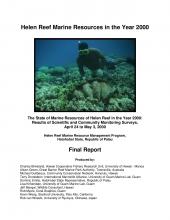
The state of marine resources of Helen reef in the year 2000: results of scientific and community monitoring surveys, April 24 to May 3, 2000 : final report
Biodiversity Conservation
Available Online

Birkeland Charles

2000
Helen Reef in the Southwest Islands of Palau is the one of the greatest marine assets of the Hatohobei (Tobi) People and of the Republic of Palau. Helen Reef is known as one of the most biologically diverse coral reef atolls in the Pacific and historically one of the most biologically abundant reefs in Palau,including acclaimed populations of plentiful marine resources including, trochus, turtles, sea cucumbers, seabirds, and many large reef fish. Reflected in its traditional Hatohobeian name Hotsarihie, which signifies “Reef of the Giant Clam”, Helen Reef is perhaps most famous in the region for its once ubiquitous giant clams, and unfortunately the unchecked foreign poaching that has occurred there over the past decades. The richness and abundance of the atoll’s resources are factors of its location, being remote from human populations and bordering the biodiverse marine eco-regions of Melanesia and SE Asia. The cumulative characteristics of the atoll have attracted many users over time including subsistence fishers from Hatohobei and neighboring islands, sea-faring traders, local businesses interests, and foreign commercial resource operations. The remoteness of Helen Reef which contributes to its historical levels of resource abundance is also a underlying cause for recent resource declines, as the atoll is usually uninhabited and has been notably vulnerable to poaching for the last half century by foreign fishermen from Asian countries