Search the SPREP Catalogue

Refine Search Results

Tags / Keywords

Language

Available Online

Tags / Keywords

Available Online

56 result(s) found.

Sort by

You searched for

  • Subject Invasive species
    X
  • Tags / Keywords eradication
    X
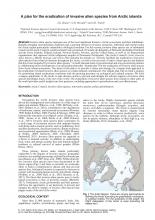
A plan for the eradication of invasive alien species from Arctic islands
BRB
Available Online

Howald, G.

,

Reaser, J.

,

Veatch, S.

2019
Invasive alien species represent one of the most significant threats to Arctic ecosystems and their inhabitants. Rapidly changing environmental conditions and a growing interest in resource extraction, settlement and tourism make the Arctic region particularly vulnerable to biological invasion. For this reason, invasive alien species are of substantial concern to the Arctic Council, a multi-national body comprised of Canada, the Kingdom of Denmark (including Greenland and the Faroe Islands), Finland, Iceland, Norway, Russia, Sweden, and the United States, as well as six international organisations that represent Arctic indigenous peoples as Permanent Participants. The Arctic Council’s Arctic Invasive Alien Species (ARIAS) Strategy and Action Plan includes the priority to: “actively facilitate the eradication of invasive alien species from island ecosystems throughout the Arctic, as well as the recovery of native island species and habitats that have been impacted by invasive alien species.” A multi-national team of governmental and non-government partners is collaborating in the development of an action plan (hereafter ‘islands plan’) for the eradication of invasive alien species from Arctic island ecosystems. The intent of the plan is to provide a vision and strategy for a region-wide approach to the eradication of island invasive alien species as a multi-national commitment. The islands plan will set forth a strategy for prioritising island eradications consistent with the growing pressures on ecological and cultural systems. We have a unique opportunity in the Arctic to take decisive action to prevent and mitigate the adverse impacts of invasive alien species that plague much of the rest of the world. The eradication of invasive alien species from islands in other parts of the world provides useful insights into best practices, including approaches to prioritisation and cost-effectiveness.
Working with the local community to eradicate rats on an inhabited island: securing the seabird heritage of the Isles of Scilly
BRB
Available Online

Bell, E.

,

Buckley, P.

,

Garratt, W.

,

Lock, L.

,

Mason, S.

,

McCarthy, R.

,

Pearce, J.

,

Pearson, J.

,

Pierre, P.

,

Sugar, K.

2019
The inhabited Isles of Scilly, 45 km off the south-western tip of the UK, are home to 13 seabird species including European storm petrel (Hydrobates pelagicus) and Manx shearwater (Puffinus puffinus), for which the UK has a global responsibility. Between 1983 and 2006, the overall seabird population in Scilly declined by c.25%. This decline triggered the establishment of the Isles of Scilly Seabird Recovery Project, a partnership with the aims to reverse seabird decline and engage the local community and visitors in conserving Scilly’s seabird heritage. The eradication of brown rats (Rattus norvegicus) from St Agnes and Gugh represented the result of over a decade of preparatory work, involving raising awareness and gaining 100% support from the community. The two islands are home to 85 people. Therefore additional, and somewhat unusual, preparations were required (including clearing sheds, communicating with school children and taking precautions to ensure the safety of pets) during the ground-based baiting operation. In 2016 St Agnes and Gugh were officially declared ‘rat-free’, meaning worldwide this is one of the largest community-based eradications to have been successful. Biosecurity on inhabited islands is complex, so to ensure the project’s sustainability, eff orts have been community-led. The community has taken ownership of protecting its seabirds, with 100% saying rat removal and the subsequent increase in seabirds has had, or will have, a positive effect on ecotourism, a key source of income for the islands. No less than 68% of the community said their businesses have directly benefited. This project represents a case study for other community-based projects, showcasing how eradications can gain community support and benefit both wildlife and human populations.
Life-history comparisons between the native range and an invasive island population of a colubrid snake
Biodiversity Conservation, BRB
Available Online

Alcaraz, S.E.

,

Fisher, R.N.

,

Fisher, S.R.

,

Gallo-Barneto, R.

,

López Jurado, L.F.

,

Patino-Martinez, C.

,

Rochester, C.J.

2019
Invasive snakes can lead to the rapid extinction of endemic vertebrates on insular ecosystems, usually because snakes are an efficient and novel predator. There have been no successful (i.e. complete) eradications to date of invasive snakes on islands. In this study we assess a novel invasion on Gran Canaria in the Canary Islands. The invader, the California king snake (Lampropeltis californiae), arrived from California via several generations in the pet trade. King snakes are captive bred for various phenotypes, and first were detected in the wild on Gran Canaria in the 1990s. Because very little natural history data exist from within their native range, we focused on developing datasets from native habitats to compare with similar data for the introduced snakes in the Canary Islands. We found that most aspects of the snake’s life history have not changed since invasion, except that there appears to be a lower level of juvenile recruitment along with an increase in the length and body mass of adult snakes on Gran Canaria. We identified environmental parameters for when capture/trapping could be completed to reduce eff ort and maximize success. Additionally, we show different trap success on the various life stages of the snakes. Risk assessments could be required prior to permitting pet trade or allowing captive bred snakes into regions where they are not native.
Spatial dynamics of invasion and distribution of alien frogs in a biodiversity hotspot archipelago
Biodiversity Conservation, BRB
Available Online

Diesmos, A.C.

,

Diesmos, M.L.L.

,

Pili, A.N.

,

Supsup, C.E.

,

Sy, E.Y.

2019
The endemic-rich amphibian fauna of the Philippine Archipelago (ca. 350,000 km2) includes six alien frogs: the American bullfrog (Lithobates catesbeianus), Asiatic painted toad (Kaloula pulchra), cane toad (Rhinella marina), Chinese bullfrog (Hoplobatrachus rugulosus), green paddy frog (Hylarana erythraea), and greenhouse frog (Eleutherodactylus planirostris). The chronological history of their invasion across the Philippines was reconstructed based on historical and geographic data. Subsequently, we estimated their current and potential distribution through species distribution modelling and Gaussian kernel density smoothing species distribution data. Seven known and potential pathways of introduction into and spread throughout the Philippines were identifi ed, namely, intentional introduction as a (1) biocontrol agent and (2) food source; contamination of (3) agriculture trade, (4) aquaculture trade, and (5) ornamental plant trade; (6) stowaway of cargo; and (7) through the exotic pet trade. Spatio-temporal patterns of distribution showed a stratifi ed diff usion process of spread wherein human-mediated jum dispersal is the primary mode followed by diff usion dispersal. The status of the American bullfrog in the Philippines is unresolved, whether it has successfully established. Meanwhile, the other five alien frogs have established populations in the wild, typically the dominant species in both artificial and disturbed habitats, and are continuously spreading throughout the Philippines. Estimates of current and potential distribution indicate that none of the alien frogs has realised its full potential distribution and that the cane toad is the most widespread, occurring in almost all major islands of the Philippines (ca. 85%), while the greenhouse frog is the least distributed, being found so far in eight provinces and on seven islands. In light of these findings, we provide policy and management recommendations for responding to current and future alien frog invasions.
Predation pressures on sooty terns by cats, rats and common mynas on Ascension Island in the South Atlantic
Biodiversity Conservation, BRB
Available Online

Dickey, R.C.

,

Hughes, B.J.

,

Reynolds, S.J.

2019
Despite the presence of invasive black rats (Rattus rattus), common mynas (Acridotheres tristis), and feral domestic cats (Felis catus), sooty terns (Onychoprion fuscatus) breed in large numbers on Ascension Island in the tropical South Atlantic Ocean. These introduced predators impact the terns by destroying eggs or interrupting incubation (mynas), eating eggs (mynas and rats), eating chicks (rats and cats), or eating adults (cats). Between 1990 and 2015, 26 censuses of sooty terns and five of mynas were completed and myna predation was monitored on 10 occasions. Rat relative abundance indices were determined through trapping around the tern colonies and rat predation was monitored by counting chick carcasses. Cat predation was quantified by recording freshly killed terns. Prior to their eradication in 2003, cats had the greatest impact on sooty terns and were depredating 5,800 adults and 3,600 near-fledging chicks (equivalent to the loss of 71,000 eggs) each breeding season. We estimated that 26,000 sooty tern eggs (13% of all those laid) were depredated by approximately 1,000 mynas. Rats were not known to depredate sooty terns prior to cat eradication but in 2005, 131 of 596 ringed (monitored) chicks (22%) were depredated by rats. In 2009 chick carcass density was 0.16 per m2. Predation by rats hugely increased in the absence of cats and was the equivalent of 69,000 eggs. Care is needed when applying our findings to seabirds globally. The scarcity of alternative food sources and seasonally high density of easily available prey in the sooty tern colony may have magnified predation by cats, rats and mynas.
Eradication and control programmes for invasive mynas (Acridotheres spp.) and bulbuls (Pycnonotus spp.): defining best practice in managing invasive bird populations on oceanic islands
Biodiversity Conservation, BRB
Available Online

Reynolds, S.J.

,

Saavedra Cruz, S.

2019
Invasive plants and animals inflict much damage on native species and this is particularly the case on isolated oceanic islands with high degrees of endemism. Such islands commonly are important refugia for species of high conservation value. Some of the most pervasive and potent of invasive animal species are birds of the myna (Acridotheres) and bulbul (Pycnonotus) genera that historically were introduced to isolated islands as biological control agents for the management of insect pest species that can cause considerable economic damage to agricultural crops and wider ecosystems. In this paper we consider a number of ‘successful’ eradication and control programmes targeting mynas and bulbuls. We review the locations and taxa where 17 such programmes took place and report that the common myna (Acridotheres tristis) has been the most heavily targeted species in eradication eff orts followed by the red-whiskered bulbul (Pycnonotus jocosus). Common mynas were also at the focus of control programmes as were jungle mynas (Acridotheres fuscus) and red-vented bulbuls (Pycnonotus cafer). By far the most favoured method of eradication and control was trapping whereas mist-netting was employed rarely. We discuss ‘best practice’ in planning and executing such eradication and control programmes on oceanic islands so as to maximise their benefits to local human communities. We outline measures that must be adopted pre-, during and post-intervention in both programme types. They include adequate resourcing, local engagement and the integration of both traditional ecological knowledge and established conservation theory.
Population assessment of a novel island invasive: tegu (Salvator merianae) of Fernando de Noronha
Biodiversity Conservation, BRB
Available Online

Abrahão, C.R.

,

Dias, R.A.

,

Ferreira, F.

,

Russell, J.C.

,

Silva, J.C.R.

2019
Fernando de Noronha is an oceanic archipelago in the Atlantic Ocean, 345 km off shore from the Brazilian coast. It comprises 21 islands and islets, of which the main island (FN) is 17 km2 with a rapidly growing tourism industry in the last decades. Despite being a protected area and bearing Ramsar and UNESCO World Heritage site status, it is threatened by multiple terrestrial invasive species since its colonisation in the early 16th century. Invasive species and the increasing tourism contributes to a list of at least 15 endangered or critically endangered species according to IUCN criteria. The black and white tegu (Salvator merianae) is the largest lizard in South America, occurring in most of the Brazilian territory and reaching up to 8 kg and 1.6 m from head to tail. As an omnivorous and opportunistic lizard, it feeds on a variety of available items, including smaller vertebrates and eggs. The introduction of the tegu to FN as well as its immediate impact on local fauna were not recorded; however, its ongoing impact is expected to be high. We captured and marked 103 tegu in FN during the months of February and November of 2015 and 2016. We also counted animals by line-transect census in a sparsely inhabited and an uninhabited area of FN. Body size affected the capture probabilities, while season and sex had little or no effect. Densities estimated by capture-recapture in the sparsely inhabited area varied from 2.29 to 8.28 animals/ha according to sampling season. Line transect census in the same area revealed a density of 3.98 (±1.1) animals/ha and in the uninhabited area 13.83 (±3.9) animals/ha. Home range was 10.54 ha, ranging from 7.36 to 15.33 hectares. Tegu activity decreased in the months of July and August of 2015. Results from this study can assist conservation managers and decision makers to implement a science-based tegu management programme in the future.
Invasion by the red-vented bulbul: an overview of recent studies in New Caledonia
BRB
Available Online

Barré, N.

,

Brescia, F.

,

Demaret, L.

,

Fogliani, B.

,

Jourdan, H.

,

Lannuzel, G.

,

Masse, F.

,

Potter, M.A.

,

Pujapujane, A.

,

Robert, N.

,

Thibault, M.

,

Vidal, E.

2019
New Caledonia is a tropical archipelago of the South Pacific Ocean, and is one of the 36 world biodiversity hotspots. However, its unique biodiversity is increasingly threatened by habitat fragmentation and introductions of invasive alien species. Among these invaders, the red-vented bulbul (Pycnonotus cafer) is currently expanding towards the north of the main island. This passerine features in the IUCN-ISSG list of the 100 worst invasive species of the world because of impacts caused by its diet. Thirty-five years after its introduction, we present an overview of data from recent studies conducted in New Caledonia that describe the local status of the red-vented bulbul, its range expansion, and potential impacts on both the local biodiversity and agriculture. Biannual monitoring of the distribution coupled with surveillance at the edges of native forests highlighted a tight association of the bulbul with man-modified habitats. Using a distance sampling method, we estimated that bulbul densities within the distribution core varied from a peak of 200 individuals/km2 in the main city of Nouméa, where the species has been introduced, to 30 individuals/km2 in rural habitats located 50 km away from Nouméa. We conducted a diet analysis on 40 bulbul corpses and found that 82% and 55% of individuals had consumed plant and animal items, respectively. We identified plant and insect species that may be of concern in the contexts of seed dispersal and predation by the red-vented bulbul. Finally, a food colour selection experiment and an open field test showed that the red-vented bulbul had a significant preference for red and sweet fruits. We estimated the economic loss caused by bulbuls to a tomato grower and discuss the result with respect to the development of an adapted management strategy, to prevent further impacts of the red-vented bulbul on the biodiversity and agriculture in the tropical island hotspot of New Caledonia.
Five eradications, three species, three islands: overview, insights and recommendations from invasive bird eradications in the Seychelles
Biodiversity Conservation, BRB
Available Online

Agricole, J.

,

Angell, G.

,

Banville, P.

,

Bunbury, N.

,

Constance A.

,

Fleischer-Dogley, F.

,

Friedlander J.

,

Haverson, P.

,

Leite, L.

,

Mahoune, T.

,

Melton-Durup, E.

,

Moumou, J.

,

Page, N.

,

Raines, K.

,

van de Crommenacker, J.

2019
Management and eradication techniques for invasive alien birds remain in their infancy compared to invasive mammal control methods, and there are still relatively few examples of successful avian eradications. Since 2011, five separate eradication programmes for invasive birds have been conducted on three islands by the Seychelles Islands Foundation (SIF). Target species were prioritised according to their threat level to the native biodiversity of the UNESCO World Heritage Sites of the Seychelles, Aldabra Atoll and Vallée de Mai, which SIF is responsible for managing and protecting. Red-whiskered bulbuls (Pycnonotus jocosus) and Madagascar fodies (Foudia madagascariensis) occurred on Assumption, the closest island to Aldabra, which, at the time, had no known introduced bird species. The growing population of ring-necked parakeets (Psittacula krameri) on Mahé posed a threat to endemic Seychelles black parrots (Coracopsis barklyi) on Praslin where the Vallée de Mai forms their core breeding habitat. In 2012, red-whiskered bulbuls and Madagascar fodies were detected on Aldabra, so an additional eradication was started. All eradications used a combination of mist-netting and shooting. The intensive part of each eradication lasted three years or less. On Assumption, 5,279 red-whiskered bulbuls and 3,291 Madagascar fodies were culled; on Mahé, 545 parakeets were culled; and on Aldabra 262 Madagascar fodies and one red-whiskered bulbul were culled. Each programme underwent 1–2 years of follow-up monitoring before eradication was confi rmed, and four of the fi ve eradications have been successful so far. None of these species had previously been eradicated in large numbers from other islands so the successes substantially advance this fi eld of invasive species management. The challenges and insights of these eradications also provide unique learning opportunities for other invasive avian eradications.