Search the SPREP Catalogue

Refine Search Results

Language

Available Online

Available Online

11 result(s) found.

Sort by

You searched for

  • Related Countries American Samoa
    X
  • Related Countries Worldwide
    X
  • Subject Environment - Protection - Samoa
    X
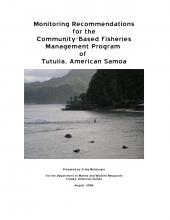
Monitoring recommendations for the Community-based fisheries Mangement Program of Tutuila, American Samoa; For the departmnet of Marine and wildlife Resources Tutuila, American Samoa August 2004
Biodiversity Conservation
Available Online

Musburger, Craig

2004
The American Samoa Department of Marine and Wildlife Resources (“DMWR”)began working with local communities on the island of Tutuila in 2001 to develop the Community­Based Fisheries Management Program (“CBFMP”). Through a series of meetings with representatives from select villages, DMWR sought the voluntary participation of communities in an effort to manage and monitor their own coral reef resources. The program has grown to include seven villages, each of which is responsible for all aspects of managing and monitoring their own resources, with technical assistance from DMWR. Committees from each village have designed and implemented management plans which vary from village to village, but generally include some type of restriction on fishing activity on part or all of the reef fronting their villages. Many of the participating villages have reported anecdotally that they have seen improvement in their resources since the program’s inception, but as of yet, there has been no effort devoted towards scientifically monitoring these areas. As such, a robust, quantitative analysis of the effectiveness of the management efforts has not been possible in any of the participating villages. While it may be too late to obtain useful “baseline” data that shows the state of the marine resources prior to the implementation of the management plans, it is imperative that monitoring commence as soon as possible to allow for future analysis of the trends in the health of the reefs of the villages participating in the CBFMP.
Coral Reefs: An english compilation of Activities for middle School Students
Available Online

?

1997
The breathtakingly beautiful coral reefs of the world cover less than a half of one percent of our planet's sea floor. And yet, these magnificent underwater empires are home to an estimated 25 percent of all oceanic species, a dazzling diversity of sea creatures. Like the teeming metropolis of Rome, a coral reef "was not built in a day."Rather, the coral heads in a reef grow at a painstakingly slow average rate of half an inch per year and require epochs of geological time to amass into reefs and coral cays.Coral reefs, in addition to providing food and shelter for countless varieties of marine life, provide benefits beyond estimation for humankind. Healthy reefs aree ssential for an adequate supply of seafood to nourish the world's populations and sustain regional fishing industries. Reefs enhance tourist businesses by attracting millions of divers and by continuously supplying coastal beaches with shimmering white sand, the fine-grained rubble of dead corals and calcareous reef algae. By breaking waves, reefs protect nearby shorelines from soil and sand erosion and from the brunt of ravaging hurricanes. A wealth of commercial and medical applications has been discovered for corals and other components of the reef community. From coral reefs come additives for cement and mortar, compounds used in violin varnishes, substances for surgically replacing broken human bones, and promising treatments for infections,viruses, arthritis, asthma, and cancer. Scientists agree that this is only the tip of the iceberg as far as important findings and innovations which will result from continued research of coral reefs.