Search the SPREP Catalogue

Refine Search Results

Related Countries

Tags / Keywords

Language

Available Online

Related Countries

Tags / Keywords

Available Online

11 result(s) found.

Sort by

You searched for

  • Tags / Keywords fiji
    X
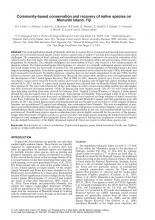
Community-based conservation and recovery of native species on Monuriki Island, Fiji
Biodiversity Conservation, BRB
Available Online

Brown, J.

,

Chand, R.

,

Cranwell, S.

,

Fisher, R.N.

,

Harlow, P.

,

Lovich, K.

,

Niukula, J.

,

Rasalato, S.

,

Seniloli, E.

,

Thaman, B.

,

Thomas-Moko, N.

,

Vadada, J.

2019
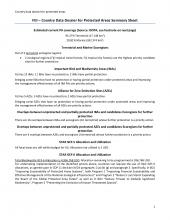
The small uninhabited island of Monuriki (40.4 ha) in western Fiji is of national and international conservation concern for its several protected species. Exotic invasive species and a Category 5 cyclone have exacerbated conservation challenges. The cooperation of local, national, and international stakeholders continues to be crucial in restoration of the island’s native ?ora and fauna. This summary presents a timeline of restoration efforts and current status of the recovery programme for Monuriki. The critically endangered dry forest habitat of Fiji is only found in a few isolated patches on disparate islands. The Fijian crested iguana (Brachylophus cf. vitiensis) is a critically endangered species restricted to a few small islands in this dry forest zone of western Fiji. The population of crested iguanas on Monuriki Island is the third largest remaining population. Even before iguanas were ?rst documented on the island in the early 1980s, individuals had been removed by local resorts for display purposes, a practice that was previously unregulated. In the late 1990s, the ?rst efforts to conserve and restore Monuriki Island were discussed, but conservation initiatives were not implemented until the development of the Crested Iguana Recovery Plan in 2008. In 2011, domestic goats (Capra hircus) and non-native rats (Rattus exulans) were removed from the island, and 10 pairs of iguanas were brought into captive breeding facilities within Fiji. In 2015, the ?rst 32 captive-bred crested iguanas were released back on Monuriki Island. More than half of these iguanas (N=26) were radio-tracked for 56 days post-release in order to assess survivorship and help provide insights into their short-term movement patterns. Of the 26 iguanas that were tracked, nearly 70% (N=18) were found after 56 days indicating excellent short-term survival. In February 2016, Tropical Cyclone Winston, a Category 5 storm passed through Fiji and devastated some of the tropical dry forest habitat on Monuriki. With sustained winds of up to 230 km/ hr nearly all of the canopy leaves from trees on Monuriki Island were removed and large amounts of debris covered the forest ?oor. Following the cyclone, a brief wildlife survey revealed Monuriki’s iguana and bird populations were still present. In 2017, the crested iguana captive breeding programme was brought to an end when 16 of the original 20 iguana founders, and an additional 32 captive bred o? spring, were reintroduced onto Monuriki. This was accomplished, in part, due to successful breeding and reestablishment of the remaining wild iguanas on the island. Despite a major storm event, reestablishment likely resulted from reduced egg and hatchling predation by the rats, and excellent habitat recovery after goat removal. Overall these invasive species eradications have proven highly successful for the recovery of the iguanas, wedge-tailed shearwaters (Puffinus paci?cus), and several other non-target species including the banded rail (Gallirallus philippensis) and endangered Fijian peregrine falcon (Falco peregrinus). Furthermore, eradication of non-native species has also helped the recovery of the highly threatened tropical dry forest ecosystem in which these species exist.
Using expert Knowledge and Field Surveys to Guide Management of an Invasive Alien Palm in a Pacific Island Lowland Rainforest
Biodiversity Conservation, BRB
Available Online

Boehmer, H.J.

,

Dyer, M.J.B.

,

Keppel, G.

,

Tuiwawa, M.

,

Vido, S.

,

Watling, D.

2019
Invasive alien ornamental plants are a global problem, especially on oceanic islands, and can have severe impacts on native biodiversity. Pinanga coronata, is an ornamental palm tree that can form mono-dominant stands in its native habitat and is widely cultivated throughout the tropics. Here we investigate the introduction, spread, impact and management of this invasive palm in the Fiji Islands, using extensive discussions with local experts and ?eld surveys. Pinanga coronata was introduced in the 1970s to the Colo-i-Suva area, eastern Viti Levu island, Fiji´s principal island, and has since become invasive in mahogany plantations and lowland rainforest. It has also been introduced and is becoming invasive on the western side of that island. However, the distribution of P. coronata remains geographically limited to the immediate vicinity of introduction sites but it is rapidly spreading. In each location, the species has formed mono-dominant stands in the understorey and appears to be displacing native plant species, as suggested by a negative correlation of its abundance with that of native tree ferns. This highlights the need for rapid control of P. coronata in Fiji. Local experts state management should involve manual removal of seedlings and saplings, killing of adult palms by injection of herbicide, and education and legislation to prevent the further spread of the species. Based on these recommendations and ?eld data, management actions to control P. coronata are proposed and steps to develop these into a management plan are discussed. Given P. coronata threatens native biodiversity in Fiji and has the potential to invade other rainforest ecosystems in the tropics, proposed management approaches are urgent and relevant for other tropical countries.
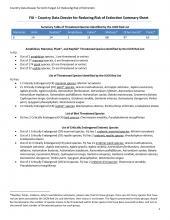
The Pacific Islands: an analysis of the status of species as listed on the 2008 IUCN Red List of Threatened Species: American Samoa, Cook Islands, Fiji, French Polynesia, Guam, Kiribati, Marshall Islands, Federated States of Micronesia, Nauru, New Caledonia, Niue, Norfolk Island, Northern Mariana Islands, Palau, Papua New Guinea, Pitcairn Island, Samoa, Solomon Islands, Tokelau, Tonga, Tuvalu, US Minor outlying islands, Vanuatu, Wallis and Futuna
Climate Change Resilience, Biodiversity Conservation, BRB
Available Online

Pippard, Helen

2009
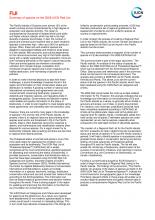
The Pacific islands of Oceania cover almost 15% of the world’s surface and are characterised by a high degree of ecosystem and species diversity. The region is characterised by thousands of isolated small coral atolls and higher volcanic islands, which has led to the high diversity of species found today. In fact, the number of plants and animals found nowhere else on earth (endemic species) is extremely high - often up to 90% for particular groups. Often, these rare and endemic species are adapted to specialised habitats and limited to small areas of a few islands. With economic and cultural dependence on the natural environment very high in the Pacific islands, along with a rapidly expanding human population, there are everincreasing demands on the region’s natural resources. Plant and animal species are therefore very vulnerable to extinction from climate change, competition from introduced (invasive) species and human impacts such as habitat destruction, over-harvesting of species and pollution.