Search the SPREP Catalogue

5 result(s) found.

Sort by

You searched for

  • Publication Year 2016
    X
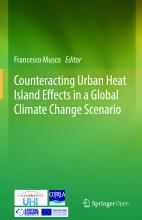
Counteracting Urban Heat Island Effects in a Global Climate Change Scenario
Available Online

Francesco Musco

2016
Reflect on the present, on the dynamics and the conditions that built it, and look forward at the same time, in search of a prospect to improve the future. Since Howard (1850–1928) and Geddes (1854–1932), this has been the dominant logic supporting the work of all those (architects, urban planners, planners, landscape architects, etc.) who grappled with city and territorial management and planning. However, from the 1970s, territorial planning has been confronted with new concepts – such as sustainable development, environmental sustainability and social equity – and more recently, new challenges – such as the ones linked to climate change, which led to the need to redefine territorial planning in disciplinary and operational terms. For some years now, the planner’s new role is under discussion, especially in relation to the challenges posed by climate change. Sustainability, mitigation, adaptation, renewable energy, low-carbon transition, ecosystem approach and post-disaster planning are just some of the new keywords surrounding the discussion on territorial management and planning. This chapter aims to present rationally, what it means to re-organize and re-think the city, in a long-term perspective. It wants to show how it is possible, and above all is a duty to integrate the new concepts mentioned above in urban planning, to deal with the effects of climate change. The Urban Heat Islands contrast enters fully into the feasible experimentation with appropriate innovations in territorial planning. The paper draws attention to the Italian situation, in the light of the European reference framework.
Freshwater ichthyofauna of the Pacific-Asia Biodiversity Transect (PABITRA) Gateway in Viti Levu, Fiji
Biodiversity Conservation

Boseto, David T.

,

Copeland, Lekima K. F.

,

Jenkins, Aaron P.

2016
The freshwater ichthyofauna of the Fiji islands remained poorly documented before the establishment of the Pacific-Asia Biodiversity Transect (PABITRA) network. The PABITRA approach assesses biodiversity along ocean-to-mountain transects and promotes sustainable land use on islands across the Pacific. Multiple surveys of freshwater fish species along the Viti Levu PABITRA transect have contributed six new occurrence records and one new species to the known freshwater fishes of Fiji since 2002. In total, 21 indigenous species of fish (9% endemic) from 10 families and no introduced fishes were found in the three PABITRA sites. Diversity was highest (16 species) at Savura forest reserve and decreased further inland into Sovi and Wabu. The assemblage found is dominated by highly migratory species (95%) that traverse the different aquatic habitats (marine, estuarine, lowland and upland streams) covered by the PABITRA transect. This high degree of connectivity highlights several growing issues affecting aquatic fauna on the high island of Viti Levu. The reduction in forest cover along the gateway transects, especially in the terminal reaches, and infrastructure development such as dams and weirs have deleterious effects on the migration routes of the Fijian ichthyofauna. Several species collected are important food sources and have cultural totemic importance to local inhabitants along the vertical transect. This paper documents the ichthyofauna of the Fiji gateway transect, ecological characteristics of this assemblage, IUCN Redlist conservation assessment status and highlights factors affecting the fragility and resilience of these communities, particularly focusing on the importance of life-history patterns and watershed conditions.