Search the SPREP Catalogue

Refine Search Results

Tags / Keywords

Language

Available Online

Tags / Keywords

Available Online

81 result(s) found.

Sort by

You searched for

Sub-global working group: state of the assessment report, Papua New Guinea - summary national assessment
Available Online

Filer, Colin ... [et al.]

2004
In September 2000, the Millennium Ecosystem Assessment (MA) issued a call for proposals to undertake ‘sub-global’ assessments at local, national, and regional scales. The Call for Proposals was circulated amongst a group of social scientists who had previously had some connection to PNG’s Biodiversity Conservation and Resource Management Program – an initiative which had been funded by the Global Environment Facility from 1993 to 1998. This program had sought to evaluate the actual and potential effectiveness of ‘integrated conservation and development projects’ in forested areas of PNG where high biodiversity values are associated with low population densities. One of the key lessons of the program had been that local communities in these areas are far more interested in ‘development’ than in ‘conservation’, because they can reasonably say that they have been conserving their ecosystems for thousands of years, but are now lagging in their access to modern health and education services because of their small and scattered populations (McCallum and Sekhran 1997; van Helden 1998, 2001; Filer 2004b). If the Government cannot afford to provide these services to remote and thinly populated areas, then local people tend to dream of the day when a logging company or mining company will deliver them from their state of backwardness.
Our precious coasts - Marine pollution, climate change and the resilience of coastal ecosystems
Climate Change Resilience, Waste Management and Pollution Control
Available Online

Corcoran, E.

,

Nellemann, C.

2006
Massive coral bleaching episodes have impacted the function of the reefs and increased rates of mortality. Coral reefs support over one million plant and animal species and their economic value is pro¬jected to more than US $ 30 billion annually. Extreme climatic con¬ditions, however, are most likely to increase in the future with cur¬rent climate scenarios. Projected increases in carbon dioxide and temperature exceed the conditions under which coral reefs have flourished over the past 500 000 years. Coral reefs are crucial bio¬diversity hotspots and support both coastal fisheries and tourism in many regions. Coral reefs, however, are in decline in many regions as a result of numerous pressures, including, but not limited to, extreme climate events, unsustainable fishing practices, diseases, sedimentation, and discharge of untreated sewage. Increasing re¬silience and securing rapid recovery of coral reefs will be essen¬tial for the ability of these ecosystems to support coastal fisheries and coastal livelihoods and cultures in the future. However, this resilience and recovery may be seriously impounded by unsustain¬able coastal infrastructure development and marine pollution from land-based sources. At the current rate of growth, coastal develop¬ment may impact up to 90% of the tropical and temperate coast¬lines by 2032 if development continues unchecked. While progress has been made to reduce the discharge and impacts of oil spills and persistent organic pollutants (POP’s), there now needs to be a focus on the largest current threats to the coastal marine environment : untreated sewage and piecemeal coastal development.
Samoa Tsunami rapid environmental impact assessment report: draft October 14th 2009
Biodiversity Conservation
Available Online

Ifopo, Pulea Etiseli

2009
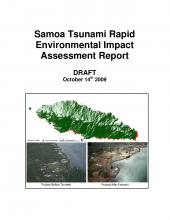
A rapid assessment of the environmental impacts of the 29 September tsunami was conducted by a multi-agency team from 3 to 14 October, 2009. Fourteen “green” and 10 “brown” environmental variables were selected and measured based on the experience of the survey team and similar reports from elsewhere. During a tour of the affected area on Upolu by car and on foot those “assessable” variables were scored “high” (over two thirds affected), “medium” (over one third, less than two thirds affected), “low” (less than a third affected) or zero (unaffected). Manono and Savaii were surveyed by air with the former showing evidence of some damage and the later apparently none or very little. The most affected areas in Upolu were villages in the Aleipata, Lepa and Falealili districts with the most obvious indicators of the tsunami’s impact being solid waste (sometimes resulting from the complete destruction of a village), erosion of the beach and fore-shore and the (expected) impact on marine resources. Other environmental variables assessed also showed similar patterns. Impacts on a wharf/dry dock facility are also described (including lost fuel drums) as are the possible environmental implications of new settlements created by displaced persons (mainly revolving around sanitation, drainage and water supply).