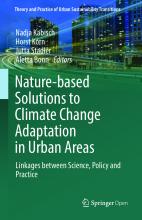
Nature-Based Solutions to Climate Change Adaptation in Urban Areas
Nadja Kabisch, Horst Korn, Jutta Stadler, Aletta Bonn
2017
This book series Theory and Practice of Urban Sustainability Transitions is intended to explore the different dynamics, challenges, and breakthroughs in accelerating sustainability transitions in urban areas across the globe. We expect to find as much different and diverse stories, visions, experiments, and creative actors as there are cities: from metropolises to country towns, from inner city districts to suburbs, from developed to developing, from monocultural to diverse, and from hierarchical to egalitarian. But we also expect to find patterns in processes and dynamics of transitions across this diversity. Transition dynamics include locked-in regimes that are challenged by changing contexts, ecological stress and societal pressure for change as well as experiments and innovations in niches driven by entrepreneurial networks, and creative communities and proactive administrators. But also included are resistance by vested interests and sunken costs, uncertainties about the future amongst urban populations, political instabilities, and the erosion of social services and systems of provision. And finally there are the forming of transformative arenas, the development of coalitions for change across different actor groups, the diffusion and adoption of new practices, and exponential growth of sustainable technologies. For this series we seek this middle ground: between urban and transition perspectives, between conceptual and empirical, and between structural and practical. We aim to develop this series to offer scholars state-of-the-art theoretical developments applied to the context of cities. Equally important is that we offer urban planners, professionals, and practitioners interested or engaged in strategic interventions to accelerate and guide urban sustainability transition frameworks for understanding and dealing with on-going developments, methods, and instruments. This book series will lead to new insights into how cities address the sustainability challenges they face by not returning to old patterns but by searching for new and innovative methods and instruments that are based on shared principles of a transitions approach. Based on concrete experiences, state-of-the-art research, and ongoing practices, the series provides rich insights, concrete and inspiring cases as well as practical methods, tools, theories, and recommendations. The book series, informed by transition thinking as it was developed in the last decade in Europe, aims to describe, analyse, and support the quest of cities around the globe to accelerate and stimulate such a transition to sustainability. To sum up, the book series aims to: Provide theory, case studies, and contextualized tools for the governance of urban transitions worldwide Provide a necessary and timely reflection on current practices of how transition management is and can be applied in urban contexts worldwide Further the theorizing and conceptual tools relating to an understanding of urban sustainability transitions Provide best practices of cities across countries and different kinds of cities as well as across policy domains in shaping their citys path towards sustainability