Search the SPREP Catalogue

Refine Search Results

Tags / Keywords

Available Online

Tags / Keywords

Available Online

6263 result(s) found.

Sort by

You searched for

  • Material Type Report
    X
Spatial Economic Analysis of Early Detection and Rapid Response Strategies for an Invasive Species
BRB
Available Online

Burnett, Kimberly

,

Kaiser, Brooks

2010
Economic impacts from invasive species, conveyed as expected damages to assets from invasion and expected costs of successful prevention and/or removal, may vary significantly across spatially differentiated landscapes. We develop a spatial-dynamic model for optimal early detection and rapid-response (EDRR) policies, commonly exploited in the management of potential invaders around the world, and apply it to the case of the Brown treesnake in Oahu, Hawaii. EDRR consists of search activities beyond the ports of entry, where search (and potentially removal) efforts are targeted toward areas where credible evidence suggests the presence of an invader. EDRR costs are a spatially dependent variable related to the ease or difficulty of searching an area, while damages are assumed to be a population dependent variable. A myopic strategy in which search only occurs when and where current expected net returns are positive is attractive to managers, and, we find, significantly lowers present value losses (by $270m over 30 years). We find further that in the tradeoff between search costs and damages avoided, early and aggressive measures that search some high priority areas beyond points of entry even when current costs of search exceed current damages can save the island more ($295m over 30 years). Extensive or non-targeted search is not advised however.
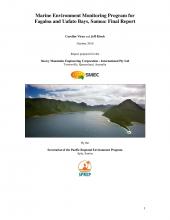
Marine environment monitoring programme for Fagaloa and Uafato bays, Samoa : final report
Available Online

Kinch, Jeff

,

Vieux, Caroline

2010
The Asian Development Bank through its contractor, the Snowy Mountain Engineering.Corporation were tasked with exploring the potential of augmenting the capacity of the Afulilo Reservoir to power a third turbine at the Ta’elafaga Hydro-power Station. To assist in this augmentation assessment, SMEC arranged with the Secretariat of the Pacific Regional Environment Program to oversight a consortium of partners to conduct a 11 month monitoring program with the purpose of assessing the status of the marine environment, particularly the coral reefs, as well as water quality in the Fagaloa and Uafato Bays. The data from the 2009-1010 marine monitoring program implies that several sites in Fagaloa Bay are exhibiting signs of various impacts from various inputs into the marine environment, which are most notable at sites 1, 2, and 14. These sites are closest to the apex of Fagaloa Bay where the Ta’elefaga Creek discharges into. Impacts for these sites include low or no coral cover and recruitment, growth in algal cover, lower salinity levels, higher rates of sedimentation and turbidity, as well as high nutrient inputs. Fish biomass at site 14 was also the lowest (sites 1 and 2 were not surveyed due to poor visibility). Other specific results across all sites include a reduction in live coral cover, a general shift to more hardier coral species, and low fish bio-mass when compared with other sites in Samoa.