Search the SPREP Catalogue

Refine Search Results

Related Countries

Tags / Keywords

Language

Available Online

Related Countries

Tags / Keywords

Available Online

35 result(s) found.

Sort by

You searched for

  • Collection BRB
    X
  • Publisher Department of Conservation (DOC)
    X
  • Publisher United Nations Environment Programme (UNEP)
    X
GEF PAS Project Document - Prevention, Control and management of Invasive Alien Species in the Pacific Islands.
Biodiversity Conservation, BRB
Available Online
2011
Invasive Alien Species (IAS) are a major threat to marine, freshwater and terrestrial biodiversity of the Pacific islands and to the people there that depend on biodiversity for their livelihoods. Invasive species are implicated in the decline of hundreds of species in the region. Participating Pacific states and the executing agency SPREP (Secretariat of the Pacific Regional Environment Programme) recognised the need to implement the regional IAS strategy, “Guidelines for Invasive Species Management in the Pacific. A Pacific strategy for managing pests, weeds and other invasive species” (hereafter, the Guidelines) and develop and implement national IAS plans and strategies. The Guidelines were originally identified as a product under this project, but were completed in 2009 prior to writing this proposal. As envisaged during the PIF process the proposed project contributes to the implementation of the Guidelines, each country’s National Biodiversity Strategy and Action Plan and helps each to meet its responsibilities under Article 8 (h) of the CBD and several other international agreements addressing IAS. The three main components (not including components related to project management) of the proposed project are designed to capture outcomes and outputs described in the Project Identification Form but they have been reorganized to follow the structure of the Guidelines.
Terminal evaluation of UN Environment project: Prevention, control and management on invasive alien species in the Pacific island.
Biodiversity Conservation, BRB
Available Online

Thomas, Peter.

2017
Invasive alien species represent an insidious and pervasive threat to the environmental, economic and human well-being of the Pacific islands. Pacific island ecosystems make up one of the world’s important biodiversity hotspots, with high numbers of endemic species that are particularly vulnerable to extinction due to their limited habitat and isolation.|This book is intended to serve as a practical guide, calling attention to the need to link emergencies, disasters and development, not only in policy statements, but in practical ways. The book identifies physical and social factors and processes determining disaster vulnerability and offers the reader a range of vulnerability-reduction options in development and disaster mitigation. The book covers the main relief and response technologies for a range of natural and technological disasters, and deals with community participation, health education, training and other social aspects relevant to the protection of health and the environment in emergencies and disasters.|The UNEP/GEF Prevention, Control and Management of Invasive Alien Species in the Pacific Islands project also known as the IAS project, commenced on 12 September 2012 and was due for completion on 30 September 2016, following an extension of one year. The project was designed to provide support to Pacific Island countries in their national efforts to implement the Guidelines for Invasive Species Management in the Pacific – a Pacific Strategy for managing pest, weeds and other invasive species (Tye 2009) which were developed and adopted as the regional strategic framework for invasive species management in 2009. Ten Pacific Island countries originally participated in the IAS project, these being the Cook Islands, Federated States of Micronesia, Kiribati, Marshall Islands, Niue, Palau, Papua New Guinea, Samoa, Tonga and Vanuatu. These were reduced to nine countries with the withdrawal of Papua New Guinea following the Mid-Term Review due to issues related to the country’s readiness to engage with the project. The project was therefore, responsible for delivering of support to a culturally, geographically and economic diverse set of Small Island Developing States (SIDS) spread across the vast geographical scope of the Pacific Ocean. The project was implemented by the UN Environment as the Implementing Agency (IA) and Executed by the Secretariat of the Pacific Regional Environment Programme (SPREP) as the Executing Agency (EA). In-country sub projects and activities were facilitated by National Project Coordinators and overseen by national Invasive Species Coordinating Committees. Its goal "to conserve ecosystems, species and genetic diversity in the Pacific region" is broad and aspirational and is backed by the Objective "to reduce the environmental economic and human health impacts of invasive alien species in both terrestrial and marine habitats in the Pacific region". The Project consisted of 5 core components: Building foundations for sustainable Invasive Alien Species (IAS) management by generating awareness and support, building institution and human capacity and strengthening legislation, policy and protocols. Defining problems, prioritisation and decision making by improving baseline information on IAS distribution and status, establishing systems to assess risk and prioritise action and developing or utilising effective management techniques. Taking management action through improved bio-security and border protection, direct management action through eradication and application of best practice methods and restoring ecosystems after IAS management. Undertaking effective monitoring and evaluation of the project.| Establishing effective and efficient project management and governance. This Terminal Project Evaluation is undertaken by the Evaluation Office of the UN Environment in order to assess the effectiveness of the project and its likely future impact on the state of IAS management in the region and its likely impact on invasive species and the environmental health of the participating countries. Further, the report aims to discern lessons and offers recommendations which may help improve the development and implementation of similar multi-country projects in the future both in the Pacific region and globally.
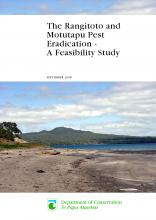
The Rangitoto and Motutapu pest eradication - a feasibility study.
BRB
Available Online

Griffiths, Richard.

,

Towns, David.

2008
The eradication of the seven remaining animal pest species remaining on Rangitoto and Motutapu was announced by the Prime Minister and Minister of Conservation in June 2006. With stoats, cats, hedgehogs, rabbits, mice and two species of rats spread across an area of 3842ha, the proposed project is the most challenging and complex island pest eradication the Department of Conservation (DOC) has ever attempted. To better understand the scale and complexity of the project, a feasibility study was undertaken. This study considered the ecological, economic and social context of the project to allow an informed decision to be made on whether or not to commit resources to further eradication planning. This document outlines the findings of the feasibility study and concludes that while a number of contingencies exist within the project, the proposed eradication is not only feasible, but has many significant benefits. No single precedent exists on which this project can be modelled and information from a wide range of sources has been required. Previous eradication and control programmes have been reviewed in conjunction with what is known about the behaviour and biology of the target species. In some cases, where information has not been available and could not be inferred, trials have been undertaken. The document has been reviewed by a number of experts both within New Zealand and overseas including DOC’s Island Eradication Advisory Group. Consultation has also been undertaken with all of the islands’ key stakeholders and communities of interest. Comments from all of these parties have been reflected in the report. Rangitoto is an iconic Scenic Reserve located just 9km from downtown Auckland City. The island is internationally significant both for its ecology and geology and is an extremely popular visitor destination served by regular ferry services. Motutapu, a Recreation Reserve, is connected to and positioned immediately to the east of Rangitoto. The island, currently managed as a pastoral farm, is noted for its extensive archaeological record but retains a diverse range of habitat types and is the focus of a community-led restoration programme. In addressing the question, ‘can it be done?’ particular attention has been paid to mice, ship rats, hedgehogs and rabbits as eradication of these species on the scale of Rangitoto and Motutapu has never been attempted. Preventing reinvasion on such highly accessible and intensively visited islands is also an enormous undertaking. It is accepted, that of all the target species, mice present the greatest risk of failure. However, while a number of mouse eradications around the world have failed, all ten attempts on islands beyond the swimming range of mice that have followed current Departmental best practice have been successful, providing confidence in the method. Rangitoto and Motutapu are a significant step up from previous operations in terms of scale but are also the logical next step to apply current techniques. Despite the unprecedented elements within the project, it is considered that the key dependencies on which eradication success relies can be met for the species targeted. Preventing reinvasion is perhaps the most important consideration of the feasibility study and the one that will ultimately determine the fate of the project. Achieving an adequate level of protection for the islands hinges heavily on changing the behaviour of all 100,000 visitors that arrive on an annual basis. Without this any investments made in removing pests will be wasted. Bringing these changes about appears possible but is contingent on a number of commitments and actions that must be put in place by both DOC and its key partners. The feasibility study also addresses what the project will take to complete and attempts to identify as many of the planning issues as possible to enable the project to be properly sized. It explores the techniques that must be used, the resources that will be required and the timeframe over which they need to be deployed. While this eradication project is the most challenging and complex to be undertaken by DOC, it also presents a significant opportunity to improve our current understanding of eradication theory and practice. If successful, the project offers outstanding benefits for conservation. The recovery of locally and nationally endangered species, the creation of a stepping stone for wildlife movement between the Hauraki Gulf and the Auckland isthmus, the potential for advocacy and education, and increased recreation and economic opportunities are just some of the likely gains. The study has shown that this project is feasible, but also that there are many significant reasons why it should proceed.
Proceedings of the Helping Islands Adapt Workshop on regional action to combat invasive species on islands to preserve biodiversity and adapt to climate change, 11-16 April, 2010, Auckland, New Zealand
Biodiversity Conservation, BRB
Available Online

Sheppard, Brian

,

Singleton-Cambage, Krista

2010
The Helping Islands Adapt workshop was held in Auckland, New Zealand between the 11th and 16th of April 2010 to support regional action against invasive species on islands, in order to preserve biodiversity and adapt to climate change. It arose from decisions under the Convention on Biological Diversity (CBD) relating to invasive alien species and island biodiversity, and was hosted by the Government of New Zealand with support from a number of partner organisations and countries. The workshop focused on four major island regions: the Caribbean, Coral Triangle, Indian Ocean and Pacific, and involved participation by 82 people from 24 countries and territories, and 29 national, regional and international organisations (see participants list in Appendix 5). The workshop was specifically designed to allow for the maximum exchange of experience and support between representatives from diverse island regions working in invasive species management. It also included a field inspection of one of the Department of Conservation‘s invasive species management projects on Rangitoto Island in Auckland‘s Hauraki Gulf. The workshop built on efforts under the Cooperative Islands Initiative, a partnership launched at the World Summit for Sustainable Development and the CBD 6th Conference of the Parties in 2002. Its intended outputs had been agreed by the organiser‘s steering committee and set out as a 'road map‘ that was used to ensure clarity of the workshop‘s intended purpose, outputs and outcomes. An overview of the workshop, its sponsors, participants and conclusions was developed during the workshop and submitted to the 14th ?Subsidiary Body on Scientific Technical and Technological Advice (SBSSTA 14) to the Convention on Biological Diversity (CBD) in Nairobi 10-21 May 2010. That report is provided in full in Appendix 5 to these proceedings.
Beyond Kapiti - A decade of invasive rodent eradications from New Zealand islands.
BRB
Available Online

Keith Broome

New Zealand, an archipelago of more than 2000 islands, has a terrestrial fauna especially depauperate in native land mammals. Kiore (Rattus exulans) was the first of four rodent species introduced by people. A project to eradicate invasive rats from Kapiti Island in 1996, represented a turning point in the technology, complexity and scale at which managers of natural heritage on New Zealand islands could operate. This paper includes case studies of some significant projects targeting rodents, sometimes with other introduced mammals, undertaken in the 12 years following Kapiti. Details of the methods, costs, results and outcomes are provided for Kapiti, Whenua Hou, Tuhua, Campbell, Raoul, Hauturu, Taukihepa, and Pomona islands, collectively representing a total of over 23,000 ha of habitat cleared of introduced mammals. Research and trials undertaken in the Kapiti project provided the basis for future environmental risk assessments, allowing other projects to focus on knowledge gaps. New trends in invasive species eradication in New Zealand include more challenging multi-species eradication projects, some of which are undertaken by self- funded community groups. To summarise the lessons of the New Zealand experience: a programmatic approach is recommended which will fit each eradication within a context or framework of goals for those islands; address biosecurity issues at the outset; build capability to attempt the most challenging and rewarding projects; facilitate investment in monitoring and manage expectations of stakeholders to ensure their ongoing support. Success breeds success but is never guaranteed.