Search the SPREP Catalogue

Refine Search Results

Tags / Keywords

Available Online

Tags / Keywords

Available Online

1091 result(s) found.

Sort by

You searched for

  • Collection BRB
    X
  • Collection PIPAP
    X
Annotated inventory of invasive social wasps (Hymenoptera, Vespidae) in the South Pacific, excluding Australia and Papua New Guinea
BRB
Available Online

Detoni, Mateus

,

Hayes, Lynley

2026
This paper presents an annotated inventory of the alien social wasps (Hymenoptera: Vespidae: Polistinae, Vespinae) of the South Pacific Oceanic islands, excluding Australia and Papua New Guinea. Here we include information on invasive social wasp distribution, known introductions and establishment dates, and notes on their invasive ecology. Introduced social wasps in the South Pacific consist of 11 species belonging to the Polistinae (Polistes: n = 7) and Vespinae (Dolichovespula: n = 1; Vespa: n = 1; Vespula: n = 2), nine of which are known to have established across the Pacific. Introduced species were recorded in nine countries and territories (Cook Islands, Easter Island, French Polynesia, Fiji, New Caledonia, New Zealand, Niue, Samoa, and Tonga), with the earliest records having happened between the 19th century and the present day. We also provide novel commentary on the ongoing and recently detected incursion of Vespa velutina (an established and impactful invasive species in Europe) into New Zealand. This inventory provides a resource to further understand the invasion biology of social insects and to scaffold risk modelling and management efforts for a taxon of impactful invasive predators in a severely understudied area.
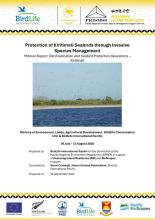
Protection of Kiritimati Seabirds through Invasive Species Management
SPREP Publications, Biodiversity Conservation, BRB
Available Online

Cranwell, Steve

2025
The Wildlife Conservation Unit and BirdLife International successfully completed baiting operations to eradicate Pacific rats from 13 motu including Motu Upua in the Kiritimati Central Lagoon. Four of these motu were previously rat free (Drum islets) and 3 others (Nimroona islets) had been baited in 2023 but rats (and one cat) were confirmed present likely following a reduction in the water level of the lagoon. The 14-day field mission also strengthened WCUs capability for detecting rats and cats and in the use of tools and practices to eradicate them. A suppression response for cats was initiated on Big Peninsula but requires WCU personnel to have regular access to vehicles to operationalise it. Observations of seabirds confirmed Phoenix Petrel numbers remain high for the Drum and Nimroona islets, but few nesting Red-tailed Tropicbirds were observed and may be attributable to the widespread poaching of these and other seabirds. Access to vehicles enabling reinstatement of regular patrols by WCU personnel is considered critical and could be facilitated through specialist expertise and the provision of parts in making repairs to the existing fleet. Other recommendations include a regular surveillance programme for priority islets to detect and respond to rat incursions.