Search the SPREP Catalogue

Refine Search Results

Tags / Keywords

Tags / Keywords

9005 result(s) found.

Sort by

You searched for

  • Available Online Yes
    X
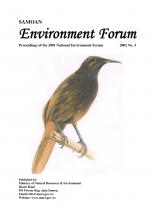
Samoan environment forum proceedings of the National Environment Forum 2001|Mulivai's smart house / Tu'u'u Ieti Taule'alo|Human resource development in Samoa - we are what we culture / Esekia Solofa|Traditional knowledge is the key to sustainable development in Samoa: examples of ecological, botanical and taxonomical knowledge / Namulauulu G.V. Ta'ana|Report of a household fisheries and dietary survey, October - November 2000 / Kelvin Passfield, Mike King, Atonio Mulipola and Etuati Ropeti|Quarantine's non-compliancy is a risk to Samoa's sustainable biodiversity / Kirifi Pouono|Sustainable forest management programmes in Samoa / Aukuso Leavasa|Urban planning and management in Apia - everybody's or nobody's business in 2002 / Paul Johnes and Jude Kohlhase|Tackling land degradation and unsustainable land use in Samoa - with emphasis on the agriculture sector / N.S. Tuivavagi, D.J. Hunter and F. Amosa|Knowing your environment - a survey of how Samoans view their environment / Maria Talaitupu Kerslake|Samoa's development paradox: diversification away from the agriculture - based economy / Tuaopepe F.S. Wendt|Planning for coastal hazards in Samoa / T'u'u'u Ieti Taule'alo and Tagaloa Bismarch Crawley
Available Online

Taulealo, Tu'u'u Ieti

,

Wulf, Violet

2002
Housing in Samoa has undergone tremendous change in the last fifty years. While smaller and less permanent traditional Samoan houses, or fale, are still being widely used the big open round- or oval-shaped fale with thatched roofs have been largely replaced by open rectangular structures with corrugated iron roofs. Within the rural villages more and more families are building European-style dwellings with internal facilities such as kitchens and bathrooms.
Conservation of Kakerori (Pomarea dimidiata) in 2002/2003
Biodiversity Conservation, BRB
Available Online

Robertson, Hugh A.

,

Saul, Edward K.

2002
In 1989, the kakerori (Pomarea dimidiata) was one of the 10 rarest bird species in the world with a declining population of just 29 birds. During each breeding season since then, rats have been poisoned within the 155 ha of forested hill country they occupy in southeastern Rarotonga. As a result, the kakerori population has rebounded, with a minimum of 259 birds being found on Rarotonga in August 2002. In 2001 and 2002, 20 yearlings were transferred to Atiu in the first two of three planned annual transfers to establish an ‘insurance’ population. In January 2003, three pairs of kakerori were found on Atiu, and successful breeding was proven with the discovery of six island-bred (unbanded) birds, belonging to at least two of the pairs. In 2002/03, the emphasis of management in the Takitumu Conservation Area shifted from the ‘recovery’ of kakerori to a programme aimed at ‘sustaining’ the population at about 250 individuals. The key to this work was the experimental reduction of rat poisoning effort, so that 30 territories had the standard weekly refills of poison bait stations, 29 received a fortnightly refill, and 20 received no rat control. As expected, breeding success was significantly better in poisoned areas (with an average of 0.95 fledglings per breeding territory) than in unpoisoned areas (with an average of 0.30 fledglings per breeding territory). This reduced rat control programme took 2–3 person days each week for 15 weeks, and used a total of 43 kg of Talon® (active ingredient brodifacoum), which was about 20% of peak poison use during the ‘recovery’ phase of the programme. The fortnightly poisoning regime offers promise as an effective, cheaper and less toxin-intensive method than that used previously.