Search the SPREP Catalogue

Refine Search Results

Tags / Keywords

Tags / Keywords

9005 result(s) found.

Sort by

You searched for

  • Available Online Yes
    X
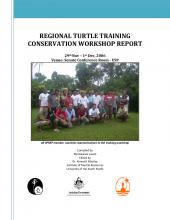
Regional turtle training conservation workshop report, 29 November - 1st December, 2006
Biodiversity Conservation
Available Online

Laveti, Merewalesi

,

MacKay, Dr. Kenneth

2006
The three days Marine Turtle Conservation Workshop in the region reflected an achievement as a successful outcome from the objective of the Turtle Conservation Project in Tuvalu, Fiji and Vanuatu implemented and coordinated by the Institute of Marine Resources (IMR) under the University of the South Pacific (USP). Fellow representatives are from various non government organisation, local community, tourist industry, government officials, SPREP staffs and regional representatives including Samoa, Tuvalu, Tonga, and the Solomon Islands. Altogether, 31 participants attended the workshop. Presentations were conclusively conducted by Dr. Ian Bell (Marine Biologist) assisted by Dr. Ken MacKay (IMR), Aisake Batibasaga (Dept. Fisheries), Alan Resture (IMR) and Lui Bell (SPREP). Participants were basically trained on appropriate scientific research methods on Turtle Conservation, these includes, identifying turtle species, identifying turtle tracks, identifying turtle nesting and feeding grounds, turtle tagging and collating and recording datas. The formulation of the network between representatives would allow information dissemination, increasing in capacity building and education and awareness on turtle conservation at national and regional level. However, SPREP installed the Turtle Research and Monitoring Database System to centralise and secure collated datas and reports on Turtle Research in the region. Conclusively, increasing in efforts, cooperation, networking, management and support on conserving marine turtles will contribute to the rehabilitation and restoring the lost population of the endangered sea turtles in the Pacific.
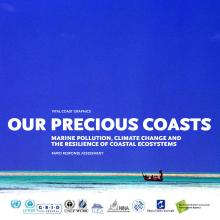
Our precious coasts - Marine pollution, climate change and the resilience of coastal ecosystems
Climate Change Resilience, Waste Management and Pollution Control
Available Online

Corcoran, E.

,

Nellemann, C.

2006
Massive coral bleaching episodes have impacted the function of the reefs and increased rates of mortality. Coral reefs support over one million plant and animal species and their economic value is pro¬jected to more than US $ 30 billion annually. Extreme climatic con¬ditions, however, are most likely to increase in the future with cur¬rent climate scenarios. Projected increases in carbon dioxide and temperature exceed the conditions under which coral reefs have flourished over the past 500 000 years. Coral reefs are crucial bio¬diversity hotspots and support both coastal fisheries and tourism in many regions. Coral reefs, however, are in decline in many regions as a result of numerous pressures, including, but not limited to, extreme climate events, unsustainable fishing practices, diseases, sedimentation, and discharge of untreated sewage. Increasing re¬silience and securing rapid recovery of coral reefs will be essen¬tial for the ability of these ecosystems to support coastal fisheries and coastal livelihoods and cultures in the future. However, this resilience and recovery may be seriously impounded by unsustain¬able coastal infrastructure development and marine pollution from land-based sources. At the current rate of growth, coastal develop¬ment may impact up to 90% of the tropical and temperate coast¬lines by 2032 if development continues unchecked. While progress has been made to reduce the discharge and impacts of oil spills and persistent organic pollutants (POP’s), there now needs to be a focus on the largest current threats to the coastal marine environment : untreated sewage and piecemeal coastal development.