Search the SPREP Catalogue

Refine Search Results

Related Countries

Language

Available Online

Related Countries

Available Online

16 result(s) found.

Sort by

You searched for

  • Available Online Yes
    X
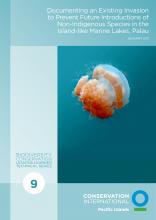
Documenting an existing invasion to prevent future introductions of non-indigenous species in the island-like marine lakes, Koror, Palau
Biodiversity Conservation, BRB
Available Online

Patris, Sharon ... [et al.]

2011
This document is part of a technical report series on conservation projects funded by the Critical Ecosystem Partnership Fund (CEPF) and the Conservation International Pacific Islands Program (CI-Pacific). The main purpose of this series is to disseminate project findings and successes to a broader audience of conservation professionals in the Pacific, along with interested members of the public and students. The reports are being prepared on an ad-hoc basis as projects are completed and written up. In most cases the reports are composed of two parts, the first part is a detailed technical report on the project which gives details on the methodology used, the results and any recommendations. The second part is a brief project completion report written for the donor and focused on conservation impacts and lessons learned. The CEPF fund in the Polynesia-Micronesia region was launched in September 2008 and will be active until 2013. It is being managed as a partnership between CI Pacific and CEPF. The purpose of the fund is to engage and build the capacity of non-governmental organizations to achieve terrestrial conservation. The total grant envelope is approximately US$6 million, and focuses on three main elements: the prevention, control and eradication of invasive species in key biodiversity areas (KBAs); strengthening the conservation status and management of a prioritized set of 60 KBAs and building the awareness and participation of local leaders and community members in the implementation of threatened species recovery plans.
Climate change and water: technical paper of the IPCC
Climate Change Resilience, Biodiversity Conservation
Available Online

Bates, Bryson

,

Kundzewicz, Zbigniew

,

Palutikof Jean

,

Wu, Shaohon Wu

2008
Observational records and climate projections provide abundant evidence that freshwater resources are vulnerable and have the potential to be strongly impacted by climate change, with wide-ranging consequences for human societies and ecosystems. Observed warming over several decades has been linked to changes in the large-scale hydrological cycle such as: increasing atmospheric water vapour content; changing precipitation patterns, intensity and extremes; reduced snow cover and widespread melting of ice; and changes in soil moisture and runoff. Precipitation changes show substantial spatial and inter-decadal variability. Over the 20th century, precipitation has mostly increased over land in high northern latitudes, while decreases have dominated from 10°S to 30°N since the 1970s. The frequency of heavy precipitation events (or proportion of total rainfall from heavy falls) has increased over most areas (likely). Globally, the area of land classified as very dry has more than doubled since the 1970s (likely). There have been significant decreases in water storage in mountain glaciers and Northern Hemisphere snow cover. Shifts in the amplitude and timing of runoff in glacier- and snowmelt-fed rivers, and in ice-related phenomena in rivers and lakes, have been observed (high confidence).