Search the SPREP Catalogue

Refine Search Results

Language

Available Online

Available Online

12 result(s) found.

Sort by

You searched for

  • Available Online Yes
    X
The legacy of Big South Cape: rat irruption to rat eradication
BRB
Available Online

Bell, Brian D.

,

Bell, Elizabeth A.

,

Merton, Don V.

Big South Cape Island (Taukihepa) is a 1040 ha island, 1.5 km from the southwest coast of Stewart Island/Rakiura, New Zealand. This island was rat-free until the incursion of ship rats (Rattus rattus) in, or shortly before, 1963, suspected to have been accidentally introduced via local fishing boats that moored at the island with ropes to the shore, and were used to transport the mutton birders to the island. This incursion was reported by the muttonbirders – local Iwi who harvest the young of titi (sooty shearwater, Puffinus riseus) – to the then New Zealand Wildlife Service (via the New Zealand Department of Lands and Survey). Investigation into the reports found ship rats had reached the island and had decimated the local land bird populations. Brian Bell and Don Merton attempted some of the first translocations of South Island saddleback (Philesturnus c. carunculatus), Stewart Island snipe (Coenocorypha aucklandica iredalei) and Stead’s bush wren (Xenicus longipes variabilis) with only the saddleback being successful. Extinctions of the snipe, wren and greater short-tailed bat (Mystacina robusta) were recorded. This was the first time rats were definitively recognised as the cause of extinction of native land birds and directed further debate into the impacts of rats and how to deal with them.
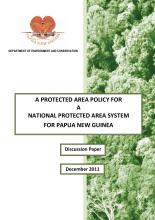
A Protected Area Policy for a National Protected Area System for Papua New Guinea : Discussion paper
Biodiversity Conservation
Available Online

Department of Environment and Conservation

2011
The purpose of this paper is to stimulate a discussion on the issue of protected areas in Papua New Guinea and the development of a strategy to develop a National Protected Area System (NPAS). The need for a comprehensive protected area system is clear from a simple consideration of PNG's domestic and international obligations to protect biodiversity for future generations, in particular the 4th Goal and Directive Principle of the Constitution. The question is not whether PNG should have an NPAS but how we should deliver it so it contributes to poverty reduction and environment protection, whilst protecting the rights of landowners who are interested in their customary land becoming part of the protected area system. The paper provides an overview of the current statue of the protected area system, discusses in critical terms the current approaches to protected area priority setting, selection, establishment and management and lays the groundwork for the development of a National Policy on Protected Areas. The paper does not pretend to have all the answers or to have considered all the issues but has been developed to stimulate discussion and to provide the opportunity for key stakeholders to provide their views as an input to the development of the Government's Policy.