Search the SPREP Catalogue

Refine Search Results

Language

Available Online

Available Online

57 result(s) found.

Sort by

You searched for

  • Available Online Yes
    X
  • Collection Biodiversity Conservation
    X
  • Publication Year 2000
    X
The utilization of seawalls in response to shoreline erosion: consequences, socio-economic, political and legal forces, and alternatives
Biodiversity Conservation
Available Online

Kelly Shawn W

2000
When coastal buildings or roads are threatened, the typical response is to harden the coast with a seawall. Seawalls run parallel to the beach and can be built of concrete, wood, steel, or boulders. Seawalls are also called bulkheads or revetments; the distinction is mainly a matter of purpose. They are designed to halt shoreline erosion caused primarily by wave action. If seawalls are maintained, they may temporarily hold back the ocean from encroaching on shoreline development. In spite of their ability to hold back the ocean, when waves hit a seawall, the waves are reflected back out to sea, taking beach sand with them and eventually causing the beach to disappear. Moreover, seawalls can cause increased erosion at the ends of the seawall on an adjacent beach that is not walled. Alternatives to seawalls exist, such as beach nourishment and managed retreat. Making coastal land use decisions that ensure a seawall will not be needed in the future to protect structures, however, is the most prudent coastal management solution. This can be accomplished by establishing setback lines and conducting managed retreat of structures that are threatened by shoreline erosion before the situation worsens, or structures that have the potential for being threatened in the future. Regional case studies are presented to illustrate.
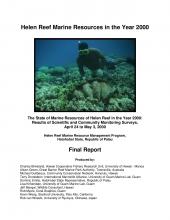
The state of marine resources of Helen reef in the year 2000: results of scientific and community monitoring surveys, April 24 to May 3, 2000 : final report
Biodiversity Conservation
Available Online

Birkeland Charles

2000
Helen Reef in the Southwest Islands of Palau is the one of the greatest marine assets of the Hatohobei (Tobi) People and of the Republic of Palau. Helen Reef is known as one of the most biologically diverse coral reef atolls in the Pacific and historically one of the most biologically abundant reefs in Palau,including acclaimed populations of plentiful marine resources including, trochus, turtles, sea cucumbers, seabirds, and many large reef fish. Reflected in its traditional Hatohobeian name Hotsarihie, which signifies “Reef of the Giant Clam”, Helen Reef is perhaps most famous in the region for its once ubiquitous giant clams, and unfortunately the unchecked foreign poaching that has occurred there over the past decades. The richness and abundance of the atoll’s resources are factors of its location, being remote from human populations and bordering the biodiverse marine eco-regions of Melanesia and SE Asia. The cumulative characteristics of the atoll have attracted many users over time including subsistence fishers from Hatohobei and neighboring islands, sea-faring traders, local businesses interests, and foreign commercial resource operations. The remoteness of Helen Reef which contributes to its historical levels of resource abundance is also a underlying cause for recent resource declines, as the atoll is usually uninhabited and has been notably vulnerable to poaching for the last half century by foreign fishermen from Asian countries