Search the SPREP Catalogue

12 result(s) found.

Sort by

You searched for

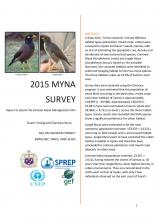
2015 Myna Survey. Report to inform the Samoan Myna Management Plan
Biodiversity Conservation, BRB
Available Online

Serra. G.

,

Young. S

2015
In May 2015, 74 line transects in three different habitat types (plantation, mixed crops, urban) were surveyed on Upolu and Savai’i islands, Samoa, with an aim of estimating the population size, density and distribution of two invasive bird species, Common Myna (Acridotheres tristis) and Jungle Myna (Acridotheres fuscus). Based on the available literature, the surveyed habitats were identified as preferred foraging habitat for the two myna species. The three habitats make up 24.9% of Samoa’s land area. Survey data were analysed using the Distance program. It was estimated that the population of myna birds occurring in the plantation, mixed crops and urban habitats of Samoa is approximately 158,995 (+- 29,588). Approximately 130,030 (+- 19,837) myna were estimated to live on Upolu and 28,968 (+- 9,751) on Savai’i, across the three habitat types. Survey results also revealed that both species show a significant preference for urban habitat. Jungle Myna were estimated to be the most numerous (population estimate: 133,925 +-24,321), occurring on both islands and in all surveyed habitat types. Jungle Myna seem to have saturated the urban habitat available in Upolu and therefore have proceeded to colonise plantations and mixed crops adjacent to urban areas. Common Myna (population estimate: 23,367 +- 7,612), having reached the shores of Samoa ca. 20 years later than Jungle Myna, show highest density in urban environments. They are concentrated in the north-west section of Upolu, with only a few individuals observed on the east coast of Savai’i.
Journal of South Pacific Law : Special Issue - Human Rights and Climate Change Law
Climate Change Resilience
Available Online

Aonima, C. & Kumar, S.

,

Bustreo, F.

,

Doebbler, C.

,

Fa'anunu, F.

,

USP

,

Wewerinke, M. & Fa'anunu, F.

2015
Climate change is often referred to as the defining challenge of our time, and it is well known that Pacific Island States are particularly vulnerable to the adverse effects of climate change. Indeed, these adverse effects are already very tangible for most communities across the region. Coastal features are visibly changing, with rising sea-levels, higher king tides and storm surges, saltwater intrusion and changing weather patterns posing an increasing threat to the livelihoods of Pacific Island communities. The threats are amplified by extreme weather events becoming more intense and more damaging as a result of climate change, with Cyclone Pam recently causing loss of human life and catastrophic damage in Vanuatu, and to a lesser extent in the Solomon Islands, Tuvalu and Kiribati. 2 While communities and governments—assisted by regional, international and nongovernmental organizations—are proactively building resilience and adapting to climate change, there is a real risk of much more severe and damaging impacts materializing in the coming decades.3 The threats are so severe that most, if not all, Pacific Island States face the threat of losing some or all of their habitable territory as a result of climate change, with related risks of the loss of traditional livelihoods and large-scale involuntary displacement