Search the SPREP Catalogue

Refine Search Results

Language

Available Online

Available Online

33 result(s) found.

Sort by

You searched for

  • Author Secretariat of the Pacific Regional Environment Programme
    X
  • Collection Biodiversity Conservation
    X
2015 Myna Survey. Report to inform the Samoan Myna Management Plan
Biodiversity Conservation, BRB
Available Online

Serra. G.

,

Young. S

2015
In May 2015, 74 line transects in three different habitat types (plantation, mixed crops, urban) were surveyed on Upolu and Savai’i islands, Samoa, with an aim of estimating the population size, density and distribution of two invasive bird species, Common Myna (Acridotheres tristis) and Jungle Myna (Acridotheres fuscus). Based on the available literature, the surveyed habitats were identified as preferred foraging habitat for the two myna species. The three habitats make up 24.9% of Samoa’s land area. Survey data were analysed using the Distance program. It was estimated that the population of myna birds occurring in the plantation, mixed crops and urban habitats of Samoa is approximately 158,995 (+- 29,588). Approximately 130,030 (+- 19,837) myna were estimated to live on Upolu and 28,968 (+- 9,751) on Savai’i, across the three habitat types. Survey results also revealed that both species show a significant preference for urban habitat. Jungle Myna were estimated to be the most numerous (population estimate: 133,925 +-24,321), occurring on both islands and in all surveyed habitat types. Jungle Myna seem to have saturated the urban habitat available in Upolu and therefore have proceeded to colonise plantations and mixed crops adjacent to urban areas. Common Myna (population estimate: 23,367 +- 7,612), having reached the shores of Samoa ca. 20 years later than Jungle Myna, show highest density in urban environments. They are concentrated in the north-west section of Upolu, with only a few individuals observed on the east coast of Savai’i.
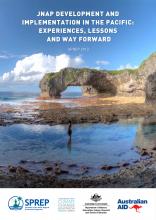
JNAP Development and implementation in the Pacific: Experiences, lessons and way forward.
Climate Change Resilience, Biodiversity Conservation
Available Online

Secretariat of the Pacific Regional Environment Programme

2013
Since 2010, Pacific Island Countries (PICs) have taken steps to develop and implement an integrated action plan, or Joint National Action Plan (JNAP), for climate change (CC) and disaster risk management (DRM). Tonga was the first country to develop its JNAP and to get government approval in July 2010, with several other PICs following suit. The development of a JNAP has been encouraged and facilitated by the Secretariat of the Pacific Regional Environment Programme (SPREP) and the Secretariat of the Pacific Community (SPC) through its Applied Geosciences Division (SOPAC) and multilateral and bilateral development partners such as the United Nations Development Program (UNDP), GIZ and the Government of Australia. Countries have also made efforts to systematically implement their JNAPs by accessing domestic resources and financial resources available through bilateral and multilateral Official Development Assistance (ODA) and climate change finances (CCF). The purpose of this report is to review the JNAP development and implementation process, and assess lessons learnt for future JNAPs in the region. The review focuses on the Cook Islands and Tonga, which have made progress in implementing their JNAP strategies. These countries obtained support from development partners for JNAP implementation. The review also included Tuvalu, which has completed development of its JNAP with Government endorsement, and countries currently in the process of developing their JNAP – Kiribati, Nauru, Niue and the Republic of Marshall Islands. Reference is also made to other countries such as Palau, Solomon Islands and Vanuatu, which chose alternative paths to their integration of CC and DRM.