Search the SPREP Catalogue

Refine Search Results

Publication Year

Available Online

Publication Year

Available Online

4 result(s) found.

Sort by

You searched for

Dispositif de suivi de l'abondance et de l'impact du cerf - Fiche finale de capitalisation - PROTEGE
SPREP Publications, Biodiversity Conservation, BRB
Available Online

PROE / SPREP

2025
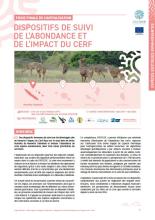
Des dispositifs innovants de suivi ont été développés afin de mesurer l’impact du Cerf Rusa sur le sous-bois de forêts humides de Nouvelle Calédonie et évaluer l’abondance de cette espèce envahissante, dans trois zones prioritaires du territoire. L’élaboration de ces dispositifs poursuit des objectifs complémentaires aux actions de régulation professionnelle mises en œuvre dans le cadre de PROTEGE. Le suivi vise notamment à réaliser un état initial et à évaluer les bénéfices des opérations de régulation, grâce à des outils adaptés à des zones d’intervention difficiles d’accès et caractérisées par une biodiversité exceptionnelle, plus de 80% des espèces végétales des forêts humides d’altitude étant endémiques à la Nouvelle-Calédonie. Un travail initial de sectorisation a permis mieux de caractériser les enjeux, les pressions sur l’environnement ainsi que le contexte socio-économique afin de délimiter les zones d’intervention prioritaires. Pour la première fois en Nouvelle-Calédonie, un protocole standardisé de mesure de l’impact des cerfs a été élaboré. Il s’appuie sur plusieurs indicateurs et prend en compte les spécificités des espèces végétales concernées et des contraintes associées à sa mise en œuvre. En complément, PROTEGE a permis d’élaborer une méthodeinnovante d’évaluation de l’abondance des cerfs, reposant sur l’utilisation d’un drone équipé de capteur thermique pour l’enregistrement de vidéos nocturnes. Un algorithme développé spécifiquement a par ailleurs vocation à réaliser automatiquement les détections à partir de ces vidéos, facilitant considérablement le traitement des données. La mise en œuvre de ce protocole pour la prospection de 4 700 hectares a révélé des densités de populations et des concentrations de hardes localement très élevées, atteignant par endroits des niveaux parmi les plus élevés enregistrés à l’échelle mondiale. Ces résultats fournissent des informations précieuses pour le ciblage de futures interventions et le suivi de leurs bénéfices. FICHE FINALE DE CAPITALISATION DU PROJET PROTEGE, financé par l'Union Européenne.
Initial recolonization of Funafuti atoll coral reefs devasted by hurricane "Bebe"
Biodiversity Conservation
Available Online

Mergner Hans

1985
On the 21st of October, 1972, hurricane "Bebe" devas- tated a large part of Funafuti atoll, Ellice Islands. Among the most spectacular geomorphological alterations caused by the hurricane was a storm beach 19 km long, 4 m high and 37 m wide. The amount of coral debris washed up from the offshore coral reefs onto the reef flat was estimated at 2.8 x 10 tons of material (Baines, Beveridge and Maragos, 1974). The oceanside reef communities of the SE and E rim of the atoll had been totally destroyed, and those of the inner reefs of the lagoon side had been heavily damaged. Eight months after the storm a quantitative analysis of the resettlement and recruitment of coral species on 7 reef sections was carried out: the destruction of the biophysiographic zones could be described as increasing from the northern border and also to the W rim of the atoll. Near the centre at Fongafale the lagoon reef flat was covered by thick carpets of the brown alga Dictyota bartaysii, possibly brought about by eutrophication effects. The resettlement of the reef flat by corals began with the recolonization of branching corals as well as regeneration of the very few surviving massive corals: about 80% of the number of new colonies belong to Acropora (mainly A. humilis and A. hyaclnthus), and about 20% to Pocillopora eydouxi, Porltes lutea (?) and some Faviidae. The percentage of the area settled by the massive coral species is, however, greater than that settled by the branching species. Nevertheless, in the long-term, branching corals are expected to have a decisive influence on the future structural and biophysiographic zonation of the reef edge and reef flat, due to their more numerous young colonies, which are evenly scattered over the reef area, and due to their rapid growth rate. Consequently, an Acropora humilis - hyacinthus-community or an Acropora - Pocillopora eydouxi-assemblage can be predicted as the future biophysiographic zone.