Search the SPREP Catalogue

Refine Search Results

Tags / Keywords

Available Online

Tags / Keywords

Available Online

222 result(s) found.

Sort by

You searched for

  • Author Secretariat of the Pacific Regional Environment Programme (SPREP)
    X
  • Collection Biodiversity Conservation
    X
COP28 PRISMSS Side Event (Summary) - Restoring Island Restoring Island Resilience
Biodiversity Conservation, BRB
Available Online

Secretariat of the Pacific Regional Environment Programme (SPREP)

2024
The Pacific Island nations of Niue and Tonga are leading global efforts to expand the management of invasive species at a large-landscape scale and increase the resilience of their ecosystems and communities to the impacts of climate change. Niue’s Environment Minister, Hon. Mona Ainuu, recently made an ambitious pledge for the country to control four priority invasive species by 2030, including Taro Vine, rats, feral pigs, and the coral eating Drupella snail. This work will help to enhance Niue’s premium ecotourism brand and directly support the provision of green jobs. Tonga has also pledged to expand the management of priority invasive species at a large-landscape scale following the successful eradication of rats from Late Island, the largest eradication ever undertaken in the Pacific Islands region. Studies have shown that, once rats are removed, the nutrients from returning seabird populations restore the climate resilience of coral reefs and increase the productivity of fish stocks by up to 50%. Tonga’s plans to scale-up the management of priority invasive species will help expand its national park system, provide refugia for 95% of the country’s biodiversity, and directly increase the climate resilience of its ecosystems and communities.
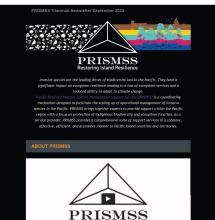
COP28 PRISMSS Side Event -Restoring Island Resilience
Biodiversity Conservation, BRB
Available Online

Secretariat of the Pacific Regional Environment Programme (SPREP)

2024
The Pacific Island nations of Niue and Tonga are leading global efforts to expand the management of invasive species at a large-landscape scale and increase the resilience of their ecosystems and communities to the impacts of climate change. Niue’s Environment Minister, Hon. Mona Ainuu, recently made an ambitious pledge for the country to control four priority invasive species by 2030, including Taro Vine, rats, feral pigs, and the coral eating Drupella snail. This work will help to enhance Niue’s premium ecotourism brand and directly support the provision of green jobs. Tonga has also pledged to expand the management of priority invasive species at a large-landscape scale following the successful eradication of rats from Late Island, the largest eradication ever undertaken in the Pacific Islands region. Studies have shown that, once rats are removed, the nutrients from returning seabird populations restore the climate resilience of coral reefs and increase the productivity of fish stocks by up to 50%. Tonga’s plans to scale-up the management of priority invasive species will help expand its national park system, provide refugia for 95% of the country’s biodiversity, and directly increase the climate resilience of its ecosystems and communities.

Bait colour and moisture do not affect bait acceptance by introduced Pacific rats (Rattus exulans) at Henderson Island, Pitcairn Islands.
Biodiversity Conservation, BRB
Available Online

Bond, A.L.

,

McClelland, G.T.W.

,

O’Keefe, S.

,

Warren, P.

2019
Rodent eradications are a useful tool for the restoration of native biodiversity on islands, but occasionally these operations incur non-target mortality. Changes in cereal bait colour could potentially mitigate these impacts but must not compromise the eradication operation. Changing bait colour may reduce mortality of Henderson crakes (Zapornia atra), an endemic globally threatened flightless bird on Henderson Island, Pitcairn Islands, South Pacific Ocean. Crakes had high non-target mortality in a failed 2011 rat eradication operation and consumed fewer blue than green cereal pellets. We examined which cereal bait properties influenced its acceptance by captive Pacific rats (Rattus exulans) on Henderson Island. We held 82 Pacific rats from Henderson Island in captivity and provided them with non-toxic cereal bait pellets of varying properties (blue or green, moist or dry). We estimated the proportion of rats consuming bait using logistic generalised linear mixed models. We found no effect of sex, females’ reproductive status, bait colour or bait moisture on rats’ willingness to consume baits. Rats’ bait consumption was unaffected by cereal bait properties (colour or moisture). The use of blue bait is unlikely to affect future eradication operational success but may reduce non-target mortality of Henderson crakes. Timing cereal bait distribution in relation to precipitation may also reduce crake mortality without compromising palatability to rats.