Search the SPREP Catalogue

Refine Search Results

Related Countries

Language

Available Online

Related Countries

Available Online

24 result(s) found.

Sort by

You searched for

Journal of South Pacific Law : Special Issue - Human Rights and Climate Change Law
Climate Change Resilience
Available Online

Aonima, C. & Kumar, S.

,

Bustreo, F.

,

Doebbler, C.

,

Fa'anunu, F.

,

USP

,

Wewerinke, M. & Fa'anunu, F.

2015
Climate change is often referred to as the defining challenge of our time, and it is well known that Pacific Island States are particularly vulnerable to the adverse effects of climate change. Indeed, these adverse effects are already very tangible for most communities across the region. Coastal features are visibly changing, with rising sea-levels, higher king tides and storm surges, saltwater intrusion and changing weather patterns posing an increasing threat to the livelihoods of Pacific Island communities. The threats are amplified by extreme weather events becoming more intense and more damaging as a result of climate change, with Cyclone Pam recently causing loss of human life and catastrophic damage in Vanuatu, and to a lesser extent in the Solomon Islands, Tuvalu and Kiribati. 2 While communities and governments—assisted by regional, international and nongovernmental organizations—are proactively building resilience and adapting to climate change, there is a real risk of much more severe and damaging impacts materializing in the coming decades.3 The threats are so severe that most, if not all, Pacific Island States face the threat of losing some or all of their habitable territory as a result of climate change, with related risks of the loss of traditional livelihoods and large-scale involuntary displacement
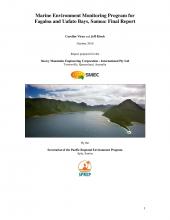
Marine environment monitoring programme for Fagaloa and Uafato bays, Samoa : final report
Available Online

Kinch, Jeff

,

Vieux, Caroline

2010
The Asian Development Bank through its contractor, the Snowy Mountain Engineering.Corporation were tasked with exploring the potential of augmenting the capacity of the Afulilo Reservoir to power a third turbine at the Ta’elafaga Hydro-power Station. To assist in this augmentation assessment, SMEC arranged with the Secretariat of the Pacific Regional Environment Program to oversight a consortium of partners to conduct a 11 month monitoring program with the purpose of assessing the status of the marine environment, particularly the coral reefs, as well as water quality in the Fagaloa and Uafato Bays. The data from the 2009-1010 marine monitoring program implies that several sites in Fagaloa Bay are exhibiting signs of various impacts from various inputs into the marine environment, which are most notable at sites 1, 2, and 14. These sites are closest to the apex of Fagaloa Bay where the Ta’elefaga Creek discharges into. Impacts for these sites include low or no coral cover and recruitment, growth in algal cover, lower salinity levels, higher rates of sedimentation and turbidity, as well as high nutrient inputs. Fish biomass at site 14 was also the lowest (sites 1 and 2 were not surveyed due to poor visibility). Other specific results across all sites include a reduction in live coral cover, a general shift to more hardier coral species, and low fish bio-mass when compared with other sites in Samoa.