Search the SPREP Catalogue

Refine Search Results

Available Online

Available Online

109 result(s) found.

Sort by

You searched for

  • Author Forum Secretariat
    X
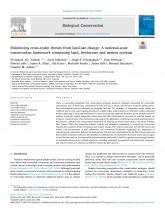
Minimizing cross-relam threats from land-use change: A national-scale conservation framework connecting land, freshwater and marine system
Environmental Governance, Biodiversity Conservation
Available Online

Atkinson, S.

,

Peterson, N

,

Possingham, H P

,

Tulloch, V J D.

,

et al.

2021
There is a growing recognition that conservation strategies should be designed accounting for cross-realm connections, such as freshwater connections to land and sea, to ensure effectiveness of marine spatial protection and minimize perverse outcomes of changing land-use. Yet, examples of integration across realms are relatively scarce, with most targeting priorities in a single realm, such as marine or freshwater, while minimizing threats originating in terrestrial ecosystems. To date, no study has optimized priorities across multiple realms to produce a spatially explicit integrated conservation plan that simultaneously accounts for multiple human activities at a national scale. This represents a major gap in the application of existing cross-realm planning theory. We present a national scale conservation framework for selecting protected areas using a case study of Papua New Guinea (PNG) that integrates multiple systems and ecological connectivity to account for cross-realm benefits and minimize threats of land-use and climate change. The relative importance of both the forests and inshore reef environments to PNG subsistence and commercial livelihoods emphasizes the importance of considering the connections between the land and sea. The plan was commissioned by the PNG Conservation and Environment Protection Authority and identifies a comprehensive set of priorities that meet conservation targets in both the land and sea. Our national-scale prioritization framework is useful for agencies and managers looking to implement actions given multiple objectives, including watershed management and biodiversity protection, and ensures actions are efficient and effective across the land and sea.
Quantification and magnitude of losses and damages resulting from the impacts of climate change: modelling the transformational impacts and costs of sea level rise in the Caribbean
Climate Change Resilience
Available Online

Simpson, M.C...[et al.]

2010
The inextricable links between climate change and sustainable development have been increasingly recognised over the past decade. In 2007, the Intergovernmental Panel on Climate Change (IPCC)1 concluded with very high confidence that climate change would impede the ability of many nations to achieve sustainable development by mid-century and become a security risk that would steadily intensify, particularly under greater warming scenarios. Article 4.8 of the United Nations Framework Convention on Climate Change (UNFCCC) lists several groups of countries that merit particular consideration for assistance to adapt to climate change “especially: (a) small island countries, (b) countries with low-lying coastal areas, c) countries with areas prone to natural disasters.” Small Island Developing States (SIDS) have characteristics which make them particularly vulnerable to the effects of climate change, sea level rise (SLR) and extreme events, including: relative isolation, small land masses, concentrations of population and infrastructure in coastal areas, limited economic base and dependency on natural resources, combined with limited financial, technical and institutional capacity for adaptation.2