
Search the SPREP Catalogue

3 result(s) found.

Sort by

You searched for

  • Author Faletau, Taniela
    X
  • Publication Year 2012
    X
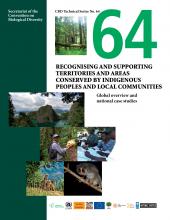
Recognising and Supporting Territories and Areas Conserved by Indigenous Peoples and Local Communities
Available Online

Corrigan, Colleen,

,

Jonas, Harry

,

Kothari, Ashish

,

Neumann, Aurélie

,

Shrumm, Holly (eds.)

2012
Indigenous peoples and local communities have managed and protected a variety of natural environments and species for a variety of reasons, cultural, spiritual and aesthetic, as well as socio-economic. Today, there are many thousands of indigenous territories and other areas conserved by indigenous peoples and local communities across the world. Indigenous peoples’ and local communities’ conserved territories and areas (ICCAs) are natural and/or modified ecosystems containing significant biodiversity values, ecological services and cultural values, voluntarily conserved by indigenous peoples and local communities, both sedentary and mobile, through customary laws or other effective means. They help maintain genetic diversity, conserve threatened species, and provide corridors for species’ movements. The cultural and economic livelihoods of millions of people depend on them for securing resources such as energy, food, water, fodder, shelter, clothing, and for providing income. ICCAs contribute to global food security by conserving important crop wild relatives, and traditional and threatened landraces. ICCAs play a critical role in ensuring access and respecting rights to customary sustainable use of biodiversity and also provide a fertile classroom for the passing on of inter-generational environmental knowledge, innovations and practices.
Strategies and on the ground options for climate change adaptation and disaster risk management in the Pacific
Climate Change Resilience
Available Online

Faletau, Taniela

,

Leavai, Peniamina

,

McFadzien, Diane

,

Ronneberg, Espen

2012
Small Island developing states (SIDS) have ongoing projects and projects in the pipeline which are targeted at implementing adaptation measures. In the Pacific alone there have been a range of such initiatives starting with the PICCAP project in the late 90s to the ongoing PACC project, the latter building on the lessons learnt from its predecessors to help increase resilience to the impacts of climate change. On a global, regional and national level these projects have stringently involved strengthening of institutions, policy and regulations, but more importantly evolved to implement on the ground-level tasks, many of which follow on from, or are acting in synergy with other projects for the mainstreaming of climate change adaptation (CCA) and disaster risk reduction (DRR) initiatives in communities. A key challenge in this context for decision makers, policy makers, and development partners is to understand and adopt strategies that are effective in mobilizing people and resources in response to CCA and DRR. All efforts in this context must be made to learn from past lessons and concerted action taken to refine, augment and deploy these initiatives appropriately and urgently.
Pacific Island States capacity development needs for climate change adaptation and disaster risk reduction
Climate Change Resilience, Biodiversity Conservation
Available Online

Faletau, Taniela

,

Leavai, Peniamina

,

McFadzien, Diane

,

Ronneberg, Espen

2012
This paper provides a brief examination of capacity development needs for climate change adaptation (CCA) and disaster risk reduction (DRR) in small island developing states (SIDS). It is noted that this is a critical time for SIDS which must contend with ongoing developmental pressures in addition to growing pressures from risks associated with global environmental change and economic liberalisation that threaten their physical and economic security. Much depends in this context on the orientation of SIDS in global economic and political systems. Getting the policies right is proving to be very difficult as SIDS continue to be deficient in a critical mass of intellectual capital, policy coherence, financial resources and qualified personnel that are needed to develop and implement sustainable development policies and projects. In turn, this critically hampers the emergence of adequate systemic capacity. SIDS however have a history of changes at the global and regional levels which not only created constraints but can be seen as a source of new opportunities for building resilience to natural disasters. How effective this process transpires in the end will depend on how well lessons learnt from preceding years are taken on board and effectively acted upon.