Search the SPREP Catalogue

Refine Search Results

Related Countries

Language

Available Online

Related Countries

Available Online

14 result(s) found.

Sort by

You searched for

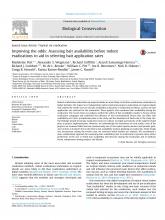
Special Issue Article: Tropical rat eradication. Improving the odds: Assessing bait availability before rodent eradications to aid in selecting bait application rates. Biological Conservation. Volume 185, May 2015
Biodiversity Conservation, BRB
Available Online

Berentsen. A.R

,

Brooke. M.L

,

Cuthbert. R.J

,

Griffiths. R.

,

Holmes. N.D

,

Howald. G.R

,

Pitt. W.C

,

Pott. M

,

Ramos-Rend¢n. G

,

Russell. J.C

,

Samaniego-Herrera. A

,

Wegmann. A.S

2015
Rodent eradications undertaken on tropical islands are more likely to fail than eradications undertaken at higher latitudes. We report on 12 independent rodent eradication projects undertaken on tropical islands that utilized the results of an in situ bait availability study prior to eradication to inform, a priori, the bait application rate selected for the eradication. These projects also monitored bait availability during the eradication. The results from our analysis verified the utility of bait availability studies to future rodent eradication campaigns and confirmed the influence of two environmental factors that can affect bait availability over time: precipitation prior to the study and the abundance of land crabs at the study site. Our findings should encourage eradication teams to conduct in-depth assessments of the targeted island prior to project implementation. However, we acknowledge the limitations of such studies (two of the projects we reviewed failed and one removed only one of two rodent species present) and provide guidance on how to interpret the results from a bait availability study in planning an eradication. Study design was inconsistent among the twelve cases we reviewed which limited our analysis. We recommend a more standardized approach for measuring bait availability prior to eradication to provide more robust predictions of the rate at which bait availability will decrease during the eradication and to facilitate future comparisons among projects and islands.
Samoan Environment Forum: proceedings of the 2005 National Environment Forum|The fact-or-myth of Samoan cultural heritage: personal reflections on family oral history / Tu'u'u Ieti Taule'alo|Samoan and Japan: concerns over mangroves development / Juliet Boon-Nanai|Status of hawksbill turtle nesting in Samoa, 2003/2004 / Mauigoa Lui Bell, Malama S. Momoemausu, Juney Ward & Malaki Iakopo|Participatory approaches for environmental initiatives - community consultation in Samoa / Natalie Mitchell|Emotional intelligence, management concept: a contributing factor for effective service delivery / Mulipola Ausetalia Titimaea|Tropical cyclone forecasting: theory and practical application - case study of tropical cyclone Olaf 2005 / Sala Sagato Tuiafiso|Samoa and the World Heritage Convention - is Samoa ready for world heritage listing / Tuiolo Schuster|Exploring the status of tsunami early warning systems in Samoa / Shaun P. Williams & Aliimalemanu F.M. Leavasa|Determination of a mean daily discharge values for Faleaseela River: implications for population water demand / Masina Nagau Chun, Iosefatu Eti & Mulipola A. Titimaea
Available Online

MNRE

2006
The community based conservation (CBC)paradigm predicts that sustainable biodiversity can only be achieved if local people perceive benefits from conservation. Through interviews, the situation in Samoa portrays that the CBC of mangroves was received with apprehension because the mangrove biodiversity was more significant than sustaining the livelihood of the local communities. In contrast, Iriomote Island residents were able to achieve maximum socio-economic benefits but to the extent that they were over commercializing the mangrove ecosystem. More research is imperative to find out how biodiversity conservation can be married with sustainable development objectives to sustain the local communities' livelihood.