Search the SPREP Catalogue

Refine Search Results

8 result(s) found.

Sort by

You searched for

  • Author Broome, K.
    X
  • Collection BRB
    X
The history of the aerial application of rodenticide in New Zealand
Biodiversity Conservation, BRB
Available Online

Broome, K.

,

Garden, P.

,

McClelland, P.

2019
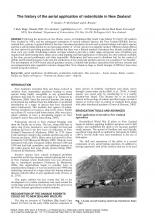
Following the incursion of rats (Rattus rattus) on Taukihepa (Big South Cape Island; 93.9 km²) off southern New Zealand in 1963, and the subsequent extirpation of several endemic species, the New Zealand Wildlife Service realised that, contrary to general belief at the time, introduced predators do not reach a natural balance with native species and that a safe breeding habitat for an increasing number of ‘at risk’ species was urgently needed. Off shore islands offered the best option for providing predator free habitat but there was a limited number of predator-free islands available and most were very small. Eradicating rodents on larger islands to provide a wider range and greater area of habitats was required and hand treating these larger areas using trapping and hand application of toxicants, the only methods available at the time, proved problematic and often impossible. Helicopters had been used to distribute bait for the control of rabbits and brushtail possums in the past but eradication of any particular predator species was considered ‘not feasible’. The development of a GPS-based aircraft guidance system, a suitable bait product, specialised bait delivery systems and second-generation anti-coagulant toxicants changed that. Now islands as large as South Georgia (3,900 km²) have been treated using this method
House mice on islands: management and lessons from New Zealand
Biodiversity Conservation, BRB
Available Online

Birmingham,C.

,

Broome, K.

,

Brown, D.

,

Brown, K.

,

Corson, P.

,

Cox, A.

,

Golding, C.

,

Griffiths, R.

,

Murphy, E.

2019
The impacts of house mice (Mus musculus), one of four invasive rodent species in New Zealand, are only clearly revealed on islands and fenced sanctuaries without rats and other invasive predators which suppress mouse populations, influence their behaviour, and confound their impacts. When the sole invasive mammal on islands, mice can reach high densities and influence ecosystems in similar ways to rats. Eradicating mice from islands is not as difficult as previously thought, if best practice techniques developed and refined in New Zealand are applied in association with diligent planning and implementation. Adopting this best practice approach has resulted in successful eradication of mice from several islands in New Zealand and elsewhere including some of the largest ever targeted for mice; in multi-species eradications; and where mouse populations were still expanding after recent invasion. Prevention of mice reaching rodent-free islands remains an ongoing challenge as they are inveterate stowaways, potentially better swimmers than currently thought, and prolific breeders in predator-free habitat. However, emergent mouse populations can be detected with conventional surveillance tools and eradicated before becoming fully established if decisive action is taken early enough. The invasion and eventual eradication of mice on Maud Island provides a case study to illustrate New Zealand-based lessons around mouse biosecurity and eradication.
Feasibility of eradicating the large white butterfly (Pieris brassicae) from New Zealand: data gathering to inform decisions about the feasibility of eradication
Biodiversity Conservation, BRB
Available Online

Broome, K.

,

Brown, K.

,

Green, C.

,

Phillips, C.B.

,

Toft, R.

,

Walker, G.

2019
Pieris brassicae, large white butter?y, was ?rst found in New Zealand in Nelson in May 2010. The Ministry for Primary Industries (MPI) responded with a monitoring programme until November 2012 when the Department of Conservation (DOC) commenced an eradication programme. DOC was highly motivated to eradicate P. brassicae by the risk it posed to New Zealand endemic cress species, some of which are already nearly extinct. DOC eliminated the butter?y from Nelson in less than four years at a cost of ca. NZ$5 million. This is the ?rst time globally that a butter?y has been purposefully eradicated. Variation in estimates of bene?ts, costs, the e?cacy of detection and control tools, and the probability of eradication success all contributed to uncertainty about the feasibility. Cost bene?t analyses can contribute to assessing feasibility but are prone to inaccurate assumptions when data are limited, and other feasibility questions are equally important in considering the best course of action. Uncertainty does not equate to risk and reducing uncertainty through data gathering can inform feasibility and decision making while increasing the probability of eradication success.
Special Issue Article: Tropical rat eradicationNon-target species mortality and the measurement of brodifacoum rodenticide residues after a rat (Rattus rattus) eradication on Palmyra Atoll, tropical Pacific. Biological Conservation. Volume 185, May 2015
Biodiversity Conservation, BRB
Available Online

Berentsen. A.R

,

Eisemann. J.D

,

Howaldd. G .R.

,

Pitt. W.C

,

Shiels. A.B

,

Volker. S.F

,

Wegmann. A.S

2015
The use of rodenticides to control or eradicate invasive rats (Rattus spp.) for conservation purposes has rapidly grown in the past decades, especially on islands. The non-target consequences and the fate of toxicant residue from such rodent eradication operations have not been well explored. In a cooperative effort, we monitored the application of a rodenticide, ‘Brodifacoum 25W: Conservation’, during an attempt to eradicate Rattus rattus from Palmyra Atoll. In 2011, Brodifacoum 25W: Conservation was aerially broadcasted twice over the entire atoll (2.5 km2) at rates of 80 kg/ha and 75 kg/ha and a supplemental hand broadcast application (71.6 kg/ha) occurred three weeks after the second aerial application over a 10 ha area. We documented brodifacoum residues in soil, water, and biota, and documented mortality of non-target organisms. Some bait (14–19% of the target application rate) entered the marine environment to distances 7 m from the shore. After the application commenced, carcasses of 84 animals representing 15 species of birds, fish, reptiles and invertebrates were collected opportunistically as potential non-target mortalities. In addition, fish, reptiles, and invertebrates were systematically collected for residue analysis. Brodifacoum residues were detected in most (84.3%) of the animal samples analyzed. Although detection of residues in samples was anticipated, the extent and concentrations in many parts of the food web were greater than expected. Risk assessments should carefully consider application rates and entire food webs prior to operations using rodenticides.
Special Issue Article: Tropical rat eradication. The next generation of rodent eradications: Innovative technologies and tools to improve species specificity and increase their feasibility on islands. Biological Conservation. Volume 185, May 2015
Biodiversity Conservation, BRB
Available Online

Baxter. G.S.

,

Beek. J

,

Campbell K.J

,

Eason C.T

,

Glen A.S

,

Godwin. J

,

Gould. F

,

Holmes. N.D

,

Howald. G.R

,

Madden F.M

,

Ponder J.B

,

Threadgill. D.W

,

Wegmann. A.S

2015
Rodents remain one of the most widespread and damaging invasive alien species on islands globally. The current toolbox for insular rodent eradications is reliant on the application of sufficient anticoagulant toxicant into every potential rodent territory across an island. Despite significant advances in the use of these toxicants over recent decades, numerous situations remain where eradication is challenging or not yet feasible. These include islands with significant human populations, unreceptive stakeholder communities, co-occurrence of livestock and domestic animals, or vulnerability of native species. Developments in diverse branches of science, particularly the medical, pharmaceutical, invertebrate pest control, social science, technology and defense fields offer potential insights into the next generation of tools to eradicate rodents from islands. Horizon scanning is a structured process whereby current problems are assessed against potential future solutions. We undertook such an exercise to identify the most promising technologies, techniques and approaches that might be applied to rodent eradications from islands. We highlight a Rattus-specific toxicant, RNA interference as species-specific toxicants, rodenticide research, crab deterrent in baits, prophylactic treatment for protection of non-target species, transgenic rodents, virus vectored immunocontraception, drones, self-resetting traps and toxicant applicators, detection probability models and improved stakeholder community engagement methods. We present a brief description of each method, and discuss its application to rodent eradication on islands, knowledge gaps, challenges, whether it is incremental or transformative in nature and provide a potential timeline for availability. We outline how a combination of new tools may render previously intractable rodent eradication problems feasible.
Special Issue Article: Tropical rat eradication. Improving the odds: Assessing bait availability before rodent eradications to aid in selecting bait application rates. Biological Conservation. Volume 185, May 2015
Biodiversity Conservation, BRB
Available Online

Berentsen. A.R

,

Brooke. M.L

,

Cuthbert. R.J

,

Griffiths. R.

,

Holmes. N.D

,

Howald. G.R

,

Pitt. W.C

,

Pott. M

,

Ramos-Rend¢n. G

,

Russell. J.C

,

Samaniego-Herrera. A

,

Wegmann. A.S

2015
Rodent eradications undertaken on tropical islands are more likely to fail than eradications undertaken at higher latitudes. We report on 12 independent rodent eradication projects undertaken on tropical islands that utilized the results of an in situ bait availability study prior to eradication to inform, a priori, the bait application rate selected for the eradication. These projects also monitored bait availability during the eradication. The results from our analysis verified the utility of bait availability studies to future rodent eradication campaigns and confirmed the influence of two environmental factors that can affect bait availability over time: precipitation prior to the study and the abundance of land crabs at the study site. Our findings should encourage eradication teams to conduct in-depth assessments of the targeted island prior to project implementation. However, we acknowledge the limitations of such studies (two of the projects we reviewed failed and one removed only one of two rodent species present) and provide guidance on how to interpret the results from a bait availability study in planning an eradication. Study design was inconsistent among the twelve cases we reviewed which limited our analysis. We recommend a more standardized approach for measuring bait availability prior to eradication to provide more robust predictions of the rate at which bait availability will decrease during the eradication and to facilitate future comparisons among projects and islands.
Special Issue Article: Tropical rat eradicationFactors associated with rodent eradication failure. Biological Conservation. Volume 185, May 2015
Biodiversity Conservation, BRB
Available Online

Alifano. A

,

Griffiths.R

,

Holmes. N.D

,

Pott. M

,

Russell. J.C.

,

Wegmann. A.S

,

Will.D

2015
Invasive rodents have an overwhelmingly detrimental impact to native flora and fauna on islands. Rodent eradications from islands have led to valuable biodiversity conservation outcomes. Tropical islands present an additional suite of challenges for rat eradications due to unique characteristics associated with these environments. To date tropical island rat eradications have failed at a higher rate than those undertaken outside the tropics. Critical knowledge gaps exist in our understanding of what drives this outcome. We collated an in-depth dataset of 216 rodenticide based rat eradication operations (33% of all known rodent eradications) in order to determine correlates of eradication failure, including both project implementation factors and target island ecology, geography and climate. We assessed both failed and successful projects, and projects inside and outside the tropics, using random forests, a statistical approach which compensates for high dimensionality within, and correlation among, predictor variables. When assessing all projects, increasing mean annual temperature, particularly above 24 °C, underscored the higher failure rate and greater difficulty of rodent eradications on islands in lower latitudes. We also found clear trends in eradication failure for factors unique to the tropics, including the presence of land crabs – burrowing and hermit crabs, and coconut palms (Cocos nucifera). The presence of agriculture was also associated with failure. Aerial operations had a higher success rate than ground-based methods but success with this technique was less likely in the presence of hermit crabs and other non-target bait consumers. Factors associated with failure in ground-based eradication methods suggested limitations to project scaling such as island area and number of staff. Bait station operations were less likely to succeed when using stopping rules based on measures of rodent abundance. Factors influencing rat eradication failure in tropical environments continue to require a deeper understanding of tropical island dynamics to achieve a higher rate of eradication success.