Search the SPREP Catalogue

7 result(s) found.

Sort by

You searched for

  • Author Broome, K.
    X
  • Author Griffiths, R.
    X
  • Publication Year 2019
    X
Multi island, multi invasive species eradication in French Polynesia demonstrates economies of scale
Available Online

Coulston, G.

,

Cranwell, S.

,

Derand, D.

,

Ghestemme, T.

,

Griffiths, R.

,

Hall, T.

,

Pott, M.

,

Will, D.

,

Zito, J.

2019
Eradication of invasive vertebrates on islands has proven to be one of the most effective returns on investment for biodiversity conservation. To recover populations of the critically endangered Polynesian ground dove (Gallicolumba erythroptera), the endangered white-throated storm-petrel (Nesofregetta fuliginosa), the endangered Tuamotu sandpiper (Prosobonia cancellata) as well as other native plant and animal species, a project was undertaken to eradicate five species of invasive alien vertebrates: Pacific rat (Rattus exulans), ship rat (R. rattus), feral cat (Felis catus), rabbit (Oryctolagus cuniculus) and goat (Capra hircus), on six islands spanning 320 km of open ocean in the Tuamotu and Gambier Archipelagos of French Polynesia. Using a ship to deliver supplies and equipment, a helicopter for offloading and bait application, and ground teams for follow up trapping and hunting, invasive vertebrates were successfully removed from five of the six islands. Pacific rats survived at one site. The project was planned and executed by a partnership consisting of international and local conservation NGO’s, working together with local communities. Combining the different eradication operations into one expedition added complexity to project planning and implementation and increased the risk of the operation failing on any one island but generated greater returns on investment allowing six islands to be targeted at significantly less cost than if each island had been completed individually. An extensive and thorough planning effort, effective relationships with local stakeholders and communities, a good operational strategy and a partnership of stakeholders that each brought complementary capacities to the project contributed to its success.
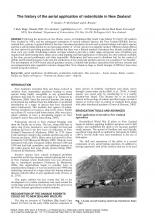
The history of the aerial application of rodenticide in New Zealand
Biodiversity Conservation, BRB
Available Online

Broome, K.

,

Garden, P.

,

McClelland, P.

2019
Following the incursion of rats (Rattus rattus) on Taukihepa (Big South Cape Island; 93.9 km²) off southern New Zealand in 1963, and the subsequent extirpation of several endemic species, the New Zealand Wildlife Service realised that, contrary to general belief at the time, introduced predators do not reach a natural balance with native species and that a safe breeding habitat for an increasing number of ‘at risk’ species was urgently needed. Off shore islands offered the best option for providing predator free habitat but there was a limited number of predator-free islands available and most were very small. Eradicating rodents on larger islands to provide a wider range and greater area of habitats was required and hand treating these larger areas using trapping and hand application of toxicants, the only methods available at the time, proved problematic and often impossible. Helicopters had been used to distribute bait for the control of rabbits and brushtail possums in the past but eradication of any particular predator species was considered ‘not feasible’. The development of a GPS-based aircraft guidance system, a suitable bait product, specialised bait delivery systems and second-generation anti-coagulant toxicants changed that. Now islands as large as South Georgia (3,900 km²) have been treated using this method
Successes and failures of rat eradications on tropical islands: a comparative review of eight recent projects
Biodiversity Conservation, BRB
Available Online

Brown, D.

,

Cranwell, S.

,

Cuthbert, R.J.

,

Griffiths, R.

,

Howald, G.

,

Keitt, B.

,

Pitt, W.C.

,

Tershy, B.

,

Wegmann, A.

2019
Rat eradication is a highly effective tool for conserving biodiversity, but one that requires considerable planning eff ort, a high level of precision during implementation and carries no guarantee of success. Overall, rates of success are generally high but lower for tropical islands where most biodiversity is at risk. We completed a qualitative comparative review on four successful and four unsuccessful tropical rat eradication projects to better understand the factors influencing the success of tropical rat eradications and shed light on how the risk of future failures can be minimised. Observations of juvenile rats surviving more than four weeks after bait application on two islands validate the previously considered theoretical risk that unweaned rats can remain isolated from exposure to rodent bait for a period. Juvenile rats emerging after bait was no longer readily available may have been the cause of some or all the project failures. The elevated availability of natural resources (primarily fruiting or seeding plants) generated by rainfall prior to project implementation(documented for three of the unsuccessful projects) may also have contributed to project failure by reducing the likelihood that all rats would consume sufficient rodent bait or compounding other factors such as rodent breeding. Our analysis highlights that rat eradication can be achieved on tropical islands but suggests that events that cannot be predicted with certainty in some tropical regions can act individually or in concert to reduce the likelihood of project success. We recommend research to determine the relative importance of these factors in the fate of future tropical projects and suggest that existing practices be re-evaluated for tropical island rodent eradications.
House mice on islands: management and lessons from New Zealand
Biodiversity Conservation, BRB
Available Online

Birmingham,C.

,

Broome, K.

,

Brown, D.

,

Brown, K.

,

Corson, P.

,

Cox, A.

,

Golding, C.

,

Griffiths, R.

,

Murphy, E.

2019
The impacts of house mice (Mus musculus), one of four invasive rodent species in New Zealand, are only clearly revealed on islands and fenced sanctuaries without rats and other invasive predators which suppress mouse populations, influence their behaviour, and confound their impacts. When the sole invasive mammal on islands, mice can reach high densities and influence ecosystems in similar ways to rats. Eradicating mice from islands is not as difficult as previously thought, if best practice techniques developed and refined in New Zealand are applied in association with diligent planning and implementation. Adopting this best practice approach has resulted in successful eradication of mice from several islands in New Zealand and elsewhere including some of the largest ever targeted for mice; in multi-species eradications; and where mouse populations were still expanding after recent invasion. Prevention of mice reaching rodent-free islands remains an ongoing challenge as they are inveterate stowaways, potentially better swimmers than currently thought, and prolific breeders in predator-free habitat. However, emergent mouse populations can be detected with conventional surveillance tools and eradicated before becoming fully established if decisive action is taken early enough. The invasion and eventual eradication of mice on Maud Island provides a case study to illustrate New Zealand-based lessons around mouse biosecurity and eradication.
Applying lessons learnt from tropical rodent eradications: a second attempt to remove invasive rats from Desecheo National Wildlife Refuge, Puerto Rico
Biodiversity Conservation, BRB
Available Online

Figuerola-Hernandez, C.E.

,

Griffiths, R.

,

Herrera-Giraldo, J.L.

,

Howald, G.R.

,

Keitt, B.

,

Silander, S.

,

Swinnerton, K.

,

Will, D.J.

2019
The introduction of invasive rats, goats, and rhesus macaques to Desecheo National Wildlife Refuge, Puerto Rico led to the extirpation of regionally signifi cant seabird colonies and negatively impacted plant and endemic reptile species. In 2012, following the successful removal of goats and macaques from Desecheo, an attempt to remove black rats using aerially broadcast rodenticide and bait stations was unsuccessful. A review of the operation suggested that the most likely contributors to the failure were: unusually high availability of alternative foods resulting from higher than average rainfall, and insufficient bait availability. In 2016, a second, successful attempt to remove rats was conducted that incorporated best practice guidelines developed during a workshop that focused on addressing the higher failure rate observed when removing rats from tropical islands. Project partners developed a decision-making process to assess the risks to success posed by environmental conditions and established go/no-go decision points leading up to implementation. Observed environmental conditions appeared suitable, and the operation was completed using aerial broadcast of bait in two applications with a target sowing rate of 34 kg/ha separated by 22 days. Application rates achieved on the ground were stratified such that anticipated high risk areas in the cliff s and valleys received additional bait. We consider the following to be key to the success of the second attempt: 1) monitoring environmental conditions prior to the operation, and proceeding only if conditions were conducive to success, 2) reinterpretation of bait availability data using the lower 99% confidence interval to inform application rates and ensure sufficient coverage across the entire island, 3) treating the two applications as independent, 4) increasing the interval between applications, 5) seeking regulatory approval to give the operational team sufficient flexibility to ensure a minimum application rate at every point on the island, and 6) being responsive to operational monitoring and making any necessary adjustments.
Feasibility of eradicating the large white butterfly (Pieris brassicae) from New Zealand: data gathering to inform decisions about the feasibility of eradication
Biodiversity Conservation, BRB
Available Online

Broome, K.

,

Brown, K.

,

Green, C.

,

Phillips, C.B.

,

Toft, R.

,

Walker, G.

2019
Pieris brassicae, large white butter?y, was ?rst found in New Zealand in Nelson in May 2010. The Ministry for Primary Industries (MPI) responded with a monitoring programme until November 2012 when the Department of Conservation (DOC) commenced an eradication programme. DOC was highly motivated to eradicate P. brassicae by the risk it posed to New Zealand endemic cress species, some of which are already nearly extinct. DOC eliminated the butter?y from Nelson in less than four years at a cost of ca. NZ$5 million. This is the ?rst time globally that a butter?y has been purposefully eradicated. Variation in estimates of bene?ts, costs, the e?cacy of detection and control tools, and the probability of eradication success all contributed to uncertainty about the feasibility. Cost bene?t analyses can contribute to assessing feasibility but are prone to inaccurate assumptions when data are limited, and other feasibility questions are equally important in considering the best course of action. Uncertainty does not equate to risk and reducing uncertainty through data gathering can inform feasibility and decision making while increasing the probability of eradication success.