Search the SPREP Catalogue

Refine Search Results

Related Countries

Language

Publication Year

Available Online

Related Countries

Publication Year

Available Online

5 result(s) found.

Sort by

You searched for

  • Author Broome, K.
    X
  • Collection BRB
    X
Global Economic Costs of Aquatic Invasive Alien Species
Biodiversity Conservation, BRB
Available Online

Ahmed, Danish A.

,

Angulo, Elena

,

Briski, Elizabeta

,

Capinha, César

,

Catford, Jane A.

,

Cuthbert, Ross N.

,

Dalu, Tatenda

,

Diagne, Christophe

,

Essl, Franz

,

Gozlan, Rodolphe E.

,

Leroy, Boris

,

Pattison, Zarah

,

Taylor, Nigel G.

,

Verbrugge, Laura

2021
Much research effort has been invested in understanding ecological impacts of invasive alien species (IAS) across ecosystems and taxonomic groups, but empirical studies about economic effects lack synthesis. Using a comprehensive global database, we determine patterns and trends in economic costs of aquatic IAS by examining: (i) the distribution of these costs across taxa, geographic regions, and cost types; (ii) the temporal dynamics of global costs; and (iii) knowledge gaps, especially compared to terrestrial IAS. Based on the costs recorded from the existing literature, the global cost of aquatic IAS conservatively summed to US$345 billion, with the majority attributed to invertebrates (62%), followed by vertebrates (28%), then plants (6%). The largest costs were reported in North America (48%) and Asia (13%) and were principally a result of resource damages (74%); only 6% of recorded costs were from management. The magnitude and number of reported costs were highest in the United States of America and for semi-aquatic taxa. Many countries and known aquatic alien species had no reported costs, especially in Africa and Asia. Accordingly, a network analysis revealed limited connectivity among countries, indicating disparate cost reporting. Aquatic IAS costs have increased in recent decades by several orders of magnitude, reaching at least US$23 billion in 2020. Costs are likely considerably underrepresented compared to terrestrial IAS; only 5% of reported costs were from aquatic species, despite 26% of known invaders being aquatic. Additionally, only 1% of aquatic invasion costs were from marine species. Costs of aquatic IAS are thus substantial, but likely underreported. Costs have increased over time and are expected to continue rising with future invasions. We urge increased and improved cost reporting by managers, practitioners and researchers to reduce knowledge gaps. Few costs are proactive investments; increased management spending is urgently needed to prevent and limit current and future aquatic IAS damages.
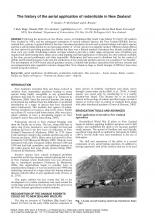
The history of the aerial application of rodenticide in New Zealand
Biodiversity Conservation, BRB
Available Online

Broome, K.

,

Garden, P.

,

McClelland, P.

2019
Following the incursion of rats (Rattus rattus) on Taukihepa (Big South Cape Island; 93.9 km²) off southern New Zealand in 1963, and the subsequent extirpation of several endemic species, the New Zealand Wildlife Service realised that, contrary to general belief at the time, introduced predators do not reach a natural balance with native species and that a safe breeding habitat for an increasing number of ‘at risk’ species was urgently needed. Off shore islands offered the best option for providing predator free habitat but there was a limited number of predator-free islands available and most were very small. Eradicating rodents on larger islands to provide a wider range and greater area of habitats was required and hand treating these larger areas using trapping and hand application of toxicants, the only methods available at the time, proved problematic and often impossible. Helicopters had been used to distribute bait for the control of rabbits and brushtail possums in the past but eradication of any particular predator species was considered ‘not feasible’. The development of a GPS-based aircraft guidance system, a suitable bait product, specialised bait delivery systems and second-generation anti-coagulant toxicants changed that. Now islands as large as South Georgia (3,900 km²) have been treated using this method
House mice on islands: management and lessons from New Zealand
Biodiversity Conservation, BRB
Available Online

Birmingham,C.

,

Broome, K.

,

Brown, D.

,

Brown, K.

,

Corson, P.

,

Cox, A.

,

Golding, C.

,

Griffiths, R.

,

Murphy, E.

2019
The impacts of house mice (Mus musculus), one of four invasive rodent species in New Zealand, are only clearly revealed on islands and fenced sanctuaries without rats and other invasive predators which suppress mouse populations, influence their behaviour, and confound their impacts. When the sole invasive mammal on islands, mice can reach high densities and influence ecosystems in similar ways to rats. Eradicating mice from islands is not as difficult as previously thought, if best practice techniques developed and refined in New Zealand are applied in association with diligent planning and implementation. Adopting this best practice approach has resulted in successful eradication of mice from several islands in New Zealand and elsewhere including some of the largest ever targeted for mice; in multi-species eradications; and where mouse populations were still expanding after recent invasion. Prevention of mice reaching rodent-free islands remains an ongoing challenge as they are inveterate stowaways, potentially better swimmers than currently thought, and prolific breeders in predator-free habitat. However, emergent mouse populations can be detected with conventional surveillance tools and eradicated before becoming fully established if decisive action is taken early enough. The invasion and eventual eradication of mice on Maud Island provides a case study to illustrate New Zealand-based lessons around mouse biosecurity and eradication.
Feasibility of eradicating the large white butterfly (Pieris brassicae) from New Zealand: data gathering to inform decisions about the feasibility of eradication
Biodiversity Conservation, BRB
Available Online

Broome, K.

,

Brown, K.

,

Green, C.

,

Phillips, C.B.

,

Toft, R.

,

Walker, G.

2019
Pieris brassicae, large white butter?y, was ?rst found in New Zealand in Nelson in May 2010. The Ministry for Primary Industries (MPI) responded with a monitoring programme until November 2012 when the Department of Conservation (DOC) commenced an eradication programme. DOC was highly motivated to eradicate P. brassicae by the risk it posed to New Zealand endemic cress species, some of which are already nearly extinct. DOC eliminated the butter?y from Nelson in less than four years at a cost of ca. NZ$5 million. This is the ?rst time globally that a butter?y has been purposefully eradicated. Variation in estimates of bene?ts, costs, the e?cacy of detection and control tools, and the probability of eradication success all contributed to uncertainty about the feasibility. Cost bene?t analyses can contribute to assessing feasibility but are prone to inaccurate assumptions when data are limited, and other feasibility questions are equally important in considering the best course of action. Uncertainty does not equate to risk and reducing uncertainty through data gathering can inform feasibility and decision making while increasing the probability of eradication success.