Search the SPREP Catalogue

Refine Search Results

Related Countries

Language

Available Online

Related Countries

Available Online

12 result(s) found.

Sort by

You searched for

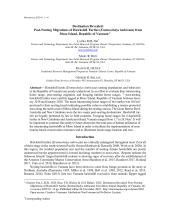
Destination Revealed: Post-Nesting Migrations of Hawksbill Turtles (Eretmochelys imbricata) from Moso Island, Republic of Vanuatu.
Biodiversity Conservation
Available Online

Balazs, George H.

,

Hickey, Francis R.

,

Jim, Laura M. R

,

Rice, Marc R.

2022
Hawksbill turtle (Eretmochelys imbricata) nesting populations and behaviors in the Republic of Vanuatu are poorly understood. In an effort to evaluate their internesting home range, post-nesting migration and foraging habitat home ranges, 7 post-nesting hawksbill turtles were satellite tagged at Moso Island, Republic of Vanuatu between January 2018 and January 2020. The mean internesting home ranges of two turtles was 0.8 km2 proximal to their nesting beach indicating possible value in establishing a marine protected area along the north coast of Moso Island during the nesting season. The Great Barrier Reef, Australia and New Caledonia were the two major post-nesting destinations. Hawksbill turtles are legally protected by law in both countries. Foraging home ranges for 4 hawksbill turtles in New Caledonia and Aneityum Island, Vanuatu ranged from 1.7 to 28.9 km2. It will be important to continue this study to better determine the total area of habitat utilization of the internesting hawksbills at Moso Island in order to facilitate the implementation of community-based conservation measures and to illuminate home range location and size.
Quantification and magnitude of losses and damages resulting from the impacts of climate change: modelling the transformational impacts and costs of sea level rise in the Caribbean
Climate Change Resilience
Available Online

Simpson, M.C...[et al.]

2010
The inextricable links between climate change and sustainable development have been increasingly recognised over the past decade. In 2007, the Intergovernmental Panel on Climate Change (IPCC)1 concluded with very high confidence that climate change would impede the ability of many nations to achieve sustainable development by mid-century and become a security risk that would steadily intensify, particularly under greater warming scenarios. Article 4.8 of the United Nations Framework Convention on Climate Change (UNFCCC) lists several groups of countries that merit particular consideration for assistance to adapt to climate change “especially: (a) small island countries, (b) countries with low-lying coastal areas, c) countries with areas prone to natural disasters.” Small Island Developing States (SIDS) have characteristics which make them particularly vulnerable to the effects of climate change, sea level rise (SLR) and extreme events, including: relative isolation, small land masses, concentrations of population and infrastructure in coastal areas, limited economic base and dependency on natural resources, combined with limited financial, technical and institutional capacity for adaptation.2
An overview of modeling climate change : impacts in the Caribbean region with contribution from the Pacific Islands, United Nations Development Programme (UNDP), Barbados, West Indies
Climate Change Resilience, Biodiversity Conservation
Available Online

Simpson, M.C...[et al.]

2009
The nations of CARICOM16 in the Caribbean together with Pacific island countries contribute less than 1% to global greenhouse gas (GHG) emissions (approx. 0.33%17 and 0.03%18 respectively), yet these countries are expected to be among the earliest and most impacted by climate change in the coming decades and are least able to adapt to climate change impacts. These nations’ relative isolation, small land masses, their concentrations of population and infrastructure in coastal areas, limited economic base and dependency on natural resources, combined with limited financial, technical and institutional capacity all exacerbates their vulnerability to extreme events and climate change impacts. Stabilising global GHG emissions and obtaining greater support for adaptation strategies are fundamental priorities for the Caribbean Basin and Pacific island countries. CARICOM leaders recently unveiled their collective position that global warming should be held to no more than 1.5°C19 and continue to develop a Climate Change Strategic Plan. The Pacific island countries have expressed their priorities for addressing climate change regionally through the Pacific Leaders’ Call to Action on Climate Change20 and the Pacific Islands Framework for Action on Climate Change 2006-2015.21