Search the SPREP Catalogue

Refine Search Results

Language

Available Online

Available Online

92 result(s) found.

Sort by

You searched for

  • Author Asian Development Bank
    X
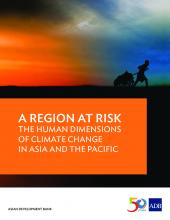
A region at risk - The human dimensions of climate change in Asia and the Pacific
Climate Change Resilience, Biodiversity Conservation
Available Online

Asian Development Bank

2017
The Asia and Pacific region is extremely vulnerable to the impacts of climate change. Unabated warming could significantly undo previous achievements of economic development and improvements of living standards. At the same time, the region has both the economic capacity and weight of influence to change the present fossil-fuel based development pathway and curb global emissions. This report sheds light on the regional implications of the latest projections of changes in climate conditions over Asia and the Pacific. The assessment concludes that, even under the Paris consensus scenario in which global warming is limited to 1.5°C to 2°C above preindustrial levels, some of the land area, ecosystems, and socioeconomic sectors will be significantly affected by climate change impacts, to which policy makers and the investment community need to adapt to. However, under a Business-As-Usual (BAU) scenario, which will cause a global mean temperature rise of over 4°C by the end of this century, the possibilities for adaptation are drastically reduced. Among others, climate change impacts such as the deterioration of the Asian “water towers”, prolonged heat waves, coastal sea-level rise and changes in rainfall patterns could disrupt ecosystem services and lead to severe effects on livelihoods which in turn would affect human health, migration dynamics and the potential for conflicts. This assessment also underlines that, for many areas vital to the region’s economy, research on the effects of climate change is still lacking.
Extreme weather and climate events and their impacts on island countries in the Western Pacific: cyclones, floods and droughts
Climate Change Resilience, Biodiversity Conservation
Available Online

Atalifo, Terry

,

Bipen, Prakash

,

Charles, Andrew

,

Cottrill, Andrew

,

Jones, David

,

Kuleshov, Yuriy

,

McGree, Simon

,

Nihmei, Salesa

,

Seuseu, Fata Lagomauitumua Sunny K.

2014
Increases in the frequency of extreme weather and climate events and the severity of their impacts on the natural environment and society have been observed across the globe in recent decades. In addition to natural climate variability and greenhouse-induced climate change, extreme weather and climate events produce the most pronounced impacts. In this paper, the climate of three island countries in the Western Pacific: Fiji, Samoa and Tuvalu, has been analysed. Warming trends in annual average maximum and minimum temperatures since the 1950s have been identified, in line with the global warming trend. We present recent examples of extreme weather and climate events and their impacts on the island countries in the Western Pacific: the 2011 drought in Tuvalu, the 2012 floods in Fiji and a tropical cyclone, Evan, which devastated Samoa and Fiji in December 2012. We also relate occurrences of the extreme weather and climate events to phases of the El Niño-Southern Oscillation (ENSO) phenomenon. The impacts of such natural disasters on the countries are severe and the costs of damage are astronomical. In some cases, climate extremes affect countries to such an extent that governments declare a national state of emergency, as occurred in Tuvalu in 2011 due to the severe drought’s impact on water resources. The projected increase in the frequency of weather and climate extremes is one of the expected consequences of the observed increase in anthropogenic greenhouse gas concentration and will likely have even stronger negative impacts on the natural environment and society in the future. This should be taken into consideration by authorities of Pacific Island Countries and aid donors when developing strategies to adapt to the increasing risk of climate extremes. Here we demonstrate that the modern science of seasonal climate prediction is well developed, with current dynamical climate models being able to provide skilful predictions of regional rainfall two-three months in advance. The dynamic climate model-based forecast products are now disseminated to the National Meteorological Services of 15 island countries in the Western Pacific through a range of web-based information tools. We conclude with confidence that seasonal climate prediction is an effective solution at the regional level to provide governments and local communities of island nations in the Western Pacific with valuable assistance for informed decision making for adaptation to climate variability and change.