Search the SPREP Catalogue

Refine Search Results

Language

Available Online

Available Online

30 result(s) found.

Sort by

You searched for

  • Available Online Yes
    X
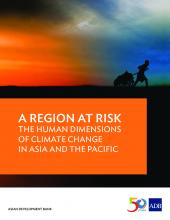
A region at risk - The human dimensions of climate change in Asia and the Pacific
Climate Change Resilience, Biodiversity Conservation
Available Online

Asian Development Bank

2017
The Asia and Pacific region is extremely vulnerable to the impacts of climate change. Unabated warming could significantly undo previous achievements of economic development and improvements of living standards. At the same time, the region has both the economic capacity and weight of influence to change the present fossil-fuel based development pathway and curb global emissions. This report sheds light on the regional implications of the latest projections of changes in climate conditions over Asia and the Pacific. The assessment concludes that, even under the Paris consensus scenario in which global warming is limited to 1.5°C to 2°C above preindustrial levels, some of the land area, ecosystems, and socioeconomic sectors will be significantly affected by climate change impacts, to which policy makers and the investment community need to adapt to. However, under a Business-As-Usual (BAU) scenario, which will cause a global mean temperature rise of over 4°C by the end of this century, the possibilities for adaptation are drastically reduced. Among others, climate change impacts such as the deterioration of the Asian “water towers”, prolonged heat waves, coastal sea-level rise and changes in rainfall patterns could disrupt ecosystem services and lead to severe effects on livelihoods which in turn would affect human health, migration dynamics and the potential for conflicts. This assessment also underlines that, for many areas vital to the region’s economy, research on the effects of climate change is still lacking.
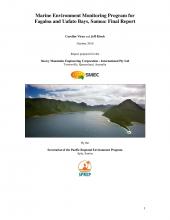
Marine environment monitoring programme for Fagaloa and Uafato bays, Samoa : final report
Available Online

Kinch, Jeff

,

Vieux, Caroline

2010
The Asian Development Bank through its contractor, the Snowy Mountain Engineering.Corporation were tasked with exploring the potential of augmenting the capacity of the Afulilo Reservoir to power a third turbine at the Ta’elafaga Hydro-power Station. To assist in this augmentation assessment, SMEC arranged with the Secretariat of the Pacific Regional Environment Program to oversight a consortium of partners to conduct a 11 month monitoring program with the purpose of assessing the status of the marine environment, particularly the coral reefs, as well as water quality in the Fagaloa and Uafato Bays. The data from the 2009-1010 marine monitoring program implies that several sites in Fagaloa Bay are exhibiting signs of various impacts from various inputs into the marine environment, which are most notable at sites 1, 2, and 14. These sites are closest to the apex of Fagaloa Bay where the Ta’elefaga Creek discharges into. Impacts for these sites include low or no coral cover and recruitment, growth in algal cover, lower salinity levels, higher rates of sedimentation and turbidity, as well as high nutrient inputs. Fish biomass at site 14 was also the lowest (sites 1 and 2 were not surveyed due to poor visibility). Other specific results across all sites include a reduction in live coral cover, a general shift to more hardier coral species, and low fish bio-mass when compared with other sites in Samoa.