Search the SPREP Catalogue

Refine Search Results

Language

Available Online

Available Online

87 result(s) found.

Sort by

You searched for

  • Author Asian Development Bank
    X
Invasive rat eradication strongly impacts plant recruitment on a tropical atoll
BRB
Available Online

Croll, Donald A.

,

Dirzo, Rodolfo.

,

Holmes, Nick D.

,

Kropidlowski, Stefan.

,

McKown, Matthew.

,

Tershy, Bernie R.

,

Wegmann, Alexander S.

,

Wolf, Coral A.

,

Young, Hillary S.

,

Zilliacus, Kelly M.

2018
Rat eradication has become a common conservation intervention in island ecosystems and its effectiveness in protecting native vertebrates is increasingly well documented. Yet, the impacts of rat eradication on plant communities remain poorly understood. Here we compare native and non-native tree and palm seedling abundance before and after eradication of invasive rats (Rattus Rattus) from Palmyra Atoll, Line Islands, Central Pacific Ocean. Overall, seedling recruitment increased for five of the six native trees species examined. While pre-eradication monitoring found no seedlings of Pisonia grandis, a dominant tree species that is important throughout the Pacific region, post-eradication monitoring documented a notable recruitment event immediately following eradication, with up to 688 individual P. grandis seedlings per 100m2 recorded one month post-eradication. Two other locally rare native trees with no observed recruitment in pre-eradication surveys had recruitment post-rat eradication. However, we also found, by five years post-eradication, a 13-fold increase in recruitment of the naturalized and range-expanding coconut palm Cocos nucifera. Our results emphasize the strong effects that a rat eradication can have on tree recruitment with expected long-term effects on canopy composition. Rat eradication released nonnative C. nucifera, likely with long-term implications for community composition, potentially necessitating future management interventions. Eradication, nevertheless, greatly benefited recruitment of native tree species. If this pattern persists over time, we expect long-term benefits for flora and fauna dependent on these native species.
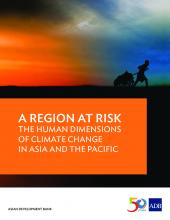
A region at risk - The human dimensions of climate change in Asia and the Pacific
Climate Change Resilience, Biodiversity Conservation
Available Online

Asian Development Bank

2017
The Asia and Pacific region is extremely vulnerable to the impacts of climate change. Unabated warming could significantly undo previous achievements of economic development and improvements of living standards. At the same time, the region has both the economic capacity and weight of influence to change the present fossil-fuel based development pathway and curb global emissions. This report sheds light on the regional implications of the latest projections of changes in climate conditions over Asia and the Pacific. The assessment concludes that, even under the Paris consensus scenario in which global warming is limited to 1.5°C to 2°C above preindustrial levels, some of the land area, ecosystems, and socioeconomic sectors will be significantly affected by climate change impacts, to which policy makers and the investment community need to adapt to. However, under a Business-As-Usual (BAU) scenario, which will cause a global mean temperature rise of over 4°C by the end of this century, the possibilities for adaptation are drastically reduced. Among others, climate change impacts such as the deterioration of the Asian “water towers”, prolonged heat waves, coastal sea-level rise and changes in rainfall patterns could disrupt ecosystem services and lead to severe effects on livelihoods which in turn would affect human health, migration dynamics and the potential for conflicts. This assessment also underlines that, for many areas vital to the region’s economy, research on the effects of climate change is still lacking.