Search the SPREP Catalogue

Refine Search Results

Available Online

Available Online

407 result(s) found.

Sort by

You searched for

  • Author UNEP
    X
  • Author Asian Development Bank
    X
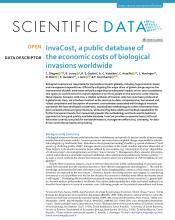
InvaCost, a Public Database of the Economic Costs of Biological Invasions Worldwide
Biodiversity Conservation, BRB
Available Online

Assailly, C.

,

Courchamp, F.

,

Diagne, C.

,

Gozlan, R. E.

,

Jarić, I.

,

Jourdain, F.

,

Leroy, B.

,

Nuninger, L.

,

Roiz, D.

,

Vaissière, A.-C.

2020
Biological invasions are responsible for tremendous impacts globally, including huge economic losses and management expenditures. Efficiently mitigating this major driver of global change requires the improvement of public awareness and policy regarding its substantial impacts on our socio-ecosystems. One option to contribute to this overall objective is to inform people on the economic costs linked to these impacts; however, until now, a reliable synthesis of invasion costs has never been produced at a global scale. Here, we introduce InvaCost as the most up-to-date, comprehensive, harmonised and robust compilation and description of economic cost estimates associated with biological invasions worldwide. We have developed a systematic, standardised methodology to collect information from peer-reviewed articles and grey literature, while ensuring data validity and method repeatability for further transparent inputs. Our manuscript presents the methodology and tools used to build and populate this living and publicly available database. InvaCost provides an essential basis (2419 cost estimates currently compiled) for worldwide research, management efforts and, ultimately, for datadriven and evidence-based policymaking.
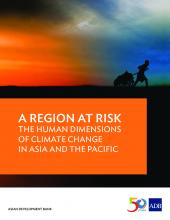
A region at risk - The human dimensions of climate change in Asia and the Pacific
Climate Change Resilience, Biodiversity Conservation
Available Online

Asian Development Bank

2017
The Asia and Pacific region is extremely vulnerable to the impacts of climate change. Unabated warming could significantly undo previous achievements of economic development and improvements of living standards. At the same time, the region has both the economic capacity and weight of influence to change the present fossil-fuel based development pathway and curb global emissions. This report sheds light on the regional implications of the latest projections of changes in climate conditions over Asia and the Pacific. The assessment concludes that, even under the Paris consensus scenario in which global warming is limited to 1.5°C to 2°C above preindustrial levels, some of the land area, ecosystems, and socioeconomic sectors will be significantly affected by climate change impacts, to which policy makers and the investment community need to adapt to. However, under a Business-As-Usual (BAU) scenario, which will cause a global mean temperature rise of over 4°C by the end of this century, the possibilities for adaptation are drastically reduced. Among others, climate change impacts such as the deterioration of the Asian “water towers”, prolonged heat waves, coastal sea-level rise and changes in rainfall patterns could disrupt ecosystem services and lead to severe effects on livelihoods which in turn would affect human health, migration dynamics and the potential for conflicts. This assessment also underlines that, for many areas vital to the region’s economy, research on the effects of climate change is still lacking.