Search the SPREP Catalogue

Refine Search Results

Related Countries

Material Type

Available Online

Related Countries

Material Type

Available Online

92 result(s) found.

Sort by

You searched for

  • Author PACC
    X
Rapport technique du projet PROTEGE relatif à l’enquête auprès des chasseurs sur les chèvres ensauvagées à Maré
SPREP Publications, Biodiversity Conservation, BRB
Available Online

ANCB

2023
Dans le cadre du projet PROTEGE une enquête a été réalisée à Maré par l’Agence néo-Calédonienne de la Biodiversité (ANCB) auprès des chasseurs de chèvres ensauvagées. Les objectifs sont d’évaluer les pratiques et l’effort de chasse, le niveau de prélèvements, la capacité et la volonté de diversifier les techniques de chasse et à augmenter l’effort de chasse, au regard des dégâts constatés. Les chèvres ensauvagées (ou férales, Capra hircus) contribuent à la raréfaction de nombreuses espèces végétales natives et à la dispersion et au développement de plusieurs plantes introduites envahissantes. Aux Îles Loyauté des troupeaux de chèvres sont présents sur une grande partie des corniches littorales de Lifou et de Maré, où la chasse de la chèvre ensauvagée répond principalement à un besoin pour les dons et coutumes, et pour l’autoconsommation. Une pré-enquête a été réalisée par l’animateur PROTEGE (également agent de l’ANCB), afin de recenser les chasseurs de chèvres férales sur Maré et de prendre leurs contacts pour la réalisation de l’enquête. Dans un deuxième temps, l’ensemble des chasseurs de chèvres ensauvagées identifiés ont été contactés afin de répondre à l’enquête.
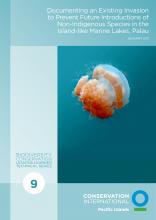
Documenting an existing invasion to prevent future introductions of non-indigenous species in the island-like marine lakes, Koror, Palau
Biodiversity Conservation, BRB
Available Online

Patris, Sharon ... [et al.]

2011
This document is part of a technical report series on conservation projects funded by the Critical Ecosystem Partnership Fund (CEPF) and the Conservation International Pacific Islands Program (CI-Pacific). The main purpose of this series is to disseminate project findings and successes to a broader audience of conservation professionals in the Pacific, along with interested members of the public and students. The reports are being prepared on an ad-hoc basis as projects are completed and written up. In most cases the reports are composed of two parts, the first part is a detailed technical report on the project which gives details on the methodology used, the results and any recommendations. The second part is a brief project completion report written for the donor and focused on conservation impacts and lessons learned. The CEPF fund in the Polynesia-Micronesia region was launched in September 2008 and will be active until 2013. It is being managed as a partnership between CI Pacific and CEPF. The purpose of the fund is to engage and build the capacity of non-governmental organizations to achieve terrestrial conservation. The total grant envelope is approximately US$6 million, and focuses on three main elements: the prevention, control and eradication of invasive species in key biodiversity areas (KBAs); strengthening the conservation status and management of a prioritized set of 60 KBAs and building the awareness and participation of local leaders and community members in the implementation of threatened species recovery plans.