Search the SPREP Catalogue

22 result(s) found.

Sort by

You searched for

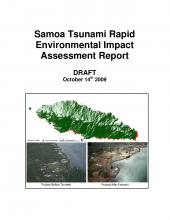
Samoa Tsunami rapid environmental impact assessment report: draft October 14th 2009
Biodiversity Conservation
Available Online

Ifopo, Pulea Etiseli

2009
A rapid assessment of the environmental impacts of the 29 September tsunami was conducted by a multi-agency team from 3 to 14 October, 2009. Fourteen “green” and 10 “brown” environmental variables were selected and measured based on the experience of the survey team and similar reports from elsewhere. During a tour of the affected area on Upolu by car and on foot those “assessable” variables were scored “high” (over two thirds affected), “medium” (over one third, less than two thirds affected), “low” (less than a third affected) or zero (unaffected). Manono and Savaii were surveyed by air with the former showing evidence of some damage and the later apparently none or very little. The most affected areas in Upolu were villages in the Aleipata, Lepa and Falealili districts with the most obvious indicators of the tsunami’s impact being solid waste (sometimes resulting from the complete destruction of a village), erosion of the beach and fore-shore and the (expected) impact on marine resources. Other environmental variables assessed also showed similar patterns. Impacts on a wharf/dry dock facility are also described (including lost fuel drums) as are the possible environmental implications of new settlements created by displaced persons (mainly revolving around sanitation, drainage and water supply).
Mainstreaming climate change in ADB's operations: climate change implementation plan for the Pacific Islands 2009-2015 Part 1: main report : Consultation draft; Part 2: Appendices, consultation draft
Climate Change Resilience, Biodiversity Conservation
Available Online

ADB

2009
This Climate Change Implementation Plan (CCIP) for the Pacific Regional Department (PARD) of the Asian Development Bank (ADB) describes the areas of focus for PARD's operations and identifies key gaps between country and ADB actions, as well as opportunities for scaling up ADB's assistance related to mitigation, adaptation and associated cross-cutting needs. This gap analysis points to recommended interventions in regional and country programs for additional technical assistance (TA) and financial assistance, including access to new climate funds and adoption of new financing mechanisms. These include multi-donor Climate Investment Funds (Clean Technology Fund and Strategic Climate Fund), ADB's Future Carbon Fund, and possibly a new Sustainable Fuel Credits mechanism to promote reduced petroleum consumption. The CCIP will evolve through periodic updates in order to effectively guide ongoing and future programs and TA and project design. Going forward, specific climate change interventions will continue to be incorporated into the Country Partnership Strategy (CPS) and Country Operations Business Plan (COBP) for each Pacific Developing Member Country (PDMC) and into the Regional Operations Business Plan (ROBP) for the Pacific region as a whole. TA and investment projects will be designed, taking into consideration regional and country variations in governance, institutional capacity, and geographic and local environmental conditions.