Search the SPREP Catalogue

Refine Search Results

Tags / Keywords

Available Online

Tags / Keywords

Available Online

2162 result(s) found.

Sort by

You searched for

  • Subject Protected areas - Management
    X
The loss of species: mangrove extinction risk and geographic areas of Global concern
Available Online

Polidoro, Beth A.

2010
Mangrove species are uniquely adapted to tropical and subtropical coasts, and although relatively low in number of species, mangrove forests provide at least US $1.6 billion each year in ecosystem services and support coastal livelihoods worldwide. Globally, mangrove areas are declining rapidly as they are cleared for coastal development and aquaculture and logged for timber and fuel production. Little is known about the effects of mangrove area loss on individual mangrove species and local or regional populations. To address this gap, species-specific information on global distribution, population status, life history traits, and major threats were compiled for each of the 70 known species of mangroves. Each species’ probability of extinction was assessed under the Categories and Criteria of the IUCN Red List of Threatened Species. Eleven of the 70 mangrove species (16%) are at elevated threat of extinction. Particular areas of geographical concern include the Atlantic and Pacific coasts of Central America, where as many as 40% of mangroves species present are threatened with extinction. Across the globe, mangrove species found primarily in the high intertidal and upstream estuarine zones, which often have specific freshwater requirements and patchy distributions, are the most threatened because they are often the first cleared for development of aquaculture and agriculture. The loss of mangrove species will have devastating economic and environmental consequences for coastal communities, especially in those areas with low mangrove diversity and high mangrove area or species loss. Several species at high risk of extinction may disappear well before the next decade if existing protective measures are not enforced.
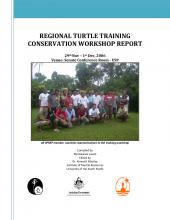
Regional turtle training conservation workshop report, 29 November - 1st December, 2006
Biodiversity Conservation
Available Online

Laveti, Merewalesi

,

MacKay, Dr. Kenneth

2006
The three days Marine Turtle Conservation Workshop in the region reflected an achievement as a successful outcome from the objective of the Turtle Conservation Project in Tuvalu, Fiji and Vanuatu implemented and coordinated by the Institute of Marine Resources (IMR) under the University of the South Pacific (USP). Fellow representatives are from various non government organisation, local community, tourist industry, government officials, SPREP staffs and regional representatives including Samoa, Tuvalu, Tonga, and the Solomon Islands. Altogether, 31 participants attended the workshop. Presentations were conclusively conducted by Dr. Ian Bell (Marine Biologist) assisted by Dr. Ken MacKay (IMR), Aisake Batibasaga (Dept. Fisheries), Alan Resture (IMR) and Lui Bell (SPREP). Participants were basically trained on appropriate scientific research methods on Turtle Conservation, these includes, identifying turtle species, identifying turtle tracks, identifying turtle nesting and feeding grounds, turtle tagging and collating and recording datas. The formulation of the network between representatives would allow information dissemination, increasing in capacity building and education and awareness on turtle conservation at national and regional level. However, SPREP installed the Turtle Research and Monitoring Database System to centralise and secure collated datas and reports on Turtle Research in the region. Conclusively, increasing in efforts, cooperation, networking, management and support on conserving marine turtles will contribute to the rehabilitation and restoring the lost population of the endangered sea turtles in the Pacific.