Search the SPREP Catalogue

Refine Search Results

Tags / Keywords

Available Online

Tags / Keywords

Available Online

167 result(s) found.

Sort by

You searched for

Large scale eradication of non-native invasive American mink (Neovison vison) from Outer Hebrides of Scotland
Biodiversity Conservation
Available Online

Maclennan, D.

,

Macleod, I.A.

,

Raynor, R.

,

Thompson, D.B.A.

,

Whitaker, S.

2019
The Hebridean Mink Project was tasked with eradicating American mink (Neovison vison) from the Outer Hebrides, an extensive, complex island archipelago, amounting to 3,050 km2. Hundreds of islands contribute to a coastline of approximately 2,500 km, 15% of Scotland’s total. The geographical complexity continues inland with over 7,500 freshwater lochs, ~24% of Scotland’s total, which enables invasive American mink, in suitable habitats, to reach densities seldom encountered elsewhere. With major funding from the EU LIFE programme, removal from the Uists began in 2001. By 2006 eradication was declared there, as no captures had occurred for 16 months. In 2007 the project extended into Harris and Lewis, adopting a systematic network of live capture traps (7,039 spaced at 450–500 m intervals utilising prominent features of the riparian network and coastline). The traps were checked in rotation until at least a 95% reduction in population had been achieved. An incremental, strategic change from systematic trapping to detection; by means of footprint monitoring, cameras and dog searching, followed by responsive trapping then occurred from 2011 onwards. By 2013 a lethal monitoring system utilising ‘kill traps’ was employed alongside remote alert systems which allowed the project to remove the remaining population of mink from Lewis and Harris, with a reduced sta? resource, and increase the trap night total to in excess of 500,000. To date, 2,198 mink have been caught, but only two non-breeding females and associated males have been caught in Lewis and Harris in the last 18 months (no juveniles captured). The challenges of geographical scale, terrain, climatic conditions and a continuously reducing sta? complement have required an adaptive management approach to achieve the project goal of a mink-free Outer Hebrides that bene?ts ground nesting birds and migratory ?sheries. This is viewed as a highly e?ective eradication project, and lessons learnt can be put into place for other ambitious control programmes.
Ecological restoration of Socorro Island, Revillagigedo Archipelago, Mexico: the eradication of feral sheep and cats.
Biodiversity Conservation
Available Online

Aguirre-Muñoz, A.

,

Benavides-Ríos, E.

,

Hall, S.

,

Méndez-Sánchez, F.

,

Nevins, H.

,

Ortega-Rubio, A.

,

Ortiz-Alcaraz, A.

,

Rojas-Mayoral, B.

,

Rojas-Mayoral, E.

,

Solís-Carlos, F.

2019
Socorro Island is part of the Revillagigedo National Park, Mexico. At 132 km2, it is the Mexican island with the highest level of endemism. It provides habitat for 117 vascular plant species, 26% of which are endemic. There is also an endemic blue lizard (Urosaurus auriculatus) and eight endemic terrestrial birds. Socorro’s ecosystem had been heavily degraded by invasive mammals for the past 140 years. Feral sheep (Ovis aries) destroyed one third of the island’s habitat and feral cats (Felis catus) severely impacted the island’s avifauna and the Socorro blue lizard. Together, feral sheep and cats are responsible for the extinction in the wild of the Socorro dove (Zenaida graysoni) and the Socorro elf owl (Micrathene whitneyi graysoni) and have been a serious threat to other vulnerable species, particularly Townsend’s shearwater (Pu?nus auricularis). As such, the island’s restoration is a high priority. We conducted a feral sheep eradication from 2009 to 2012, using aerial and terrestrial methods, aided by Judas sheep and trained dogs, to kill 1,762 animals. The vegetation recovery has been remarkable, as well as the improvement of soil properties such as compaction, nitrogen, organic carbon, phosphorus, and calcium. In 2011, we initiated a feral cat control programme, which soon became an eradication project. The ongoing feral cat eradication has been a challenge, due to Socorro’s large size, vegetation and topographical complexity. By December 2016, 502 cats had been dispatched, using soft leg-hold traps equipped with telemetry transmitters and lethal traps: a total e? ort of 50,000 trap-nights. Cat abundance has decreased very signi?cantly and catch per unit of e? ort indicates that the eradication is nearing completion. The abundance of the Socorro blue lizard and terrestrial birds has already increased. We estimate completing the feral cat eradication by the end of 2017, when we will shift to a veri?cation of eradication phase.
Rat and lagomorph eradication on two large islands of central Mediterranean: differences in island morphology and consequences on methods, problems and targets
Biodiversity Conservation, BRB
Available Online

Baccetti, N.

,

Capizzi, D.

,

Cencetti, T.

,

De Pietro, F.

,

Giannini, F.

,

Gotti, C.

,

Puppo, F.

,

Quilghini, E.

,

Raganella Pelliccion, E.

,

Sammuri, G.

,

Sposimo, P.

,

Trocchi, V.

,

Vagniluca, S.

,

Zanichelli, F.

2019
Montecristo and Pianosa islands, although approximately equal in surface area (c. 1,000 ha), di?er greatly in substrate, human presence, vegetation and altitude (650 m vs. 30 m asl, respectively). The former island hosts one of the largest yelkouan shearwater (Pu?nus yelkouan) populations in Italy, the latter a depleted remnant of once numerous Scopoli’s shearwaters (Calonectris diomedea). Two consecutive EU-funded LIFE projects have been designed to protect these seabird populations. On Montecristo, rough and inaccessible, aerial delivery of toxic baits in January-February 2012 eradicated black rats (Rattus rattus) and feral rabbits (Oryctolagus cuniculus) (originally a non-target species), with no permanent consequences on a local, ancient population of wild goats (Capra hircus). Eradication on Pianosa, currently underway (started January 2017), is being performed by ground baiting, delivered by 4,750 dispensers placed on a 50 m × 50 m grid throughout the island. The latter operation is included in a multi-species eradication aimed at several other target species, among which was the brown hare (Lepus europaeus), apparently introduced around 1840. Genetic analyses on the ?rst trapped hares showed that this was the last uncontaminated and viable population of L. europaeus subsp. meridiei in existence. Whether of natural origin or introduced, the commencement of eradication of this population has instead created the awareness of a taxon otherwise unavailable for conservation elsewhere. While both projects address the same conservation issues (protection of shearwater colonies and restoration of natural communities), they di?er greatly regarding economic cost, public perception, e? ort needed to maintain results in the long term and e?ects on non-target species. In the present paper, speci?c attention has been paid to the comparison between bait delivering techniques, results obtained, the array of problems originating from the complex regulatory framework and reactions by the general public.
Safeguarding Orkney's native wildlife from non-native invasive stoats
Biodiversity Conservation
Available Online

Auld, M.

,

Ayling, B.

,

Bambini, L.

,

Harper, G.

,

Neville, G.

,

Sankey, S.

,

Thompson, D.B.A.

,

Walton, P.

2019
The Orkney Islands, o? the north-east coast of Scotland, support highly significant?cant cultural and natural heritage. The combined land area of the 70 islands is 990 km2 (380 sq mi), 1% of the UK, but they host over 20% of the UK’s breeding hen harriers (Circus cyaneus) (declining over much of its mainland range), 8% of breeding curlews (Numenius arquata) (one of only two UK populations not in decline) and an internationally important assemblage of breeding seabirds. The Orkney Islands are naturally free of mammalian predators, and all bird species, including raptors, are ground-nesting in the largely treeless landscape. Rats (Rattus spp.), hedgehogs (Erinaceus europaeus) and feral cats (Felis catus) are present across the archipelago. Stoats (Mustela erminea) are native to mainland UK but not Orkney, yet were detected on Orkney Mainland in 2010. Orkney Mainland has an area of 523 km2 (202 sq mi). Early attempts at removing them were not successful. By 2013 stoats were present across the Orkney Mainland and connected isles. In 2016, SNH and RSPB formed a partnership to eradicate stoats to protect the native wildlife and designated sites of the Orkney islands, and to secure the wider socio-economic and cultural bene?ts of thriving native wildlife. Di?culties faced in developing the project include predicting the e? ort required to remove stoats at a rate faster than they can reproduce, securing community support and access to private land and, in particular, funding large scale biodiversity restoration projects. A feasibility study determined that stoat eradication would be possible using DOC200 kill traps, and search dogs in later stages of the eradication. There are no legally available poisons that could be used on stoats in the UK. A Biosecurity Plan has been produced for the archipelago, with a current focus on preventing the spread of stoats to the uninvaded isles. The partnership is working to secure funds and community support for what will be the world’s largest stoat eradication attempted to date. We present the ?ndings of the feasibility study and our proposed methodology.
Rhesus macaque eradication to restore the ecological integrity of Desecheo National Wildlife Refuge, Puerto Rico.
Biodiversity Conservation
Available Online

Campbell, K.J.

,

DeNicola, A.J.

,

Hall, T.J.

,

Hanson, C.C.

,

Keitt, B.S.

,

Silander, S.

2019
A non-native introduced population of rhesus macaques (Macaca mulatta) was targeted for removal from Desecheo Island (117 ha), Puerto Rico. Macaques were introduced in 1966 and contributed to several plant and animal extirpations. Since their release, three eradication campaigns were unsuccessful at removing the population; a fourth campaign that addressed potential causes for previous failures was declared successful in 2017. Key attributes that led to the success of this campaign included a robust partnership, adequate funding, and skilled ?eld sta? with a strong eradication ethic that followed a plan based on eradication theory. Furthermore, the incorporation of modern technology including strategic use of remote camera traps, monitoring of radio-collared Judas animals, night hunting with night vision and thermal ri?e scopes, and the use of high-power semi-automatic ? rearms made eradication feasible due to an increase in the probability of detection and likelihood of removal. Precision shooting and trapping were the primary methods used throughout the campaign. Long-term monitoring using camera traps and observed sign guided a management strategy that adapted over time in response to population density and structure. Lessons learnt include, 1) macaques quickly adjusted their behaviour in response to human presence and removal methods, 2) camera traps and thermal scopes provided high detection likelihood compared to other methods, and 3) the use of Judas animals and night hunting with thermal and night vision ri?e-scopes facilitated removals. The removal of macaques from Desecheo Island appears to be the ?rst introduced non-hominid primate eradication from an island.
Assessing the critical role that land crabs play in tropical island rodent eradications and ecological restoration
Biodiversity Conservation
Available Online

Boudgelas, S.

,

Harper, G.A.

,

Russel, J.C.

,

Samaniego-Herrera, A.

2019
Invasive rodent eradications are one of the most effective conservation interventions to restore island ecosystems. However, achievements in the tropics are lagging behind those in temperate regions. Land crab interference in bait uptake has been identified as one of the main causes of rodent eradication failure on tropical islands, but the issue of effective mitigation of bait loss due to land crab consumption is poorly understood. For example, there are over 100 species of land crab and each may behave differently. We reviewed the available literature to answer: (1) which crab species are the most problematic? (2) what mitigation measures have been effective? and (3) how do invasive rodents impact land crab communities? We analysed a systematic dataset from six tropical islands to test two hypotheses: (a) bait uptake is highest when burrowing (Brachyura) land crabs are present; and (b) small land crabs (including juveniles of the larger species) are highly vulnerable to rodent predation. We found that large species (e.g. genera Cardisoma, Johngarthia and Birgus) are the most problematic during rodent eradications. Effective mitigation measures to prevent bait loss include using higher bait application rates and conducting eradications during the driest months. Land crab communities tend to go through significant changes after rodent removal. From our analyses, we confirmed pre-eradication data are valuable for eradication planning, as seasonality and type of crab can influence outcomes. Post- eradication data confirmed small crab species ( 60 mm) are highly vulnerable to rodent predation. More effort should be invested into monitoring land crabs in tropical latitudes, particularly to determine any biogeographic or taxon trends in land crab interference. Land crabs are key for the restoration of the islands, as they shape ecosystems through their role as ecosystem engineers, hence they are excellent indicators of ecosystem recovery. Our results will contribute to the better planning of future rodent eradications on tropical islands where land crabs are significant bait competitors.
Trail cameras are a key monitoring tool for determining target and non-target bait-take during rodent removal operations: evidence from Desecheo Island rat eradication
Biodiversity Conservation
Available Online

Figuerola-Hernandez, C.

,

Samra, C.

,

Shiels, A.B.

,

Silander, S.

,

Swinnerton, K.J.

,

Will, D.

,

Witmer, G.W.

2019
Efforts to remove invasive rodents (e.g. Rattus spp. and Mus musculus) from islands often use toxicant-laced baits containing the anticoagulants brodifacoum or diphacinone. Rodenticide baits are generally delivered through aerial- or hand-broadcast, or in bait stations. These baits are not rodent-species and are subject to non-target consumption or secondary exposure (e.g. an individual preying upon another individual that has consumed bait). During rodenticide applications, it is generally unknown which animals are visiting and consuming bait; and to quantify this, we recommend using trail cameras (e.g. Reconyx™ motion-activated infra-red) positioned to monitor individual bait pellets. To demonstrate the importance and effectiveness of using trail cameras during such operations, we report results of target (Rattus rattus, black rat) and non-target (native land crab, lizard, insect) bait-interactions after an aerial-broadcast of Brodifacoum-25D Conservation to eradicate rats from Desecheo Island, Puerto Rico. During the ?rst ?ve days following bait application, trail cameras (n = 15) revealed that there were 40 incidences of animals contacting bait pellets: 50% rat, 32% hermit crab, 13% Ameiva lizard, and 5% insect. Trail cameras provide temporal and spatial information regarding the e?ectiveness of rodent removal, and the last rat pictured by trail cameras on Desecheo was six days after bait application began. Trail cameras revealed 30 incidences of animals contacting bait pellets 6–20 days after bait application began: 47% hermit crab, 37% Ameiva lizard, 13% insect, and 3% black crab. Despite viewing ~69,000 images from trail cameras, lizards were never pictured consuming bait on Desecheo; therefore, any brodifacoum exposure to Desecheo lizards likely occurred via secondary pathways (e.g. consumption of contaminated insects). Scaling up, we estimate that > 75% of the total bait distributed on Desecheo was not consumed by rats. Trail cameras help inform the hazards of rodenticide use and can be easily incorporated into rodent removal operations.
The history of the aerial application of rodenticide in New Zealand
Biodiversity Conservation, BRB
Available Online

Broome, K.

,

Garden, P.

,

McClelland, P.

2019
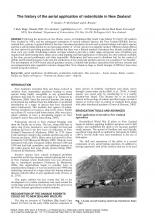
Following the incursion of rats (Rattus rattus) on Taukihepa (Big South Cape Island; 93.9 km²) off southern New Zealand in 1963, and the subsequent extirpation of several endemic species, the New Zealand Wildlife Service realised that, contrary to general belief at the time, introduced predators do not reach a natural balance with native species and that a safe breeding habitat for an increasing number of ‘at risk’ species was urgently needed. Off shore islands offered the best option for providing predator free habitat but there was a limited number of predator-free islands available and most were very small. Eradicating rodents on larger islands to provide a wider range and greater area of habitats was required and hand treating these larger areas using trapping and hand application of toxicants, the only methods available at the time, proved problematic and often impossible. Helicopters had been used to distribute bait for the control of rabbits and brushtail possums in the past but eradication of any particular predator species was considered ‘not feasible’. The development of a GPS-based aircraft guidance system, a suitable bait product, specialised bait delivery systems and second-generation anti-coagulant toxicants changed that. Now islands as large as South Georgia (3,900 km²) have been treated using this method
Successes and failures of rat eradications on tropical islands: a comparative review of eight recent projects
Biodiversity Conservation, BRB
Available Online

Brown, D.

,

Cranwell, S.

,

Cuthbert, R.J.

,

Griffiths, R.

,

Howald, G.

,

Keitt, B.

,

Pitt, W.C.

,

Tershy, B.

,

Wegmann, A.

2019
Rat eradication is a highly effective tool for conserving biodiversity, but one that requires considerable planning eff ort, a high level of precision during implementation and carries no guarantee of success. Overall, rates of success are generally high but lower for tropical islands where most biodiversity is at risk. We completed a qualitative comparative review on four successful and four unsuccessful tropical rat eradication projects to better understand the factors influencing the success of tropical rat eradications and shed light on how the risk of future failures can be minimised. Observations of juvenile rats surviving more than four weeks after bait application on two islands validate the previously considered theoretical risk that unweaned rats can remain isolated from exposure to rodent bait for a period. Juvenile rats emerging after bait was no longer readily available may have been the cause of some or all the project failures. The elevated availability of natural resources (primarily fruiting or seeding plants) generated by rainfall prior to project implementation(documented for three of the unsuccessful projects) may also have contributed to project failure by reducing the likelihood that all rats would consume sufficient rodent bait or compounding other factors such as rodent breeding. Our analysis highlights that rat eradication can be achieved on tropical islands but suggests that events that cannot be predicted with certainty in some tropical regions can act individually or in concert to reduce the likelihood of project success. We recommend research to determine the relative importance of these factors in the fate of future tropical projects and suggest that existing practices be re-evaluated for tropical island rodent eradications.