Search the SPREP Catalogue

Refine Search Results

Tags / Keywords

Available Online

Tags / Keywords

Available Online

6131 result(s) found.

Sort by

You searched for

  • Subject Environment - Cook Islands
    X
  • Subject Environment - Protection
    X
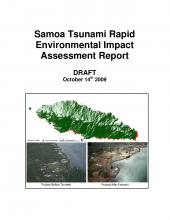
Samoa Tsunami rapid environmental impact assessment report: draft October 14th 2009
Biodiversity Conservation
Available Online

Ifopo, Pulea Etiseli

2009
A rapid assessment of the environmental impacts of the 29 September tsunami was conducted by a multi-agency team from 3 to 14 October, 2009. Fourteen “green” and 10 “brown” environmental variables were selected and measured based on the experience of the survey team and similar reports from elsewhere. During a tour of the affected area on Upolu by car and on foot those “assessable” variables were scored “high” (over two thirds affected), “medium” (over one third, less than two thirds affected), “low” (less than a third affected) or zero (unaffected). Manono and Savaii were surveyed by air with the former showing evidence of some damage and the later apparently none or very little. The most affected areas in Upolu were villages in the Aleipata, Lepa and Falealili districts with the most obvious indicators of the tsunami’s impact being solid waste (sometimes resulting from the complete destruction of a village), erosion of the beach and fore-shore and the (expected) impact on marine resources. Other environmental variables assessed also showed similar patterns. Impacts on a wharf/dry dock facility are also described (including lost fuel drums) as are the possible environmental implications of new settlements created by displaced persons (mainly revolving around sanitation, drainage and water supply).
The Pacific Islands: an analysis of the status of species as listed on the 2008 IUCN Red List of Threatened Species: American Samoa, Cook Islands, Fiji, French Polynesia, Guam, Kiribati, Marshall Islands, Federated States of Micronesia, Nauru, New Caledonia, Niue, Norfolk Island, Northern Mariana Islands, Palau, Papua New Guinea, Pitcairn Island, Samoa, Solomon Islands, Tokelau, Tonga, Tuvalu, US Minor outlying islands, Vanuatu, Wallis and Futuna
Climate Change Resilience, Biodiversity Conservation, BRB
Available Online

Pippard, Helen

2009
The Pacific islands of Oceania cover almost 15% of the world’s surface and are characterised by a high degree of ecosystem and species diversity. The region is characterised by thousands of isolated small coral atolls and higher volcanic islands, which has led to the high diversity of species found today. In fact, the number of plants and animals found nowhere else on earth (endemic species) is extremely high - often up to 90% for particular groups. Often, these rare and endemic species are adapted to specialised habitats and limited to small areas of a few islands. With economic and cultural dependence on the natural environment very high in the Pacific islands, along with a rapidly expanding human population, there are everincreasing demands on the region’s natural resources. Plant and animal species are therefore very vulnerable to extinction from climate change, competition from introduced (invasive) species and human impacts such as habitat destruction, over-harvesting of species and pollution.