Search the SPREP Catalogue

Refine Search Results

Available Online

Available Online

527 result(s) found.

Sort by

You searched for

  • Subject Tuna
    X
  • Subject Environment protection
    X
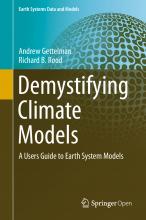
Demystifying Climate Models
Available Online

Andrew Gettelman, Richard B. Rood

2016
Human-caused climate change is perhaps the defining environmental issue of the early twenty-first century. We observe the earth’s climate in the present, but observations of future climate are not available yet. So in order to predict the future, we rely on simulation models to predict future climate. This book is designed to be a guide to climate simulation and prediction for the non-specialist and an entry point for understanding uncertainties in climate models. The goal is not to be simply a popular guide to climate modeling and prediction, but to help those using climate models to understand the results. This book provides background on the earth’s climate system and how it might change, a detailed qualitative analysis of how climate models are constructed, and a discussion of model results and the uncertainty inherent in those results. Throughout the text, terms in bold will be referenced in the glossary. References are provided as footnotes in each chapter. Who uses climate models? Climate model users are practitioners in many fields who desire to incorporate information about climate and climate change into planning and management decisions. Users may be scientists and engineers in fields such as ecosystems or water resources. These scientists are familiar with models and the roles of models in natural science. In other cases, the practitioners are engineers, urban planners, epidemiologists, or architects. Though not necessarily familiar with models of natural science, experts in these fields use quantitative information for decision-making. These experts are potential users of climate models. We hope in the end that by understanding climate models and their uncertainties, the reader will understand how climate models are constructed to represent the earth’s climate system. The book is intended to help the reader become a more competent interpreter or translator of climate model output.
Encyclopedia of biological invasions.
Biodiversity Conservation, BRB

Rejmanek, Marcel

,

Simberloff, Dadniel

2011
This encyclopedia illuminates a topic at the forefront of global ecology - biological invasions, or organisms that come to live in the wrong place. Written by leading scientists from around the world, the book addresses all aspects of this subject at a global level - including invasions by animals, plants, fungi, and bacteria - in succinct, alphabetically arranged articles. Scientifically uncompromising, yet clearly written and free of jargon, the volume encompasses fields of study including biology, demography, geography, ecology, evolution, sociology, and natural history and features many cross-references, suggestions for further reading, illustrations, an appendix of the world's worst 100 invasive species, a glossary, and more. The book features articles on well-known invasive species such the zebra mussel, chestnut blight, cheatgrass, gypsy moth, Nile perch, giant African snail, and Norway rat and details regions with especially large numbers of introduced species including the Great Lakes, Mediterranean Sea, Hawaiian Islands, Australia and New Zealand. This work will be of great value in ecology and conservation science. Invasive species are a severe and exponentially growing problem of the environment, and one difficult even to characterize, much less contain.-Edward O. Wilson, author and scientist "Second only to habitat loss mixed with climate disruption, invasive species represent the next most serious threat to biodiversity. The Encyclopedia of Biological Invasions, written by an impressive group of experts, now makes available to conservation biologists, managers, decision makers, and concerned citizens a comprehensive single source of this key topic."-Paul R. Ehrlich, co-author of The Dominant Animal