Search the SPREP Catalogue

Refine Search Results

Tags / Keywords

Available Online

Tags / Keywords

Available Online

824 result(s) found.

Sort by

You searched for

  • Subject Marine resource
    X
Overseas environmental impact statement: Guam and CNMI military relocation: relocating marines from Okinawa, visiting aircraft carrier berthing, and army air and missile defense task force: Executive summary : DRAFT
Biodiversity Conservation
Available Online

Naval Facilities Engineering Command, Pacific

2009
The National Environmental Policy Act of 1969 requires federal agencies to examine the environmental effects of their proposed actions. On behalf of the Department of Defense, the Department of the Navy is preparing this Draft EIS/OEIS to assess the potential environmental effects associated with the proposed military activities. The Navy is the lead agency for preparation of this Draft EIS/OEIS. The Office of the Secretary of Defense directed the Navy to establish a Joint Guam Program Office that serves as the NEPA proponent of the proposed actions. A number of federal agencies were invited to be cooperating agencies in the preparation of this Draft EIS/OEIS. These agencies have either jurisdiction or technical expertise for certain components of the proposed actions or a potentially affected resource. The agencies that have accepted the invitation to participate as cooperating agencies are United States (U.S.) Fish and Wildlife Service, Department of Transportation Federal Highways Administration, Federal Aviation Administration, U.S. Environmental Protection Agency Region 9, U.S. Office of Insular Affairs, U.S. Department of Agriculture, U.S. Army Corps of Engineers, and U.S. Air Force.
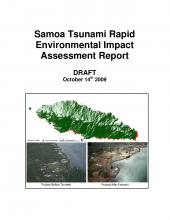
Samoa Tsunami rapid environmental impact assessment report: draft October 14th 2009
Biodiversity Conservation
Available Online

Ifopo, Pulea Etiseli

2009
A rapid assessment of the environmental impacts of the 29 September tsunami was conducted by a multi-agency team from 3 to 14 October, 2009. Fourteen “green” and 10 “brown” environmental variables were selected and measured based on the experience of the survey team and similar reports from elsewhere. During a tour of the affected area on Upolu by car and on foot those “assessable” variables were scored “high” (over two thirds affected), “medium” (over one third, less than two thirds affected), “low” (less than a third affected) or zero (unaffected). Manono and Savaii were surveyed by air with the former showing evidence of some damage and the later apparently none or very little. The most affected areas in Upolu were villages in the Aleipata, Lepa and Falealili districts with the most obvious indicators of the tsunami’s impact being solid waste (sometimes resulting from the complete destruction of a village), erosion of the beach and fore-shore and the (expected) impact on marine resources. Other environmental variables assessed also showed similar patterns. Impacts on a wharf/dry dock facility are also described (including lost fuel drums) as are the possible environmental implications of new settlements created by displaced persons (mainly revolving around sanitation, drainage and water supply).