Search the SPREP Catalogue

Refine Search Results

Available Online

Available Online

524 result(s) found.

Sort by

You searched for

  • Subject Tuna
    X
  • Subject Environment protection
    X
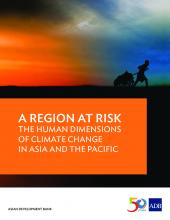
A region at risk - The human dimensions of climate change in Asia and the Pacific
Climate Change Resilience, Biodiversity Conservation
Available Online

Asian Development Bank

2017
The Asia and Pacific region is extremely vulnerable to the impacts of climate change. Unabated warming could significantly undo previous achievements of economic development and improvements of living standards. At the same time, the region has both the economic capacity and weight of influence to change the present fossil-fuel based development pathway and curb global emissions. This report sheds light on the regional implications of the latest projections of changes in climate conditions over Asia and the Pacific. The assessment concludes that, even under the Paris consensus scenario in which global warming is limited to 1.5°C to 2°C above preindustrial levels, some of the land area, ecosystems, and socioeconomic sectors will be significantly affected by climate change impacts, to which policy makers and the investment community need to adapt to. However, under a Business-As-Usual (BAU) scenario, which will cause a global mean temperature rise of over 4°C by the end of this century, the possibilities for adaptation are drastically reduced. Among others, climate change impacts such as the deterioration of the Asian “water towers”, prolonged heat waves, coastal sea-level rise and changes in rainfall patterns could disrupt ecosystem services and lead to severe effects on livelihoods which in turn would affect human health, migration dynamics and the potential for conflicts. This assessment also underlines that, for many areas vital to the region’s economy, research on the effects of climate change is still lacking.
Encyclopedia of biological invasions.
Biodiversity Conservation, BRB

Rejmanek, Marcel

,

Simberloff, Dadniel

2011
This encyclopedia illuminates a topic at the forefront of global ecology - biological invasions, or organisms that come to live in the wrong place. Written by leading scientists from around the world, the book addresses all aspects of this subject at a global level - including invasions by animals, plants, fungi, and bacteria - in succinct, alphabetically arranged articles. Scientifically uncompromising, yet clearly written and free of jargon, the volume encompasses fields of study including biology, demography, geography, ecology, evolution, sociology, and natural history and features many cross-references, suggestions for further reading, illustrations, an appendix of the world's worst 100 invasive species, a glossary, and more. The book features articles on well-known invasive species such the zebra mussel, chestnut blight, cheatgrass, gypsy moth, Nile perch, giant African snail, and Norway rat and details regions with especially large numbers of introduced species including the Great Lakes, Mediterranean Sea, Hawaiian Islands, Australia and New Zealand. This work will be of great value in ecology and conservation science. Invasive species are a severe and exponentially growing problem of the environment, and one difficult even to characterize, much less contain.-Edward O. Wilson, author and scientist "Second only to habitat loss mixed with climate disruption, invasive species represent the next most serious threat to biodiversity. The Encyclopedia of Biological Invasions, written by an impressive group of experts, now makes available to conservation biologists, managers, decision makers, and concerned citizens a comprehensive single source of this key topic."-Paul R. Ehrlich, co-author of The Dominant Animal