Search the SPREP Catalogue

Refine Search Results

Available Online

Available Online

278 result(s) found.

Sort by

You searched for

  • Subject Environment - Protection
    X
Understanding the Bigger Energy Picture
Available Online

Michael Düren

2017
Since thousands of years, the human race has been developing cultural skills and technological capabilities that support its struggle for survival and lead to dominance over all other species. Since about a century, the exponential growth of knowledge, technology, industry and population (see Fig. 1.1) has reached a scale where man modifies biosphere to an extent, that living conditions on the whole planet earth start to change significantly. Resources that had been abundant are becoming scarce within decades. We have arrived in the Anthropocene [1] where man has a significant impact on the basic living conditions of the biosphere of the whole planet. A continuation of this growth rate will unavoidably reach its natural limits where resources vanish; the biosphere will change more rapidly than the ability of organisms and ecosystems to accommodate, and contaminations will endanger living. When such a condition is reached, it is likely that our human civilization will collapse and human population will diminish rapidly. Historic examples demonstrated that drought, hunger, wars and epidemics were typical endpoints of drastic environmental changes and overpopulation. While historic examples mostly affected only individual towns, islands, countries or indigenous nations, the limits of growth this time affect the whole planet and there is no “new world” to which our civilization can migrate. Recent research has proven that the era of a new biological mass extinction has already started [2] and it can be assumed that finally also our species will be affected.
Samoa Tsunami rapid environmental impact assessment report: draft October 14th 2009
Biodiversity Conservation
Available Online

Ifopo, Pulea Etiseli

2009
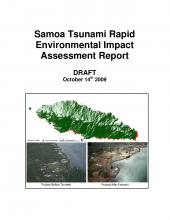
A rapid assessment of the environmental impacts of the 29 September tsunami was conducted by a multi-agency team from 3 to 14 October, 2009. Fourteen “green” and 10 “brown” environmental variables were selected and measured based on the experience of the survey team and similar reports from elsewhere. During a tour of the affected area on Upolu by car and on foot those “assessable” variables were scored “high” (over two thirds affected), “medium” (over one third, less than two thirds affected), “low” (less than a third affected) or zero (unaffected). Manono and Savaii were surveyed by air with the former showing evidence of some damage and the later apparently none or very little. The most affected areas in Upolu were villages in the Aleipata, Lepa and Falealili districts with the most obvious indicators of the tsunami’s impact being solid waste (sometimes resulting from the complete destruction of a village), erosion of the beach and fore-shore and the (expected) impact on marine resources. Other environmental variables assessed also showed similar patterns. Impacts on a wharf/dry dock facility are also described (including lost fuel drums) as are the possible environmental implications of new settlements created by displaced persons (mainly revolving around sanitation, drainage and water supply).