Search the SPREP Catalogue

Refine Search Results

Tags / Keywords

Available Online

Tags / Keywords

Available Online

576 result(s) found.

Sort by

You searched for

  • Publication Year 2009
    X
Dugong surveys of Manus and Bougainville Islands, Papua New Guinea
Available Online

Bass Deborah

2009
Dugong dugon are the last extant species in the Family Dugongidae and are listed as Vulnerable to extinction by the IUCN Red List. The dugong population is believed to be in decline globally. Throughout its range, relic populations remain and are separated by large areas where populations have disappeared (Marsh & Lefebvre 1994). The degree of the decline of numbers or fragmentation of its range is not known for any country. For many countries the only information available is from incidental sightings, drownings and anecdotal information. The Pacific region supports the world's largest remaining population of dugongs (Marsh et al. 2002). Dugong occur in most of Melanesia, Papua New Guinea (PNG), the northeast and east coasts of Australia and as far east as Vanuatu.. The current status of dugongs is unknown throughout the region (Marsh et al. 2002) and information on dugong distribution and abundance is outdated or non-existent. It is likely that dugongs are widely distributed in small numbers in much of PNG. the Solomon Islands and Vanuatu and that larger numbers occur in the Papua New Guinea waters of Torres Strait. Marsh et al. (2002) states that their reliance on relatively shallow water seagrass beds for food, limits the ability of dugongs to travel between islands and continents that are separated by extensive areas of deep water. For this reason, many island populations become essentially isolated, making these populations especially vulnerable to extinction.
Pacific Ocean Synthesis: scientific literature review of coastal and ocean threats, impacts and solutions
Climate Change Resilience, Biodiversity Conservation
Available Online

Caldwell, Margaret ... [et al.]

2009
The objective of this Pacific Ocean synthesis is to comprehensively and systematically survey the published scientific literature, government publications and other peer-reviewed reports to identify Pacific Ocean and regional threats as well as the environmental and socioeconomic impacts of those threats. In addition, the report highlights select regional and Pacific Ocean solutions presented by the literature. This report summarizes and distills the scientific literature and highlights common trends in and around the Pacific Ocean regarding threats, impacts and solutions through the review of more than 3400 scientific articles and reports. It also reveals gaps in knowledge and areas where more natural and social science research is needed that could inform coastal and ocean policy and management. For this analysis, the Pacific Ocean was organized into seven regions representing 50 countries or territories. Results from this synthesis were vetted and verified by over 30 natural, physical, and social scientists from around the Pacific who convened in Honolulu, Hawaii in August 2008 (Appendix A). The meeting, which used the synthesis as the foundation for discussion, resulted in the creation of the document, “Ecosystems and People of the Pacific Ocean—Threats and Opportunities for Action: A Consensus Statement.” This statement, which has been signed by more than 375 scientists, identifies and prioritizes key threats to the health and productivity of the Pacific Ocean, many accelerated by global climate change, for which broad consensus exists in the scientific community. It also highlights the environmental and socioeconomic impacts of these threats and outlines a “road map” that identifies available solutions for these threats.
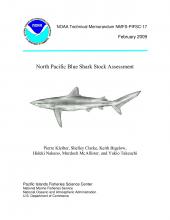
North Pacific blue shark stock assessment
Biodiversity Conservation
Available Online

Kleiber, Pierre ... [et al.]

2009
A stock assessment of the blue shark (Prionace glauca) population in the North Pacific was conducted using catch and effort data from commercial longline and large mesh driftnet fisheries from the years 1971 through 2002 as well as small mesh driftnet fisheries operating primarily in the 1980s. Because reporting of shark catch has not been required in these fisheries, which target primarily tunas, a system for identifying the more reliable longline catch reports was utilized. Two different assessment models were utilized, a surplus production model, and an integrated age and spatial structured model tested with a variety of structural assumptions. The two models were found to be in general agreement. The trends in abundance in the production model and all alternate runs of the integrated model show the same pattern of decline in the 1980s followed by recovery to above the level at the start of the time series. The integrated model analyses indicated some probability (around 30%) that biomass at the end of the time series was less than BMSY (overfished) and that there was a lesser probability at that time that fishing mortality was greater than FMSY (overfishing occurring). There was an increasing trend in total effort expended by longline fisheries toward the end of the time series, and this trend may have continued thereafter. It would be prudent to assume that the population is at least close to MSY level and fishing mortality may be approaching to the MSY level in the future.